In today’s hyper-distributed digital landscape, branch environments have transformed dramatically. Enterprises now operate across hybrid clouds, remote work hubs, SD-WAN-connected sites, and geographically dispersed micro-offices. This decentralization has accelerated innovation-but it has also expanded the attack surface, weakened visibility, and strained traditional perimeter-based security.
The reality is stark: Over 65% of cyberattacks now target branch offices, remote sites, and unmanaged edge networks. Legacy firewalls, centralized backhauling, and manual policy control cannot keep pace with encrypted traffic growth, IoT proliferation, and identity-driven threats.To secure modern enterprise branches, organizations need a unified, cloud-native, zero-trust framework- Secure Access Service Edge (SASE) enhanced with AI-driven detection and automated response. This is where Seceon provides a transformative advantage, delivering continuous analytics, behavioral intelligence, and real-time threat correlation that strengthens and modernizes SASE deployments.
What is a Modern Branch Security Architecture with SASE?
A SASE-enabled branch security architecture integrates networking and security into a cloud-delivered service model. It provides secure, identity-aware, and policy-driven access between users, devices, applications, and cloud environments-regardless of location.
A modern SASE architecture includes:
Zero-trust network access (ZTNA) for identity-based connectivity
Cloud-delivered secure web gateway (SWG) and firewall-as-a-service (FWaaS)
SD-WAN for optimized branch-to-cloud performance
CASB for SaaS security and data governance
Continuous monitoring of branch, cloud, and remote connectivity
AI-driven analytics for encrypted flows, lateral movement, and identity abuse
Unified policy enforcement across all branch users and devices
Together, SASE converts fragmented branch security into a unified, adaptive, cloud-first model.
Why SASE Matters for Securing Modern Branches
1. Eliminates Legacy Network Complexity and Backhauling
Traditional branch architectures route traffic through central data centers, causing:
Latency and performance degradation
Increased MPLS costs
Blind spots in east-west traffic
Difficulty enforcing consistent policies
SASE enables direct-to-cloud, secure, identity-based access-improving scalability and performance.
2. Enables Zero-Trust Access Across All Branch Users & Devices
Branches today include employees, contractors, IoT devices, third-party tools, and unmanaged endpoints. SASE enforces:
Continuous identity verification
Least-privilege access
Device posture checks
Dynamic session monitoring
Seceon amplifies this with behavioral baselining to detect anomalies in identity, device behavior, and branch activity.
3. Strengthens Threat Defense for Encrypted, East-West, and Cloud Traffic
Most branch traffic is now encrypted. Threats often hide in:
SD-WAN tunnels
East-west branch movement
Encrypted SaaS sessions
IoT device communication
Seceon’s AI-driven engines analyze encrypted patterns, flag abnormal flows, detect hidden C2 channels, and catch signatureless threats that bypass traditional SASE controls.
4. Provides Continuous Monitoring and Context-Aware Branch Security
Modern SOC teams require:
Deep visibility into branch traffic
Rapid correlation of branch, cloud, and identity telemetry
Real-time alerting for lateral movement
Automated response for branch compromise
Seceon delivers this with unified telemetry correlation and automated containment workflows.
5. Improves Performance While Reducing Operational Overhead
Branch teams struggle with:
Distributed policies
Manual configurations
Config drift across multiple appliances
SASE centralizes management, while Seceon ensures health, consistency, and active detection of misconfigurations, misrouting, or policy gaps.
How Seceon Enhances SASE for Modern Branch Security
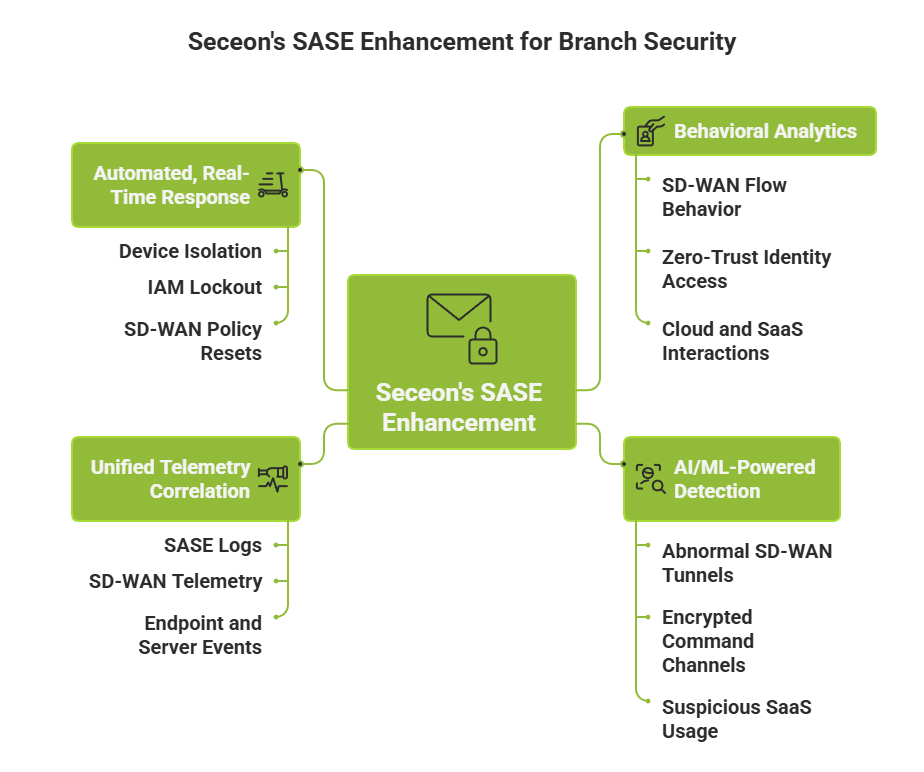
Behavioral Analytics Across Branch Traffic, Users & Devices
Seceon builds adaptive baselines for:
SD-WAN flow behavior
Zero-trust identity access patterns
Cloud and SaaS interactions
Device and IoT communication at the branch
Encrypted east-west patterns
Branch-to-cloud service usage
This makes it possible to detect deviations that signal insider threats, compromised credentials, or lateral movement.
AI/ML-Powered Detection of Branch Threats
Seceon identifies:
Abnormal SD-WAN tunnel behaviors
Encrypted command-and-control channels
Suspicious SaaS usage patterns
Compromised remote access or VPN misuse
Lateral movement within branch sites
Zero-day and signatureless threats
Unauthorized device onboarding
This ensures swift detection-even when attackers bypass SASE perimeter controls.
Unified Telemetry Correlation Across Branch, Cloud & Identity Systems
Seceon correlates:
SASE logs
SD-WAN telemetry
Endpoint and server events
Identity provider (IdP/IAM) signals
Network flows
Cloud access logs
Threat intelligence feeds
SOC teams receive unified, contextualized incidents rather than fragmented alerts.
Automated, Real-Time Response for Branch Threats
Seceon provides:
Automated isolation of compromised branch devices
IAM lockout for suspicious identities
SD-WAN policy resets or routing quarantines
Blocking malicious destinations
Automated SOAR-driven containment
Playbooks for branch-specific threats
Threats are contained in minutes-reducing branch exposure time dramatically.
Key Components of Modern SASE-Enabled Branch Security
Zero-trust identity-based access
SD-WAN with application-aware routing
FWaaS + SWG for advanced cloud-delivered perimeter
DNS and URL filtering
CASB for SaaS and cloud data protection
Unified policy management
AI-driven analytics and UEBA
Encrypted traffic visibility
IoT and edge device security
Real-time monitoring and automated response
Seceon strengthens each component with deeper analytics, threat correlation, and intelligence.
Use Cases & Real-World Scenarios
Branch lateral movement detection across SD-WAN
Insider threat detection in remote or micro-branch offices
Encrypted C2 detection inside SASE tunnels
Privileged account misuse in branch environments
Compromised IoT device behavior at branch sites
Branch-to-branch propagation of malware or ransomware
Misconfigured SASE policies or routing anomalies
Suspicious SaaS access from branch networks
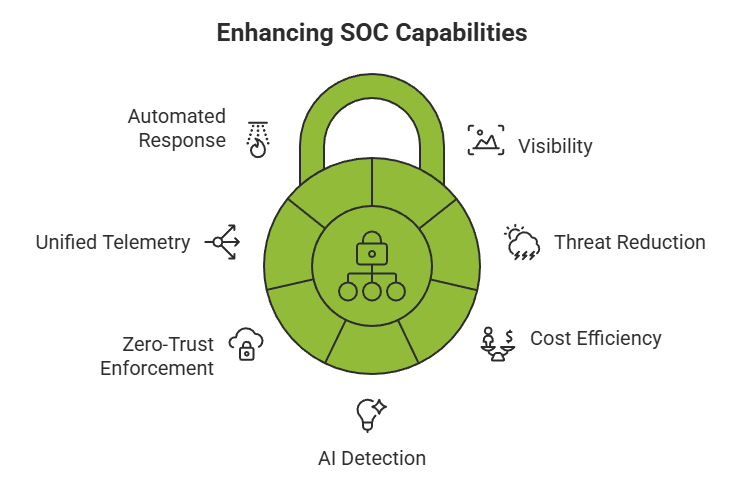
Benefits for SOC Teams and Enterprises
Stronger visibility into branch, cloud, and identity activity
Reduced dwell time for branch-targeted threats
Lower cost and higher performance across distributed sites
AI-driven detection for signatureless and encrypted threats
Zero-trust enforcement across all branch and edge environments
Unified telemetry and reduced alert fatigue
Rapid containment with automated response
Challenges & Considerations
Migrating legacy branches to a SASE architecture
Securing unmanaged devices and IoT at branch locations
Maintaining consistent policies across multiple sites
Managing SD-WAN and SASE misconfigurations
Training SOC analysts on cloud + branch hybrid visibility
Ensuring identity governance at scale
Seceon addresses these challenges with continuous analytics, automated correlation, and real-time threat containment.
The Future of Modern Branch Security
Fully AI-driven adaptive SASE enforcement
Zero-touch branch provisioning
Autonomous routing and identity-driven segmentation
Continuous encrypted traffic inspection without decryption
Predictive threat modeling for branch environments
Unified multi-cloud and multi-branch security dashboards
SASE + XDR fusion for holistic enterprise protection
Why Choose Seceon?
Unified visibility across branch, cloud, network, and identity
AI-driven detection that outperforms static SASE controls
Behavioral analytics tailored to each branch environment
Automated containment for branch-specific threats
Seamless integration with SD-WAN, ZTNA, SWG, CASB, and FWaaS
Rapid deployment with minimal operational overhead
Seceon transforms traditional SASE deployments into intelligent, self-learning, threat-aware branch security architectures.
Conclusion
Modern branches demand more than perimeter firewalls and fragmented tools. They require a zero-trust, cloud-first, AI-driven architecture that unifies networking and security-enabled by SASE and strengthened by Seceon’s advanced analytics.
Seceon equips enterprises with real-time visibility, adaptive detection, and automated response, ensuring branch environments stay secure, resilient, and high-performing-no matter how distributed or complex they become.
For organizations modernizing their branch security strategy, Seceon provides the intelligence, automation, and architectural strength needed to stay ahead of the evolving threat landscape.