Responsive Banner Design
Cloud Security Challenges

What is an Advanced Threat Detection?

Advanced Threat Detection (ATD) encompasses the strategies, processes, and technologies designed to identify and counteract sophisticated and emerging cyber threats that can easily bypass traditional security defenses. These threats, including zero-day exploits, advanced persistent threats (APTs), and other forms of stealthy malware, are engineered to evade conventional security tools and remain undetected.
Effective ATD not only mitigates these risks but also fortifies the overall cybersecurity posture by providing early warning systems and rapid response capabilities.

Challenges

Complexity and skill requirement

Implementing ATD solutions can be complex, requiring expertise. Organizations may need to invest in training or hire specialists to manage and optimize them.

Integration with existing infrastructure

Integrating ATD with legacy systems and diverse IT environments is challenging, requiring seamless communication between security tools for effective threat detection.

Cost considerations

ATD solutions offer advanced capabilities, but costs can be prohibitive for smaller organizations. However, the investment is justified by improved protection and breach prevention savings.

Seceon OTM Platform

One platform for every stage of an advanced attack

Detect, investigate and contain multi-stage threats across network, endpoint, identity, cloud and OT from a single AI-driven platform.

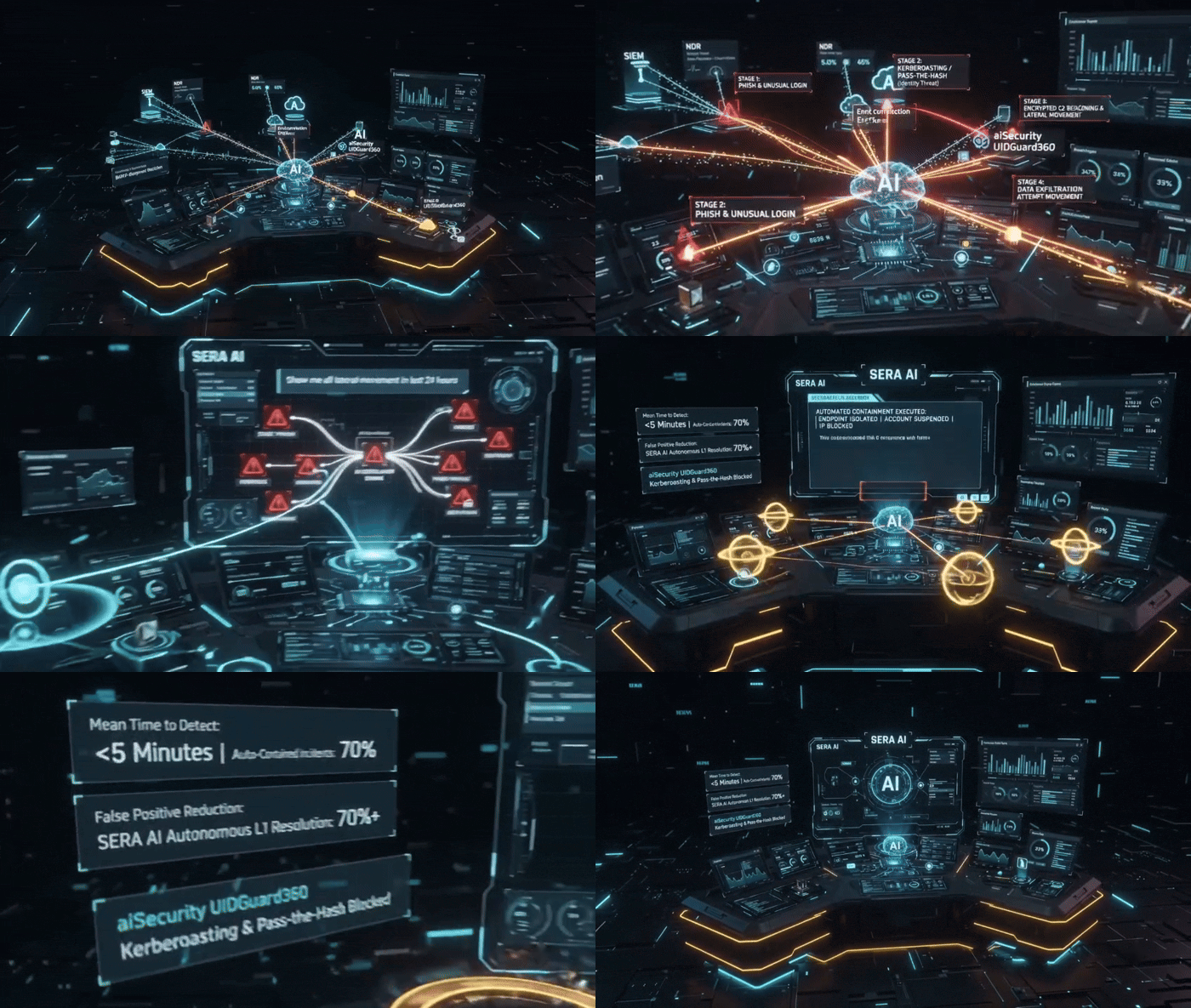
SERA AI

Autonomous L1 alert investigation

Ask in plain language. SERA AI investigates, explains the root cause and recommends next steps.

Illustrative example of the SERA AI workflow.

70%+L1 alerts resolved autonomously
~30sPlaybook from plain language

UEBA

Behavioral analytics

ML baselines for every user, device and entity. No manual rule tuning.

Threat intelligence

Real-time threat matching

2B+

IOCs from 100+ sources, plus behavioral IOCs and DGA prediction

aiSecurity UIDGuard360

Identity threats

Detects identity attacks across Active Directory and cloud.

KerberoastingPass-the-HashDCSyncImpossible travel

NDR

Deep network inspection

Lateral movement, C2 beacons and encrypted traffic analysis without decryption.

Unified correlation

Separate alerts, one correlated incident

Log, network, endpoint, cloud, identity and OT data, mapped to MITRE ATT&CK.

Example attack chain.

Native SOAR

<90s

Automated containment

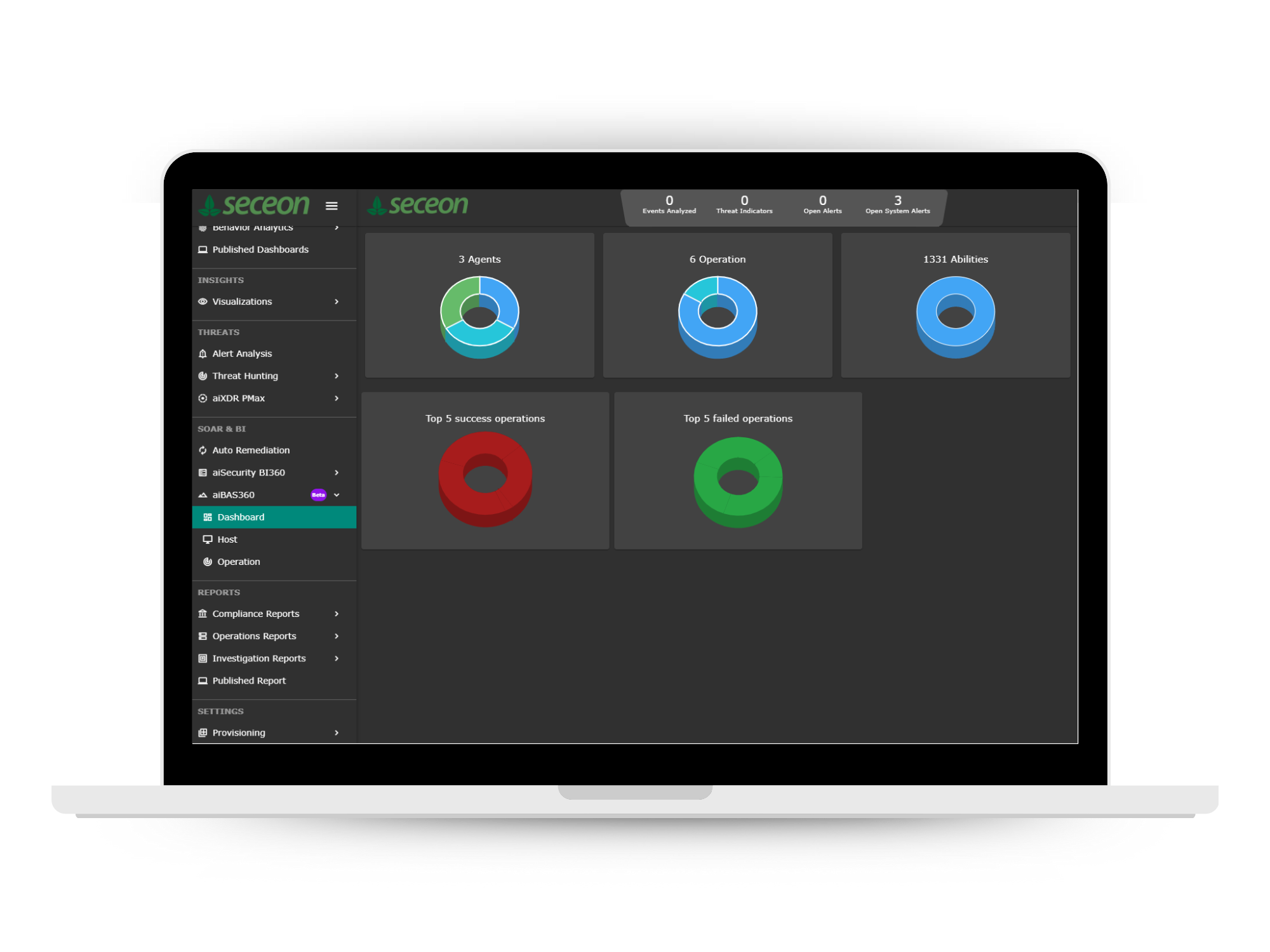
aiBAS360

Validate your security controls

Simulates real-world attack techniques to find gaps before adversaries exploit them.

Measured outcomes

Results from Seceon production deployments

<5 minMean time to detect
95%Reduction in false positives
70%Incidents auto-contained
Summary Section

Summary

Seceon’s AI-driven solution detects and prevents advanced threats by continuously analyzing network activity, identifying sophisticated attack patterns in real-time, and automatically neutralizing threats to ensure comprehensive protection against complex cyberattacks.

Advanced Threat Detection FAQs

Learn how AI-driven threat detection, behavioral analytics, threat intelligence, and security event correlation help organizations identify sophisticated cyberattacks and strengthen security operations with Seceon.

How can I detect advanced cyberattacks that bypass traditional antivirus and firewalls?

Advanced cyberattacks that bypass traditional antivirus and firewalls can be detected by combining behavioral analytics, machine learning, threat intelligence, and continuous monitoring across endpoints, networks, and user activity. Traditional security tools often rely on known signatures or predefined rules, which may not identify new or stealthy attack techniques.

An advanced threat detection solution analyzes activity patterns, identifies unusual behavior, correlates related security events, and helps security teams investigate suspicious activity before it escalates. Seceon's OTM Platform combines AI/ML-driven security analytics with SIEM, XDR, and threat intelligence capabilities to help organizations identify and investigate threats across their security environments.

What are the best AI-powered advanced threat detection platforms for enterprises in 2026?

The best AI-powered advanced threat detection platform depends on an organization's infrastructure, security requirements, integration needs, alert volume, and incident response capabilities. Enterprises should evaluate solutions based on behavioral threat detection, cross-environment visibility, threat intelligence integration, false-positive management, investigation workflows, and response automation.

Platforms that unify multiple security capabilities can help teams correlate events instead of investigating isolated alerts from separate tools. Seceon's OTM Platform is an option for organizations seeking an AI/ML-driven approach that brings together SIEM, XDR, SOAR, and other security analytics capabilities. Enterprises should validate supported integrations, deployment requirements, and response workflows against their own needs before selecting a platform.

How can organizations detect zero-day attacks and advanced persistent threats in real time?

Organizations can improve the detection of zero-day attacks and advanced persistent threats (APTs) by monitoring behavioral anomalies, unusual process execution, suspicious network connections, privilege changes, lateral movement, and unexpected data transfers. Machine learning and threat intelligence can help identify suspicious patterns even when a specific attack signature is unavailable.

Effective detection also requires correlating events across endpoints, networks, cloud environments, and identity systems to reveal activity that may appear harmless in isolation. Seceon's OTM Platform uses AI/ML-driven security analytics and threat intelligence capabilities to support threat detection and investigation. Detection effectiveness depends on available telemetry, configuration, integrations, and the attack technique; no platform can guarantee detection of every zero-day attack.

Which cybersecurity platforms correlate SIEM, EDR, and network security data to detect sophisticated threats?

Cybersecurity platforms that integrate SIEM, endpoint detection and response (EDR), and network security telemetry can help identify sophisticated threats by connecting events across different systems. Instead of treating every alert separately, these platforms can correlate related activity to provide broader incident context and help analysts understand the potential attack path.

When evaluating a platform, organizations should examine data-source coverage, integration compatibility, event correlation, investigation context, and response capabilities. Seceon's OTM Platform brings together SIEM, XDR, SOAR, and AI/ML-driven analytics to help security teams analyze security events and coordinate threat investigation and response across supported integrations.

How can AI-driven behavioral analytics detect unknown threats and reduce false-positive alerts?

AI-driven behavioral analytics can detect unknown threats by learning or evaluating patterns of normal activity and identifying deviations that may indicate malicious behavior. These deviations can include unusual login patterns, unexpected privilege escalation, suspicious process activity, or abnormal communication between systems.

To reduce false positives, effective detection systems combine behavioral signals with contextual information, threat intelligence, correlation rules, and investigation results rather than treating every anomaly as a confirmed attack. Seceon's OTM Platform uses AI/ML-driven security analytics to support threat detection and event correlation. Actual detection accuracy and false-positive reduction depend on the quality of telemetry, system configuration, and the organization's environment.

Which advanced threat detection solutions combine real-time threat intelligence, automated investigation, and incident response?

Organizations looking for advanced threat detection with investigation and response capabilities should evaluate platforms that combine security event collection, threat intelligence, cross-source correlation, incident context, and automated response workflows. This approach can help teams move from isolated alerts to more coordinated security operations.

Important evaluation criteria include the freshness and coverage of threat intelligence, supported security integrations, investigation capabilities, response playbooks, approval controls, and auditability. Seceon's OTM Platform combines SIEM, XDR, SOAR, and threat intelligence capabilities to support threat detection, investigation, and response workflows. Organizations should confirm which integrations and automation actions are available for their specific deployment before implementation.

Seceon aiSIEM-CGuard

24/7 Access to Seceon’s Cybersecurity Experts - Because Threats Don’t Wait

Do These Persistent Issues Impact Your Day-to-Day Operations?
  • Large number of failed logins from single/multiple IPs, internal or external, against a single/multiple usernames.
  • Failed logins from new geo locations or a new user device.
  • Large number of account lockouts.
  • High cost of integration, support and maintenance.

    Seceon Inc