
Responsive Banner Design

What is Data Exfiltration?

Data Exfiltration is the covert theft of data from a computer system or network, posing a severe cybersecurity threat. Attackers target valuable information, including financial data, personal details, and intellectual property, often trading it on the dark web.
The consequences of data exfiltration can lead to devastating losses, reputational damage, legal penalties, and even compromise of national security.

Challenges of Data Exfiltration

Detection Complexity

Detecting data exfiltration is challenging, as it often mimics legitimate network activity, making early detection crucial.

False Positives

Traditional security tools, like Data Loss Prevention (DLP), can generate high volumes of false positives, burdening security teams.

User Impact

Poorly configured tools can impact user productivity, blocking legitimate traffic and creating operational inefficiencies.

Cost and Resources

Securing networks from data exfiltration can be resource-intensive, requiring specialized tools and expert personnel.

Seceon OTM Platform

Spot data leaving before the damage is done

Behavioral baselines, network analysis and threat intelligence flag unusual outbound transfers across network, cloud and endpoints, then contain the path automatically.

Potential Data Exfiltration alert

Unusual outbound volume, flagged

Raised when an unusual amount of data is uploaded or transferred to blacklisted destinations or IPs, or to unusual public or private applications.

Illustrative example, based on a sample detection log.

Blacklisted destinationsBlacklisted IPsUnusual applications

DNS tunneling

Data hidden in DNS

Detects data encoded inside DNS queries through query length and entropy analysis.

DNS-over-HTTPS bypass

NDR

Encrypted channels

Finds anomalies in TLS traffic without decrypting it, plus data staging and exfiltration patterns.

No decryption needed

Insider Threat alert

Insiders and USB copies

Flags data access abuse by legitimate users, including files copied to removable USB media.

USB copyData access abuse

aiSIEM-CGuard

Cloud storage exfiltration

Detects S3 and Blob bucket exfiltration attempts and unusual data access in the cloud.

AWSAzureGCP

Network patterns

Exfiltration that hides in normal protocols

Compares upload volume against the download baseline and watches for unusual external destinations.

DNS abuseICMP abuseHTTP POST to rare domainsUnusual external destinations
2B+

Threat intelligence

Known-bad destinations

Transfers to known malicious IPs and domains are matched against IOCs from 100+ sources, and history is re-checked when new intelligence arrives.

Automated response

<90s

Cut off the transfer path

Investigation

See the whole story, not one alert

Network events are correlated with endpoint, identity and application events for full kill-chain reconstruction, alongside file access monitoring on sensitive paths.

Data Exfiltration FAQs

Learn how behavioral baselines, network analysis, threat intelligence, and automated response help organizations detect and stop data exfiltration across network, cloud, and endpoints with Seceon.

How can I detect data exfiltration before sensitive data leaves my network?

Data exfiltration is the covert theft of data from a computer system or network, and it often mimics legitimate network activity, which makes early detection difficult. Organizations can detect it by combining behavioral baselines, network traffic analysis, and threat intelligence to flag unusual outbound transfers, such as abnormal upload volumes or connections to blacklisted destinations and unusual applications.

Seceon's OTM Platform, with aiSIEM and aiXDR, uses behavioral baselines, network analysis, and threat intelligence to flag unusual outbound transfers across network, cloud, and endpoints, and can contain the transfer path automatically. Detection effectiveness depends on available telemetry, configuration, and the technique used.

What are the best data exfiltration detection tools for enterprises that reduce DLP false positives in 2026?

The best data exfiltration detection approach depends on an organization's data types, infrastructure, compliance needs, and team capacity. Traditional Data Loss Prevention (DLP) tools can generate high volumes of false positives and block legitimate traffic, so enterprises should evaluate solutions based on behavioral detection, cross-source correlation, threat intelligence coverage, response automation, and the impact on user productivity.

Seceon's OTM Platform is an option for organizations seeking behavior-based exfiltration detection that goes beyond static rules. It compares upload volume against the download baseline, watches for unusual external destinations, and matches transfers to known-bad IPs and domains against IOCs from 100+ sources, re-checking history when new intelligence arrives. Organizations should validate integrations and tuning requirements against their own environment before selecting a platform.

How can organizations detect data hidden in DNS tunneling, ICMP, HTTP POST, and encrypted traffic?

Attackers often hide stolen data inside normal-looking protocols. Organizations can detect this by analyzing DNS query length and entropy to find data encoded in DNS, watching for DNS-over-HTTPS bypass, spotting unusual HTTP POST requests to rare domains, and identifying ICMP abuse. For encrypted channels, anomalies can be detected in TLS traffic without decrypting it.

Seceon's OTM Platform detects DNS tunneling through query length and entropy analysis, finds anomalies in TLS traffic without decryption through its NDR capabilities, and flags data staging and exfiltration patterns, including DNS abuse, ICMP abuse, and HTTP POST to rare domains. Results depend on traffic visibility and sensor placement.

How can I detect insider data theft, including files copied to USB drives?

Insider data theft is difficult to catch because the activity comes from legitimate users with valid access. Organizations can detect it by monitoring data access behavior, flagging abuse of access privileges, tracking files copied to removable media such as USB drives, and monitoring file access on sensitive paths.

Seceon's OTM Platform raises Insider Threat alerts for data access abuse by legitimate users, including files copied to removable USB media, and it supports file access monitoring on sensitive paths. Detection depends on endpoint coverage and configuration, and policies should be reviewed against an organization's privacy and legal requirements.

How can I detect S3 and Azure Blob bucket data exfiltration in AWS, Azure, and GCP?

Organizations can detect cloud storage exfiltration by monitoring storage access patterns, flagging unusual bulk downloads or transfers, and correlating cloud activity with identity and network behavior. Native cloud logs alone often lack the context needed to separate legitimate data movement from theft, so correlation across sources is important.

Seceon's aiSIEM-CGuard detects S3 and Blob bucket exfiltration attempts and unusual data access in the cloud across AWS, Azure, and GCP, and correlates these findings with on-premises and network activity. Supported data sources depend on the cloud services connected and their configuration.

Which solutions can automatically stop data exfiltration and reconstruct the full attack kill chain?

Organizations should look for platforms that combine detection with automated containment and investigation. Useful response actions include isolating the affected host, blocking the destination at the firewall, and sinkholing malicious DNS, while investigation benefits from correlating network, endpoint, identity, and application events to show how an incident unfolded.

Seceon's OTM Platform supports automated response in under 90 seconds, including isolating the host, blocking the destination at the firewall, and sinkholing malicious DNS. It correlates network events with endpoint, identity, and application events for full kill-chain reconstruction, from file access to data staging to outbound transfer. Organizations should confirm which response actions and integrations are available for their specific deployment before implementation.

Summary Section

Summary

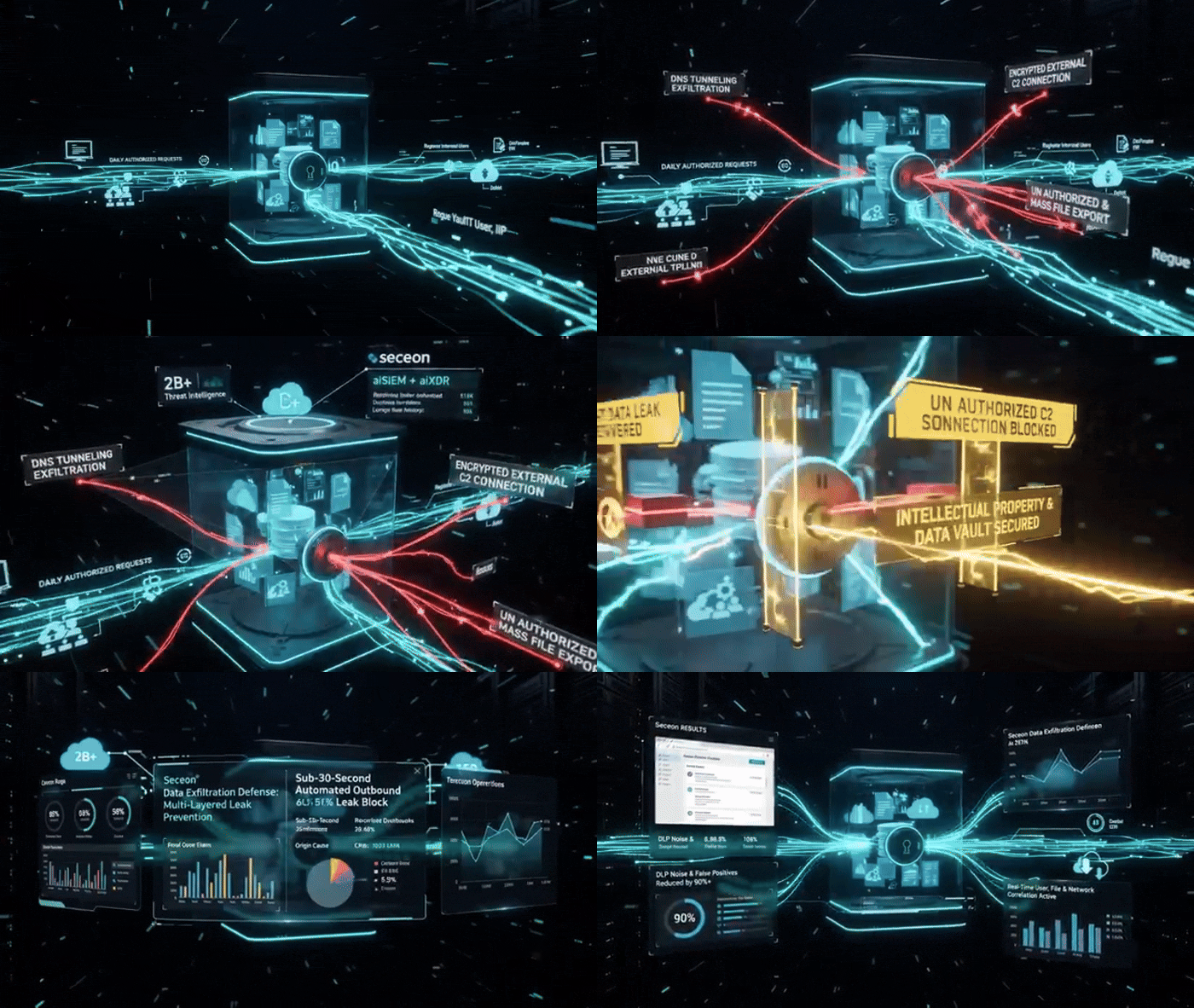
Seceon’s AI-powered solution detects and prevents data exfiltration by monitoring unusual data movements, identifying threats in real-time, and automatically blocking suspicious activities to ensure robust protection against unauthorized data leakage.

Seceon aiSIEM-CGuard

24/7 Access to Seceon’s Cybersecurity Experts - Because Threats Don’t Wait

Do These Persistent Issues Impact Your Day-to-Day Operations?
  • Large number of failed logins from single/multiple IPs, internal or external, against a single/multiple usernames.
  • Failed logins from new geo locations or a new user device.
  • Large number of account lockouts.
  • High cost of integration, support and maintenance.

    Seceon Inc