Cybersecurity is entering a new era where human-dependent security operations can no longer withstand the speed, volume, and sophistication of AI-powered attacks.
2026 marks the definitive turning point where AI becomes the backbone of threat detection-replacing reactive SOC workflows with autonomous, self-learning, intelligent defense ecosystems.
Threat actors are now using generative AI for reconnaissance, exploit development, and large-scale automated intrusions. In response, organizations must adopt platforms capable of predictive, real-time, and autonomous threat identification.
Seceon’s AI-driven Open XDR and SOC Automation platform is engineered for this new landscape-delivering continuous, autonomous protection across hybrid, multi-cloud, OT, IoT, and edge environments.
AI-driven threat detection goes beyond simply automating alerts.
It represents a complete reinvention of how threats are identified, analyzed, and mitigated.
In 2026, AI-powered cybersecurity systems will be capable of:
This is not just evolutionary it’s transformative.
It signals a shift from reactive cybersecurity to self-defending digital ecosystems.
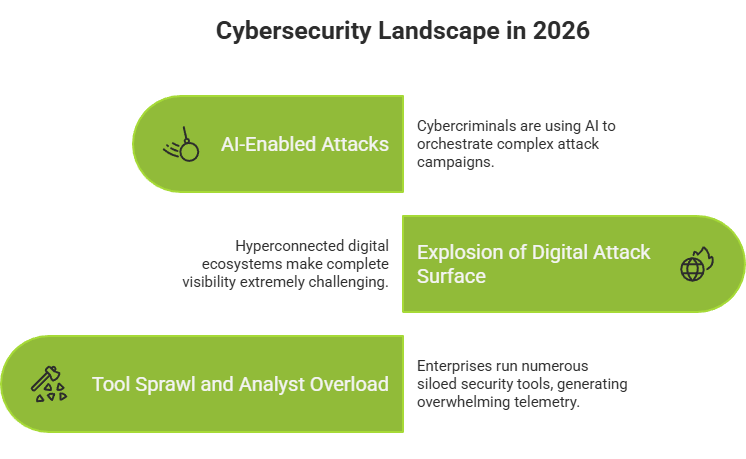
Cybercriminals have moved beyond scripted tools and into AI-orchestrated attack campaigns.
Key trends shaping 2026:
Result: Threats evolve faster than human analysts can respond, forcing a shift to autonomous detection.
Modern enterprises now operate in hyperconnected digital ecosystems, making complete visibility extremely challenging.
Contributors to the expanding attack surface:
Every new API, identity, sensor, and workload becomes a potential vulnerability.
Most enterprises now run 45-75 siloed security tools, generating overwhelming volumes of telemetry.
Consequences:
The challenge is no longer data collection-it is intelligence synthesis.
Over the past few years, AI in cybersecurity has rapidly matured. What began as simple rule-based automation has now advanced into machine learning–driven analytics—and in 2026, AI reaches full autonomy.
AI systems can now independently execute the entire detection-to-response lifecycle, including:
This eliminates the long detection windows attackers once exploited, transitioning security programs from reactive to real-time protection.
New global cybersecurity regulations now expect continuous monitoring, rapid incident reporting, and automated resilience. Traditional, human-dependent SOC workflows can’t meet these demands.
Modern frameworks increasingly require:
As compliance expectations rise, AI becomes the only realistic way for organizations to achieve the required level of speed, accuracy, and scalability.
Security teams are more strained than ever, and organizations simply cannot hire fast enough to keep up with growing threat demands. In 2026, AI steps in as the force multiplier.
AI reduces analyst overload by:
The result: lean, highly efficient teams where AI handles the heavy operational load, and analysts focus on strategic decisions.
Seceon’s advanced detection fabric leverages:
Designed to detect the hardest-to-find threats:
Its models self-learn and self-tune, ensuring continuous accuracy as threats evolve.
Seceon’s Open XDR platform correlates billions of events across network, identity, endpoint, cloud, and OT.
It automatically:
This eliminates alert noise and accelerates decision-making.
Seceon integrates with EDRs, firewalls, IAM, and cloud platforms to execute:
Mitigation becomes instant, even when SOC analysts are unavailable.
Seceon ingests telemetry from:
This delivers 360° visibility, removing blind spots that attackers exploit.
Seceon’s architecture supports:
Features such as multi-tenancy, scalability, and automated compliance reporting make it ideal for mission-critical operations.
The shift that begins in 2026 will define the next decade of cybersecurity.
Emerging trends include:
By 2030, AI-first SOCs will become the global standard-and organizations relying on manual processes will be left behind.

2026 is the year AI becomes the undeniable core of global threat detection and response.
With attackers scaling through automation, digital ecosystems expanding, and talent shortages worsening, human-only SOC models are no longer viable.
Seceon’s AI-driven Open XDR and SOC Automation platform empowers organizations to make this transition-offering real-time detection, contextual correlation, predictive analytics, and instant autonomous response.
Organizations embracing AI-driven cyber defense in 2026 will become:
The era of autonomous cybersecurity has begun-and Seceon is leading it.