
Bangalore is the beating heart of India’s technology landscape, a global hub where innovation, data, and enterprise operations converge at unprecedented scale. But a new report highlights a stark reality: as digital acceleration skyrockets, so do the cyber risks facing the multinational organizations (MNCs) operating here. With the DPDP Act 2023 reshaping compliance expectations and attackers increasingly targeting Global Capability Centers (GCCs) as gateways into Fortune 500 networks, Bangalore-based operations now sit at the center of a high-stakes cybersecurity storm.
This analysis breaks down the threats shaping the 2024-2025 landscape and examines why unified, AI-driven security platforms like Seceon’s are becoming mission-critical for enterprises navigating India’s rapidly evolving regulatory and risk environment.
Bangalore’s MNC ecosystem handles global codebases, R&D, sensitive financial operations, and enormous volumes of personal data, making these hubs extremely attractive to APT groups and cybercriminals.
Several forces have collided:
Why it’s a warning:
Most organizations lack real-time visibility or automated evidence collection, making compliance almost impossible without modernized security operations.
Bangalore GCCs hold privileged access to global networks.
A breach here can enable attackers to pivot into parent company environments across continents.
Why it’s dangerous:
A ransomware attack or credential compromise in Bangalore can cripple systems in the U.S., Europe, and APAC within minutes.
Bangalore has massive tech talent, but security teams suffer:
Why it matters:
Junior analysts drowning in noise are more likely to miss subtle but devastating threats.
Multi-cloud adoption (AWS, Azure, GCP) has exploded alongside legacy on-prem systems.
The risk:
Misconfigurations, unmanaged APIs, and hidden Shadow IT resources create blind spots attackers exploit long before detection.
Even if you are not headquartered in Bangalore, the implications are global.
For global enterprises relying on Bangalore operations, cybersecurity is no longer a back-office concern. It is a board-level continuity risk.
Fragmented tools, spreadsheets, and overworked SOC teams cannot defend a high-velocity, high-risk ecosystem. Seceon’s unified aiSIEM + aiXDR + SOAR platform directly addresses the triple challenge of regulatory pressure, hybrid complexity, and talent shortages.
Here’s how:
Challenge:
Strict fines and 6-hour reporting make manual incident response impossible.
Seceon Advantage:
This enables MNCs to meet India’s new compliance demands without increasing operational burden.
Challenge:
Alert fatigue plus attrition equals missed threats.
Seceon Advantage:
Organizations maintain resilience even as teams shift or scale.
Challenge:
Data and identities are scattered across Bangalore on-prem systems and global cloud regions.
Seceon Advantage:
MNCs gain the single, correlated security view they have been missing.
Challenge:
Ransomware and credential compromises propagate faster than humans can respond.
Seceon Advantage:
This capability is essential for GCCs supporting multiple time zones.
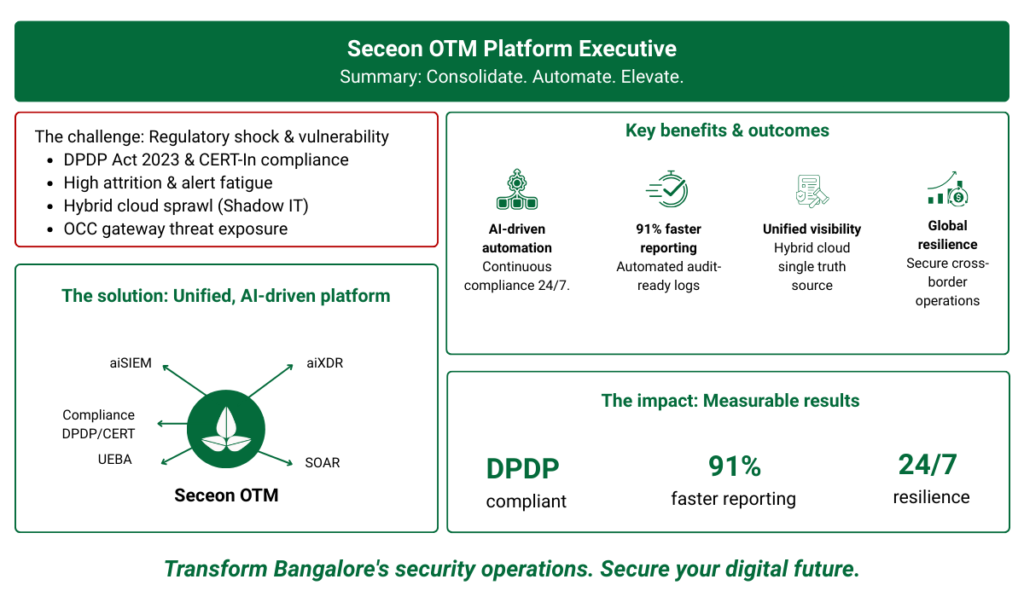
Bangalore is India’s innovation engine, but also a prime target for global adversaries.
As DPDP enforcement intensifies, cloud ecosystems expand, and attackers exploit GCCs as entry points to global networks, cybersecurity becomes existential for MNCs operating here.
The question isn’t if Bangalore operations will be tested. It is when.
And when that moment comes, fragmented tools and manual workflows will not hold the line.
Unified, AI-powered platforms like Seceon’s are now the new standard for resilience, enabling MNCs to stay compliant, secure, and globally connected in a rapidly evolving threat landscape.
