
Cybersecurity has evolved from a back-office IT function into a boardroom-level business imperative. Organizations today face a convergence of challenges: increasingly sophisticated cyber threats, expanding attack surfaces driven by cloud and remote work, complex regulatory obligations, and a persistent shortage of skilled security professionals.
Attackers now operate at machine speed-leveraging automation, artificial intelligence, and multi-stage attack campaigns-while many organizations struggle to maintain even baseline security visibility. As a result, the traditional model of building and operating in-house security operations is becoming economically and operationally unsustainable.
This reality has accelerated the adoption of Managed Security Services (MSS). Industry research indicates steady and significant growth in the global MSS market over the next several years, reflecting a fundamental shift in how enterprises approach cyber defense. Rather than managing security in isolation, organizations are increasingly partnering with specialized providers to deliver continuous, expert-driven, and scalable protection.
Managed Security Services represent a strategic cybersecurity model in which organizations outsource critical security operations to Managed Security Service Providers (MSSPs). These providers deliver continuous monitoring, threat detection, investigation, and response through dedicated Security Operations Centers (SOCs) staffed by experienced security analysts.
Unlike reactive or tool-centric security approaches, MSS delivers proactive, intelligence-driven protection across the entire attack surface, including:
MSSPs combine people, process, and technology to provide enterprise-grade security capabilities that are difficult and costly for most organizations to build internally.
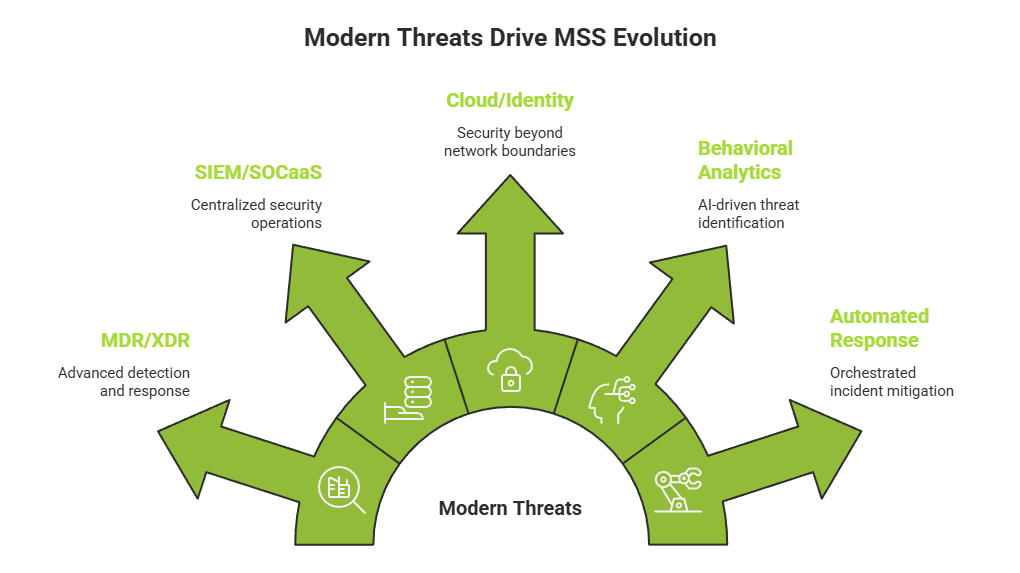
Early managed security services focused primarily on perimeter defense, managing firewalls, intrusion detection systems, and antivirus tools. However, modern threats no longer respect network boundaries.
Today’s MSS offerings have evolved to include:
This evolution reflects the reality that modern cyberattacks are multi-stage, identity-driven, and behavior-based, requiring continuous monitoring and advanced analytics rather than static rules and signatures.
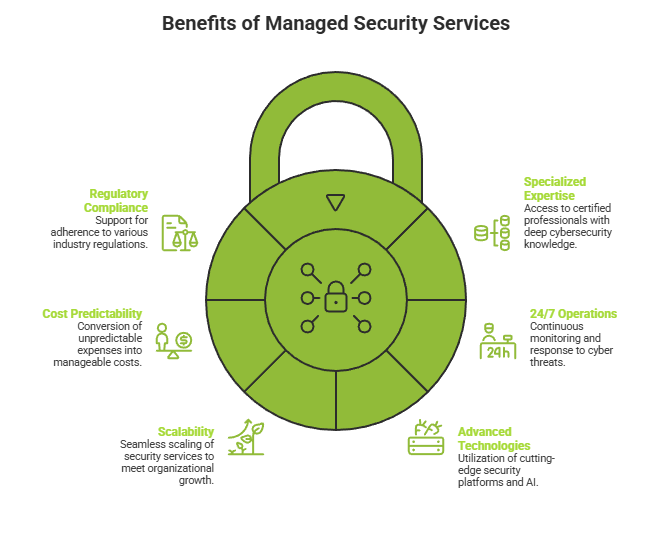
Cybersecurity talent remains scarce and expensive. MSSPs employ teams of certified professionals with deep expertise in threat intelligence, incident response, forensics, cloud security, and regulatory compliance-capabilities that would be prohibitively costly for most organizations to maintain internally.
Cyber threats do not operate on business schedules. MSS provides continuous monitoring and response, ensuring that incidents detected outside business hours are investigated and contained immediately.
Leading MSSPs invest heavily in enterprise-grade platforms, AI-driven analytics, global threat intelligence, and automation frameworks. Organizations gain access to these capabilities without the capital expenditure, integration effort, or operational overhead.
As organizations grow, migrate workloads to the cloud, or expand into new regions, MSS scales seamlessly. New environments can be protected rapidly without delays associated with hiring, training, or re-architecting security infrastructure.
Subscription-based MSS models convert unpredictable capital and operational expenses into predictable, manageable costs, enabling better financial planning and reducing total cost of ownership compared to in-house SOCs.
MSSPs support compliance with regulatory and industry frameworks such as GDPR, HIPAA, PCI DSS, SOC 2, ISO 27001, DORA, and NIS2, providing continuous control monitoring, audit-ready reporting, and expert guidance.
A fully managed SOC delivering 24/7 monitoring, investigation, and incident response. SOC analysts correlate events across the environment to identify and contain threats before they escalate.
MDR services combine advanced detection technologies with proactive threat hunting and expert-led response to identify threats that evade automated controls.
XDR provides unified visibility and detection across endpoints, networks, cloud workloads, identities, and email-enabling detection of sophisticated, multi-stage attacks.
SIEM as a Service eliminates the complexity of deploying and managing SIEM platforms internally while delivering centralized visibility, correlation, and compliance reporting.
Continuous identification, prioritization, and remediation guidance for vulnerabilities across infrastructure, applications, and cloud environments.
Continuous monitoring of cloud configurations, identity behavior, access patterns, and data exposure-addressing the most common modern attack vectors.
Despite their value, many traditional MSS offerings struggle with:
These challenges have driven demand for AI-driven, automation-first platforms purpose-built for managed security operations.
Seceon redefines managed security by delivering a unified, AI-powered security platform engineered specifically for MSSPs and large-scale SOC operations.
Seceon ingests and correlates telemetry across:
This cross-domain correlation provides full attack visibility, not isolated alerts.
Using machine learning and Dynamic Threat Modeling, Seceon:
Integrated SOAR capabilities enable:
This dramatically reduces Mean Time to Respond (MTTR).
Seceon enables MSPs to evolve into high-margin MSSPs by supporting:
The future of MSS lies in:
Platforms like Seceon are at the forefront of this transformation-enabling MSSPs and enterprises to move beyond reactive security toward proactive cyber resilience.
Managed Security Services have become essential in a threat landscape defined by speed, scale, and complexity. Organizations can no longer rely on fragmented tools or understaffed internal teams to defend against modern cyber threats.
Seceon empowers MSSPs to deliver next-generation managed security-combining AI-driven detection, unified visibility, automated response, and true multi-tenancy into a single, scalable platform. For organizations, this means stronger security, faster response, lower cost, and greater confidence. For service providers, it means a profitable, scalable path to delivering high-value cybersecurity services.
