Digital transformation has redefined how organizations operate. Cloud adoption, hybrid work models, SaaS platforms, and connected ecosystems have expanded the attack surface across businesses of every size.
What differs is not the type of threats faced – but the scale and complexity of managing them. A startup scaling rapidly can experience enterprise-level risk exposure within months. A multinational corporation may struggle with operational fragmentation across regions and environments.
Security architectures must therefore evolve beyond static protection models. Scalable security ensures that as infrastructure grows, data volumes expand, and compliance demands intensify, protection mechanisms adapt seamlessly – without creating operational strain.
Smaller organizations often operate with lean teams and constrained budgets. Their challenges typically include limited in-house expertise, fragmented toolsets, and high alert volumes relative to team capacity.
In these environments, security must be efficient, consolidated, and intelligent. Platforms should minimize manual oversight, reduce false positives, and provide broad visibility without requiring complex integrations. Scalability here means enabling growth without increasing operational overhead.
Larger enterprises face scale in a different dimension. Global operations, hybrid and multi-cloud environments, thousands of users, and regulatory complexity create layered risk.
The challenge is less about tool availability and more about coordination. Disconnected systems, inconsistent telemetry, and delayed incident response can introduce blind spots. For these organizations, scalable security must support high-volume analytics, centralized oversight, and cross-domain orchestration.
Legacy security frameworks were not designed for today’s distributed infrastructure. Static rule-based detection, siloed tools, and manual response processes create bottlenecks as organizations expand.
As data increases, alert fatigue intensifies. As environments diversify, visibility fragments. Scaling such models often results in higher costs and slower response times – rather than improved resilience.
Modern enterprises require intelligence-driven architectures capable of operating at scale without increasing complexity.
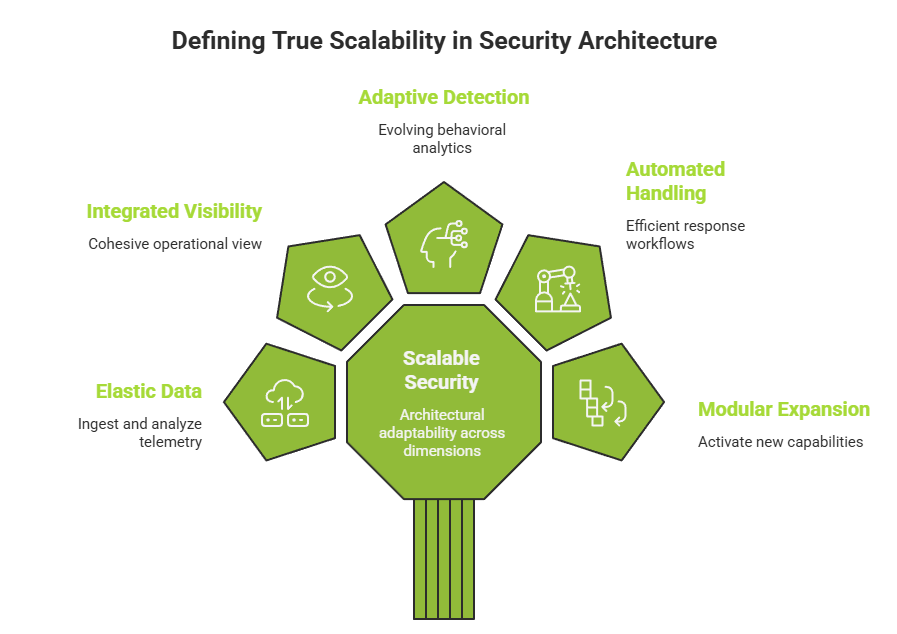
Scalable security is not simply expanding infrastructure capacity. It requires architectural adaptability across several dimensions:
Together, these principles ensure that protection scales proportionally with organizational growth.
Artificial intelligence and automation redefine how security scales.
Instead of relying solely on manual triage, AI-driven analytics correlate events across environments, identify anomalous behavior patterns, and prioritize real threats. Automated response mechanisms execute containment actions in real time, reducing dwell time and minimizing impact.
For smaller teams, this delivers operational leverage. For larger enterprises, it ensures consistency and speed across distributed environments. In both cases, AI reduces friction while strengthening defensive posture.
Seceon is architected to address scalability at its foundation – delivering unified, AI-driven security that adapts to organizational growth.
For lean teams, Seceon provides streamlined deployment and centralized visibility across endpoint, network, cloud, and identity layers. Intelligent threat detection minimizes false positives, while automated response workflows reduce manual effort.
This enables smaller organizations to maintain strong security controls without expanding staffing or managing multiple platforms. As business operations grow, the security posture scales alongside them.
For complex infrastructures, Seceon supports high-volume telemetry processing and real-time cross-domain correlation. Centralized governance ensures consistent policy enforcement across hybrid and multi-cloud environments.
Advanced analytics detect sophisticated threats across global operations, while orchestration capabilities coordinate response at scale. The result is operational clarity without sacrificing flexibility or performance.
Seceon’s modular architecture allows organizations to deploy essential capabilities initially and expand as requirements evolve. Whether integrating new cloud workloads, onboarding remote users, or addressing new compliance mandates, the security framework remains consistent and resilient.
By embedding AI, automation, and unified intelligence into a single platform, Seceon transforms scalability from an operational challenge into a strategic advantage.
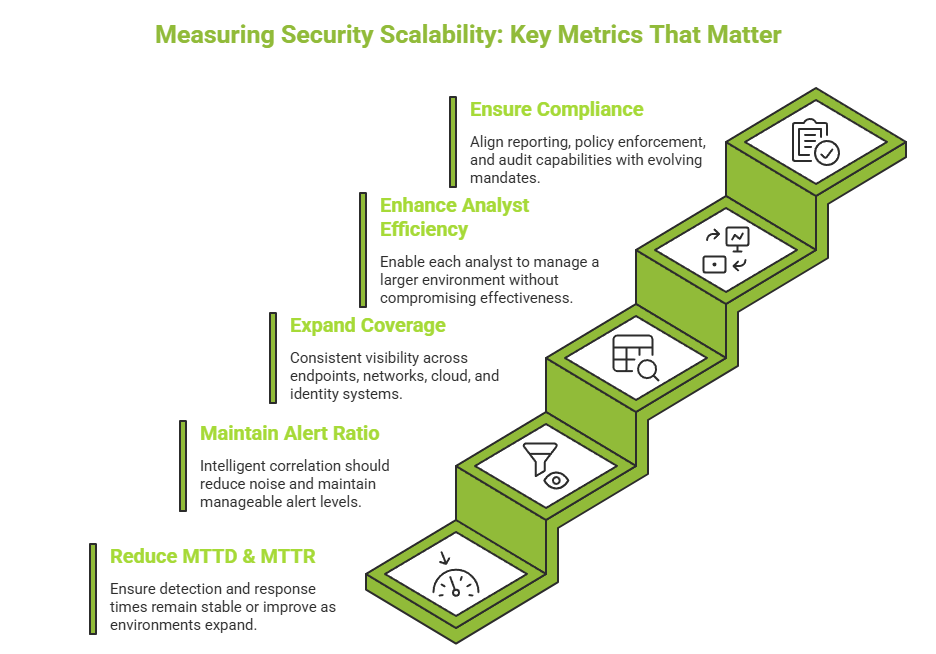
Measuring Security Scalability: Key Metrics That Matter
Scalability in cybersecurity should not be defined by infrastructure size alone – it must be measured through operational performance and risk reduction outcomes. Organizations that prioritize scalable security architectures monitor specific indicators to ensure their defenses evolve effectively alongside business growth.
Mean Time to Detect (MTTD) and Mean Time to Respond (MTTR)
As environments expand, detection and response times must remain stable – or improve. If response speed declines as telemetry increases, the architecture is not truly scalable.
Alert-to-Incident Ratio
Growing data volumes should not result in exponentially growing analyst workload. Intelligent correlation should reduce noise and maintain manageable alert levels even as infrastructure scales.
Coverage Across Attack Surfaces
Scalable security must maintain consistent visibility across endpoints, networks, cloud workloads, and identity systems – regardless of geographic expansion or digital transformation initiatives.
Operational Efficiency per Analyst
A well-architected platform enables each analyst to manage a larger environment without compromising effectiveness. Productivity metrics are a strong indicator of scalability maturity.
Compliance and Audit Readiness
As organizations enter new markets or industries, regulatory requirements expand. Scalable security ensures reporting, policy enforcement, and audit capabilities remain aligned with evolving mandates.
By tracking these metrics, enterprises gain tangible visibility into whether their security investments are supporting long-term growth or introducing hidden operational risk.
When security scales effectively, it accelerates business initiatives. Organizations can expand into new markets, adopt emerging technologies, and pursue digital innovation without introducing disproportionate risk.
A scalable security foundation reduces uncertainty, strengthens resilience, and builds stakeholder confidence. Rather than acting as a constraint, cybersecurity becomes an enabler of sustainable growth.
The enterprise landscape will continue evolving. Distributed infrastructure, AI-powered threats, and expanding regulatory oversight will define the coming years.
Organizations that adopt scalable, intelligence-driven security architectures today position themselves to adapt tomorrow – regardless of size or complexity.
Scalability is no longer optional. It is essential to maintaining resilience in a dynamic digital ecosystem.