A Policy Roadmap for Secure by Design AI: Building Trust Through Security-First Development

A Policy Roadmap for Secure by Design AI: Building Trust Through Security-First Development

As artificial intelligence systems become embedded in critical infrastructure, healthcare, finance, and national security, the need for robust security frameworks has never been more urgent. The concept of “Secure by Design” AI represents a fundamental shift from reactive security measures to proactive, integrated protection built into every layer of AI development and deployment.

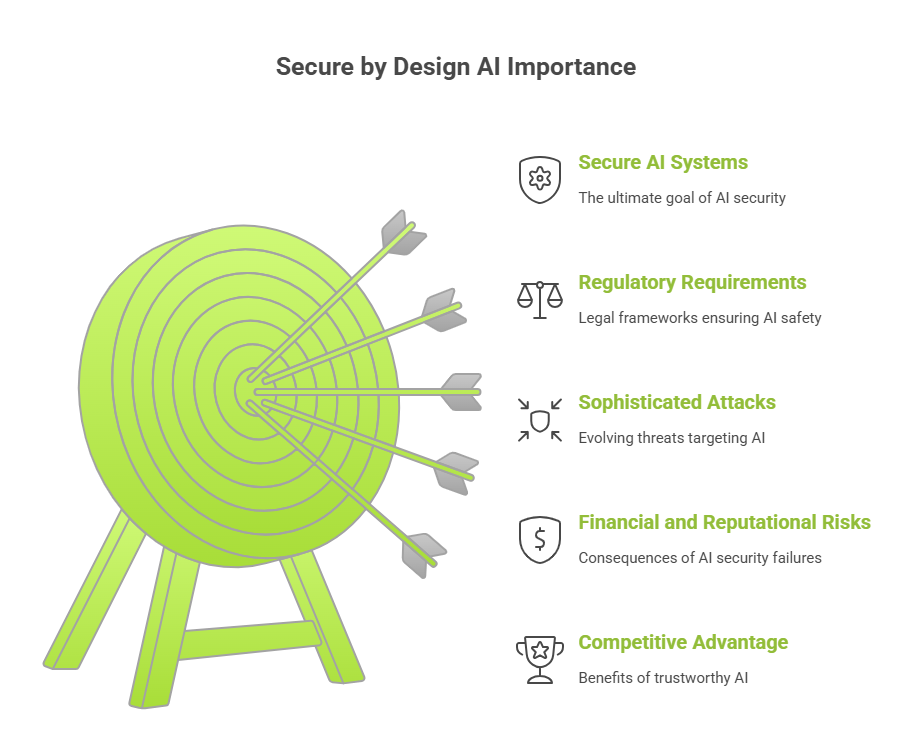
Why Secure by Design AI Matters

The rapid proliferation of AI technologies has outpaced security standards development. Recent incidents involving model poisoning, adversarial attacks, and data breaches have exposed critical vulnerabilities. Organizations now face mounting pressure from regulators, customers, and stakeholders to demonstrate that their AI systems are fundamentally secure-not just effective.

Key drivers include:

  • Growing regulatory requirements (EU AI Act, NIST AI RMF)
  • Increasing sophistication of AI-targeted attacks
  • Financial and reputational risks from AI security failures
  • Competitive advantage through trustworthy AI systems

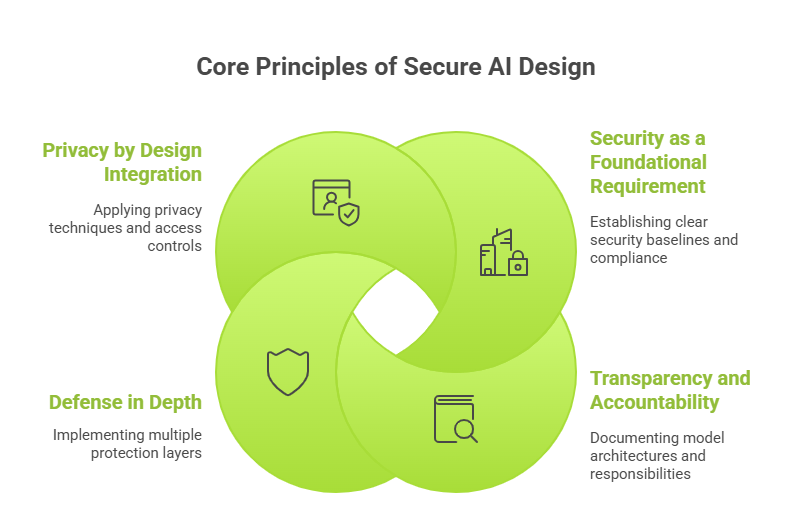
Core Principles of Secure by Design AI

1. Security as a Foundational Requirement

  • Establish clear security baselines for all AI projects
  • Conduct threat modeling and risk assessment before production
  • Require third-party AI providers to demonstrate security compliance
  • Treat security as non-negotiable, not optional

2. Transparency and Accountability

  • Document model architectures, training data sources, and decision processes
  • Define clear roles and responsibilities for AI security
  • Maintain comprehensive audit trails for forensic analysis
  • Enable independent verification of security claims

3. Defense in Depth

  • Implement multiple protection layers: data, model, infrastructure, runtime
  • Deploy input validation and output filtering
  • Use anomaly detection and continuous monitoring
  • Ensure no single point of failure compromises the system

4. Privacy by Design Integration

  • Apply differential privacy techniques
  • Enforce data minimization principles
  • Implement robust access controls
  • Protect sensitive information throughout the AI lifecycle

Policy Framework: Key Components

Data Governance and Protection

Data Provenance and Validation

  • Verify all data sources rigorously
  • Detect poisoned or corrupted training data
  • Maintain detailed lineage documentation
  • Conduct adversarial robustness testing on datasets

Secure Data Storage and Access

  • Encrypt data at rest and in transit
  • Apply role-based access controls (least privilege)
  • Segregate AI training data from production systems
  • Use air-gapped environments for sensitive applications

Data Quality and Bias Monitoring

  • Continuously monitor for anomalies and distribution shifts
  • Detect potential manipulation attempts
  • Track data quality metrics
  • Identify and mitigate embedded biases

Model Development Security

Secure Development Environments

  • Restrict access to hardened development environments
  • Integrate version control and comprehensive logging
  • Protect against supply chain attacks
  • Screen dependencies for malicious code

Adversarial Robustness Testing

  • Test against known attack vectors before deployment
  • Evaluate resistance to adversarial examples
  • Assess vulnerability to model inversion attacks
  • Establish minimum robustness thresholds by application domain

Model Validation and Certification

  • Implement formal validation processes
  • Verify model behavior against security requirements
  • Consider third-party security audits for critical applications
  • Document validation results comprehensively

Deployment and Runtime Security

Infrastructure Hardening

  • Deploy on hardened infrastructure with network segmentation
  • Implement intrusion detection systems and monitoring
  • Use container security and API gateway protections
  • Apply rate limiting and access controls

Runtime Integrity Monitoring

  • Monitor model behavior continuously for anomalies
  • Establish behavioral baselines during testing
  • Set automated alerts for threshold deviations
  • Track inference patterns for suspicious activity

Secure Model Updates

  • Use cryptographic verification for model updates
  • Implement rollback capabilities
  • Deploy updates in stages
  • Enable rapid response to security issues

Incident Response and Recovery

AI-Specific Incident Response Plans

  • Adapt traditional procedures for AI-specific threats
  • Include both security specialists and AI experts on response teams
  • Define escalation procedures and communication protocols
  • Conduct regular incident response drills

Forensic Capabilities

  • Log model queries, predictions, and system states
  • Enable reconstruction of attack vectors
  • Assess scope of model integrity compromises
  • Preserve evidence for investigation

Recovery and Remediation

  • Quarantine compromised models immediately
  • Perform clean retraining with validated data
  • Conduct thorough security reassessment
  • Document lessons learned and update policies

Regulatory Compliance and Standards

Framework Alignment

  • NIST AI Risk Management Framework
  • ISO/IEC 42001 for AI Management Systems
  • EU AI Act compliance requirements
  • Industry-specific regulations (HIPAA, financial services, critical infrastructure)

Compliance Strategies

  • Map security controls to regulatory requirements
  • Maintain documentation for audit purposes
  • Address cross-border data transfer requirements
  • Stay current with evolving regulations

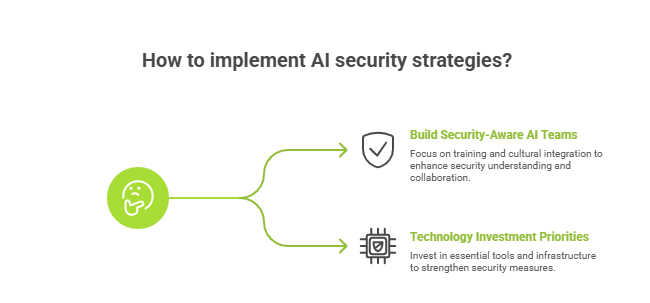
Implementation Strategies

Building Security-Aware AI Teams

Training and Development

  • Cross-train data scientists in security fundamentals
  • Educate security teams on ML/AI concepts
  • Establish security champions within AI teams
  • Provide ongoing education on emerging threats

Cultural Integration

  • Foster collaboration between security and AI teams
  • Integrate security into development workflows
  • Reward proactive security identification
  • Share threat intelligence across teams

Technology Investment Priorities

Essential Tools and Platforms

  • Adversarial testing and model validation tools
  • AI-powered security monitoring solutions
  • Secure development and deployment pipelines
  • Confidential computing for sensitive workloads

Infrastructure Requirements

  • Hardened compute environments
  • Secure model registries
  • Encrypted data stores
  • Network segmentation and isolation

Measuring Success

Key Metrics and KPIs

  • Vulnerability detection and remediation rates
  • Mean time to detect and respond to incidents
  • Adversarial robustness scores
  • Security test coverage percentage
  • Policy compliance rates

Continuous Improvement

  • Conduct quarterly security assessments
  • Perform annual third-party penetration testing
  • Review and update policies based on threat intelligence
  • Track industry benchmarks and best practices
  • Gather feedback from development and security teams

Emerging Challenges and Future Considerations

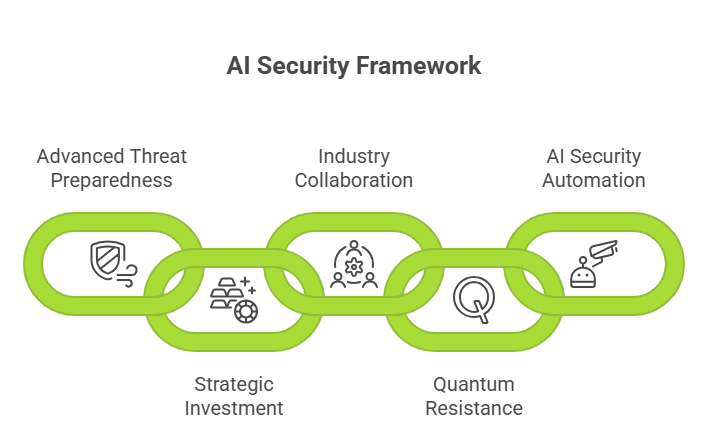
Preparing for Advanced Threats

  • Multi-modal AI systems with expanded attack surfaces
  • Autonomous agents requiring new security paradigms
  • Quantum computing threats to cryptographic protections
  • AI-powered attacks against AI defenses

Strategic Priorities

  • Invest in research on emerging AI security techniques
  • Participate in industry security working groups
  • Develop quantum-resistant security roadmaps
  • Plan for AI security automation

Conclusion

Implementing Secure by Design AI requires sustained commitment, but organizations that embed security deeply into AI development will build more resilient systems and earn greater stakeholder trust. The framework outlined above provides a practical foundation for developing AI systems worthy of the confidence society places in them.

Key Takeaways:

  • Security must be integrated from conception, not retrofitted
  • Multiple layers of defense protect against evolving threats
  • Clear policies and accountability drive consistent security outcomes
  • Continuous monitoring and improvement are essential
  • Regulatory compliance is increasingly mandatory

At Seceon, we believe security and innovation are complementary imperatives. By adopting comprehensive Secure by Design policies, organizations can unlock AI’s transformative potential while protecting against critical risks.

Ready to strengthen your AI security posture? Contact Seceon’s AI security specialists to discuss your specific requirements and develop a customized security roadmap for your organization.

Learn more about Seceon’s AI security solutions at www.seceon.com

Leave a Reply

Your email address will not be published. Required fields are marked *

Categories

Seceon Inc
Privacy Overview

This website uses cookies so that we can provide you with the best user experience possible. Cookie information is stored in your browser and performs functions such as recognising you when you return to our website and helping our team to understand which sections of the website you find most interesting and useful.