Modern enterprises operate in highly dynamic digital environments where cloud platforms, SaaS applications, remote work infrastructure, and connected devices continuously generate vast volumes of security data. Every login attempt, network request, endpoint activity, and application interaction contributes to an expanding stream of telemetry that security teams must monitor.
Traditional monitoring tools were designed for earlier network environments where security events were fewer and easier to investigate manually. Today, however, the scale and speed of cyber threats have dramatically increased. Security Operations Centre (SOCs) often face thousands of alerts each day, many of which are repetitive, low-priority, or false positives. This overwhelming volume makes it difficult for analysts to identify the few alerts that truly indicate malicious activity. As organizations struggle to keep pace with sophisticated attacks and expanding attack surfaces, AI-based cybersecurity monitoring has emerged as a critical capability for modern security operations.
AI-based cybersecurity monitoring refers to the use of artificial intelligence, machine learning, and advanced analytics to continuously observe, analyze, and interpret security data across an organization’s digital environment.
Instead of relying solely on predefined rules or static signatures, AI-driven monitoring platforms analyze behavioral patterns across multiple data sources, including:
By learning what normal activity looks like, AI systems can automatically detect anomalies that may indicate potential security incidents such as unauthorized access, lateral movement, privilege escalation, or data exfiltration.
This intelligence enables security teams to identify threats faster, more accurately, and often before significant damage occurs.
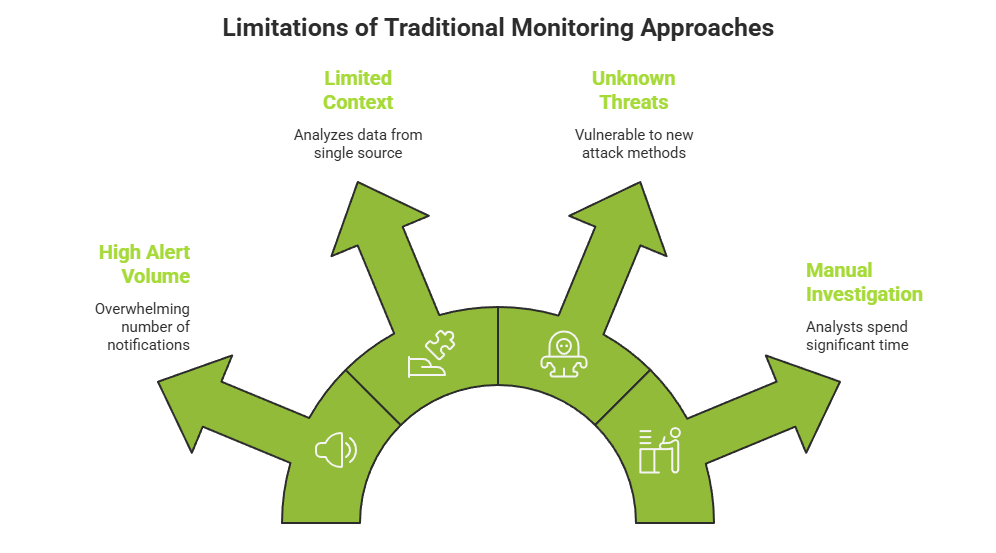
Conventional security monitoring solutions typically depend on rule-based detection mechanisms. While effective for known threats, these approaches struggle to keep pace with modern attack techniques.
Some of the key limitations include:
These challenges highlight why modern SOCs are increasingly turning toward AI-driven monitoring platforms to enhance operational efficiency and threat detection accuracy.
Artificial intelligence transforms security monitoring by introducing automation, behavioral analysis, and predictive insights into the detection process.
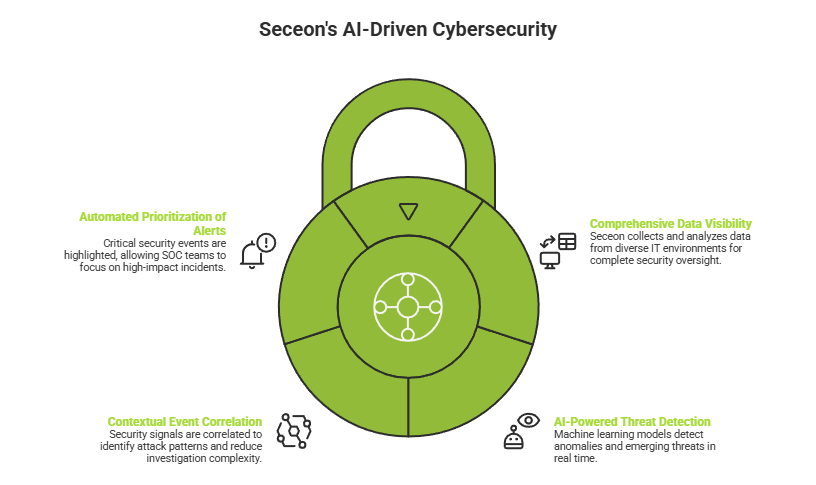
AI systems continuously analyze patterns of activity across users, devices, and applications. When unusual behavior occurs-such as abnormal login locations, unusual data transfers, or unexpected system interactions-the system flags these anomalies for investigation.This behavioral approach enables the detection of threats that may bypass traditional rule-based defenses.
In modern IT environments, a single security incident may generate multiple events across various systems. AI algorithms automatically correlate these events, connecting seemingly unrelated signals into a unified incident timeline.This capability significantly improves visibility into complex attack chains.
Machine learning models improve accuracy over time by learning from historical security data. As the system refines its understanding of normal operational patterns, it becomes better at filtering out benign activity and prioritizing alerts that require attention.The result is a more manageable and actionable set of alerts for SOC teams.
By continuously analyzing large datasets in real time, AI-powered monitoring systems can identify suspicious activity far earlier than manual analysis alone.Early detection reduces the potential impact of cyber incidents and enables faster containment.
AI-based monitoring is not just about improving detection-it also plays a key role in transforming how security operations function.
Modern SOC teams must manage complex hybrid environments that include on-premises infrastructure, cloud services, mobile devices, and third-party integrations. AI provides the scalability required to monitor these environments continuously without overwhelming human analysts.
By automating data analysis and prioritizing meaningful alerts, AI allows security professionals to focus on higher-value tasks such as threat investigation, incident response, and strategic security planning.This shift enables organizations to move from reactive security practices toward proactive and intelligence-driven defense strategies.
Seceon provides a unified platform designed to deliver intelligent, automated cybersecurity monitoring across the entire enterprise environment.
The platform integrates advanced analytics, behavioral intelligence, and automated threat detection to help organizations gain deep visibility into security events across networks, endpoints, identities, and cloud infrastructure.
Key capabilities include:
By combining these capabilities into a unified platform, Seceon enables organizations to monitor threats continuously, detect attacks earlier, and respond more efficiently to evolving cyber risks.
Beyond detecting ongoing threats, AI-based cybersecurity monitoring is increasingly enabling organizations to anticipate potential risks before they fully materialize. By analyzing historical attack patterns, behavioral trends, and evolving threat intelligence, AI systems can identify indicators that suggest an increased likelihood of malicious activity. This predictive capability allows security teams to strengthen defenses proactively, adjust monitoring policies, and prioritize high-risk areas of the infrastructure. Instead of reacting only after suspicious activity occurs, organizations can use AI-driven insights to prepare for emerging threats and reduce the probability of successful attacks.
As cyber threats become more sophisticated and digital infrastructures continue to grow, traditional monitoring approaches will struggle to keep pace.
AI-driven monitoring represents the next evolution of security operations-one where intelligent automation, predictive analytics, and real-time insights enable organizations to detect and respond to threats with unprecedented speed and precision.
Organizations that adopt AI-based monitoring strategies will be better positioned to protect critical assets, reduce operational complexity, and maintain resilient security operations in an increasingly complex threat landscape.