

As digital transformation accelerates across industries, organizations are navigating increasingly complex, dynamic, and distributed IT ecosystems. The rapid adoption of cloud technologies, remote work infrastructure, SaaS applications, and AI-powered systems has significantly expanded the cyber attack surface. In parallel, cyber adversaries are employing cutting-edge technologies—such as automation, artificial intelligence, and advanced evasion tactics—to bypass traditional, rule-based security tools. In this environment, the need for a cybersecurity approach that is adaptive, intelligent, and capable of operating at machine speed has never been greater. The solution lies in the integration of AI-driven cybersecurity platforms, which are designed to address the evolving challenges of modern security landscapes.
Traditional cybersecurity solutions rely on signature-based detection and static rules, which have proven increasingly ineffective against advanced persistent threats, fileless malware, and sophisticated social engineering tactics. These legacy tools are often reactive, identifying threats only after they have breached the network or disrupted operations. In contrast, AI-driven platforms leverage machine learning, behavioral analytics, and dynamic threat modeling to identify and respond to threats in real time, before they can cause significant harm.
AI-driven cybersecurity platforms go beyond mere detection; they provide a holistic view of an organization’s security posture by continuously monitoring, analyzing, and securing all digital touchpoints across the enterprise. This includes networks, endpoints, cloud workloads, identities, applications, and APIs. By analyzing vast amounts of telemetry from diverse sources, AI-driven platforms are capable of identifying subtle anomalies, correlating related events, and uncovering hidden attack patterns. This approach not only enables earlier detection but also dramatically reduces false positives and accelerates the overall response time to threats.
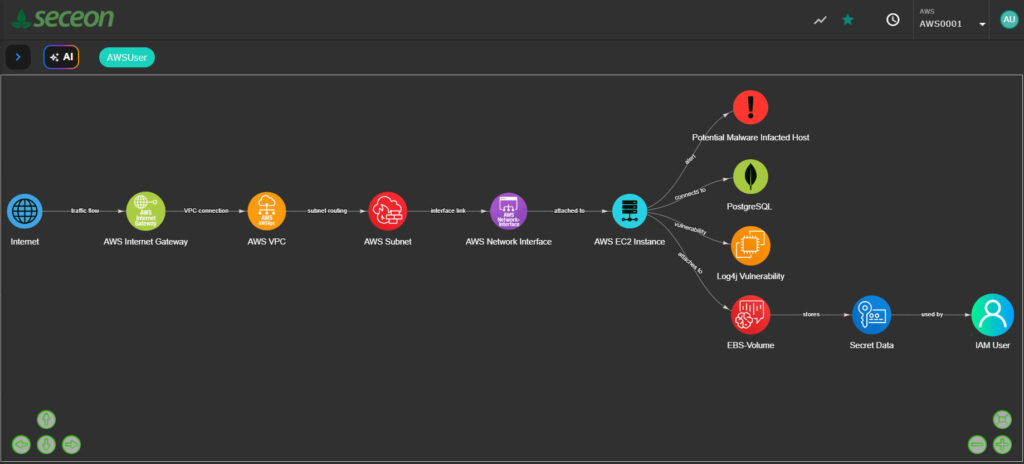
One of the most significant advantages of AI-driven cybersecurity platforms is unified visibility. In most organizations, security teams are forced to manage multiple, disparate security tools—each focused on a specific domain, such as network security, endpoint protection, cloud security, or identity management. These siloed solutions often generate alerts independently, with insufficient context, making it difficult for security teams to gain a comprehensive understanding of risk across the entire digital ecosystem.
AI-driven platforms address this issue by consolidating data from across various domains into a single, unified system. By normalizing and correlating telemetry from multiple sources, these platforms provide security teams with a comprehensive, real-time view of their organization’s security posture. This holistic perspective enables security teams to understand how threats move across systems and where interventions can be most effective. As a result, organizations can respond faster and more accurately, minimizing the time between detection and containment.
At the heart of AI-driven cybersecurity is behavioral analytics. Traditional security tools often fail to detect new, previously unknown threats because they rely on predefined signatures or rules. In contrast, AI-driven platforms use machine learning models to establish baselines of normal behavior for users, devices, applications, and networks. These models continuously learn and adapt as environments evolve, enabling them to identify deviations from established patterns that may indicate malicious activity.
For example, a user’s login from an unfamiliar location may not be suspicious on its own. However, if this login is followed by unusual access to sensitive files, abnormal data transfers, or unexpected network communication, the AI platform can automatically flag these actions as potentially malicious. This ability to detect anomalous behaviors—rather than simply looking for known threats—makes AI-driven cybersecurity platforms particularly effective against modern threats such as zero-day attacks, fileless malware, insider threats, and credential abuse.
Traditional security tools often treat security events as isolated incidents, without considering how they relate to one another. However, modern cyberattacks are highly dynamic and involve a series of interrelated actions that can span across multiple systems and environments. AI-driven cybersecurity platforms address this challenge by dynamic threat correlation and threat modeling.
Instead of focusing on individual alerts, AI-driven platforms build relationships between events across the environment to construct a complete picture of an attack. For example, a suspicious login attempt may trigger an alert, but when combined with unusual data access, network traffic patterns, and user behavior, it becomes clear that a compromised identity is in play. By automatically identifying relationships between actions, AI-driven platforms can prioritize high-risk incidents and enable security teams to respond more effectively.
Moreover, AI-driven platforms incorporate dynamic threat modeling, which allows them to predict the likely progression of an attack. By understanding the tactics, techniques, and procedures (TTPs) of attackers, the platform can anticipate the next moves of the adversary and proactively intervene to prevent further escalation, lateral movement, or data exfiltration.
In today’s fast-paced threat landscape, speed is critical. Manual investigation and response processes can take hours or even days, during which attackers can escalate privileges, move laterally within the network, or exfiltrate sensitive data. To mitigate this, AI-driven cybersecurity platforms integrate automation into their workflows.
Automation enables security teams to take immediate, predefined actions when high-confidence threats are detected. For instance, the platform may automatically isolate a compromised endpoint, disable a malicious account, or block a suspicious network connection. These actions can be executed in real time, drastically reducing the mean time to respond (MTTR) and minimizing the impact of an incident.
Automated response capabilities also allow organizations to quickly address fast-moving threats such as ransomware or credential stuffing attacks. In these cases, where time is of the essence, an automated response can prevent further damage while security teams investigate and remediate the issue.
The adoption of cloud services and the shift to remote work have created new challenges for security teams. Cloud environments are inherently dynamic, with workloads constantly spinning up and down. Misconfigurations, excessive permissions, and exposed APIs are common entry points for attackers in the cloud. Similarly, identity-based attacks, such as phishing, MFA fatigue, and token theft, are on the rise, as attackers increasingly target credentials to gain unauthorized access.
AI-driven cybersecurity platforms excel in monitoring these evolving environments. By continuously analyzing cloud activity and monitoring user and entity behavior, these platforms can detect risky changes, unusual access patterns, and suspicious API calls in real time. This is particularly important for organizations that are embracing Zero Trust principles, where access decisions are continuously validated based on context and risk.
In addition, AI-driven platforms apply user and entity behavior analytics (UEBA) to detect subtle deviations from normal access patterns, which are indicative of identity-based attacks. By correlating these behaviors with other signals from the network, endpoints, and cloud environments, these platforms offer a robust and adaptive approach to identity protection.
From an operational perspective, AI-driven cybersecurity platforms deliver significant value. By consolidating multiple security functions—such as network security, endpoint protection, cloud security, and identity management—into a unified platform, organizations can reduce tool sprawl and simplify security operations. This not only lowers the total cost of ownership (TCO) but also enhances the efficiency of security teams, enabling them to focus on high-priority tasks.
In terms of business impact, AI-driven cybersecurity platforms help organizations minimize breach risks, reduce downtime, and protect valuable assets such as revenue, reputation, and customer trust. Furthermore, these platforms provide built-in reporting and audit capabilities that support regulatory compliance and offer executive-level visibility into the organization’s risk posture.
By replacing fragmented, siloed security architectures with an integrated, intelligent system, platforms like those offered by Seceon enable organizations to improve their security posture, respond more effectively to threats, and gain resilience in the face of an ever-changing threat landscape.
In conclusion, the adoption of an AI-driven cybersecurity platform is no longer a luxury but a strategic necessity for organizations operating in today’s increasingly complex and interconnected digital world. As cyber threats become more sophisticated and traditional security tools struggle to keep pace, AI-driven platforms provide a comprehensive, adaptive, and proactive approach to defense. By combining unified visibility, behavioral intelligence, dynamic threat modeling, and automated response, these platforms deliver a scalable and future-ready defense strategy. As businesses continue to embrace digital transformation, AI-driven cybersecurity will serve as the foundation of effective, real-time protection, enabling organizations to stay ahead of adversaries and maintain secure, resilient operations in the face of emerging threats.
