
Artificial intelligence is no longer a “nice to have” in cybersecurity – it’s embedded everywhere. From detecting suspicious activity to responding to incidents in real time, AI now sits at the heart of modern security operations.
But as organizations hand over more responsibility to intelligent systems, a tough question emerges: who’s really in control?
This is where AI governance comes in. Not as a compliance checkbox, but as a practical necessity. Without clear governance, AI can quietly introduce blind spots, amplify risk, and erode trust – even while appearing to make security stronger.
In this blog, we’ll break down why AI governance matters in cybersecurity, the risks of getting it wrong, and how organizations can build AI systems that are not just powerful, but trustworthy.
Artificial intelligence has permeated nearly every aspect of modern cybersecurity operations. From endpoint detection and response (EDR) to security information and event management (SIEM) platforms, AI algorithms analyze network traffic, detect anomalies, classify threats, and even orchestrate automated responses. The statistics are compelling: organizations using AI-powered security tools report up to 95% reduction in false positives and can detect breaches 60% faster than traditional methods.
However, this rapid adoption has outpaced the development of governance frameworks. Many organizations deploy AI security tools without fully understanding their decision-making processes, training data biases, or failure modes. This creates a dangerous paradox: the more we rely on AI for security, the more vulnerable we become to AI-specific attacks and failures.
When AI systems influence security decisions, the risks go far beyond technical issues. Without proper AI governance, models can develop blind spots or bias, lose accuracy over time due to model drift, or be targeted through adversarial attacks. A lack of explainability makes it harder for security teams to trust and validate automated actions, while growing regulatory requirements demand transparency, data protection, and human oversight. When governance fails, organizations face missed threats, compliance risk, reputational damage, and loss of trust.
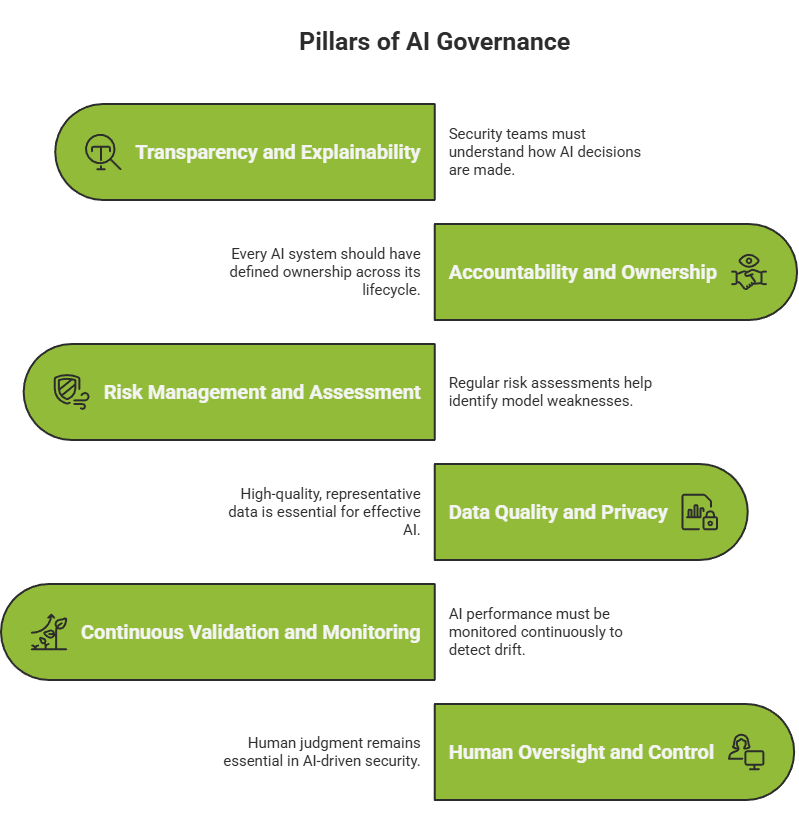
Effective AI governance in cybersecurity is built on six foundational pillars that ensure AI systems remain trustworthy, effective, and aligned with organizational values.
Security teams must understand how AI decisions are made, especially for high-impact actions. Explainable AI techniques and clear documentation help teams validate alerts, assess confidence, and trust system outputs.
Every AI system should have defined ownership across its lifecycle. Clear accountability ensures faster issue resolution and reinforces responsibility for both internal models and third-party tools.
Regular risk assessments help identify model weaknesses, adversarial exposure, and operational impact. Governance frameworks should include mitigation and fallback plans for critical AI failures.
High-quality, representative data is essential for effective AI. Strong data governance and privacy controls reduce bias, protect sensitive information, and ensure regulatory compliance.
AI performance must be monitored continuously to detect drift or degradation. Ongoing testing against evolving threats ensures models remain accurate and resilient over time.
Human judgment remains essential in AI-driven security. Critical decisions should allow human approval and override, balancing automation with accountability and ethical responsibility.
Making governance real requires structure, not just principles.
Organizations that do this well typically:
The goal isn’t perfection – it’s predictability and control.
The regulatory landscape for AI is evolving quickly, adding new layers of complexity for organizations using AI in cybersecurity. Existing data protection laws now intersect with AI-specific regulations such as the EU AI Act, which follows a risk-based approach and often classifies cybersecurity AI as high risk. In the U.S., executive directives and sector-specific rules place similar expectations on transparency, testing, and oversight, particularly in regulated industries like finance, healthcare, and critical infrastructure.
Strong AI governance makes compliance far more manageable. Organizations with clear ownership, documented controls, ongoing testing, and human oversight are better positioned to demonstrate responsible AI use. When regulators ask how AI systems are monitored, validated, or kept fair, governance artifacts such as performance reports, audit logs, and validation records become proof – not paperwork.
At Seceon, AI governance isn’t just about meeting compliance requirements – it’s about building security systems teams can truly trust. Our platform is designed with governance built in, giving organizations visibility and control over AI-driven decisions without sacrificing speed or scale.
Here’s how we do it:
We believe the future of cybersecurity lies in AI that strengthens human expertise, not replaces it. Seceon’s governance-first approach ensures organizations retain clarity, control, and confidence as AI becomes central to security operations.
AI governance in cybersecurity will only grow more critical as AI systems become more sophisticated and autonomous. Emerging technologies like large language models (LLMs) for security analysis, generative AI for threat simulation, and reinforcement learning for adaptive defense create new governance challenges alongside new capabilities.
Organizations should prepare for governance requirements that extend beyond individual models to encompass entire AI ecosystems. As AI systems increasingly interact with each other, governance frameworks must address emergent behaviors, cascading failures, and the complex interdependencies that arise when multiple AI systems collaborate in security operations.
The organizations that thrive will be those that view AI governance not as a constraint but as a competitive advantage. Trustworthy AI systems attract customers, satisfy regulators, and empower security teams to focus on strategic challenges rather than firefighting AI-induced incidents. Governance creates the foundation for sustainable AI adoption that delivers lasting value.
Conclusion: Taking Action Today
AI governance in cybersecurity is an ongoing effort that requires collaboration, adaptability, and clear accountability. Organizations don’t need perfect frameworks to begin – they need practical foundations, such as understanding where AI is used, assigning clear ownership, and continuously monitoring performance.
The most effective security teams treat AI as a powerful tool guided by human judgment, not a black box operating unchecked. By balancing automation with transparency and oversight, organizations can build resilient security programs that earn trust and scale responsibly. Those who commit to strong AI governance today will be best positioned to lead as threats and technologies evolve.