
Executive Summary
Modern cyber adversaries no longer depend on loud malware, obvious exploits, or easily identifiable indicators of compromise. Instead, they leverage legitimate credentials, trusted tools, and native system functions to operate silently within enterprise environments. These attacks are deliberately designed to resemble normal business activity, rendering traditional detection methods ineffective.
Behavioral Threat Analytics (BTA) shifts the security focus from static indicators to behavioral intent. By continuously monitoring and learning how users, entities, and systems normally operate, BTA detects subtle deviations that indicate insider threats, credential compromise, privilege abuse, and advanced persistent attacks-often at their earliest stages.This blog explores the evolution of threat detection, the core principles behind Behavioral Threat Analytics, its real-world security impact, and how Seceon’s AI-native platform operationalizes behavioral intelligence to deliver real-time, high-confidence threat detection and response.
The Limitations of Traditional Threat Detection
Traditional security architectures were built for a perimeter-centric, predictable IT environment. Detection logic largely revolved around:
- Signature-based detection
- Rule-driven event correlation
- Static thresholds and predefined conditions
While these approaches still detect known threats, they fail in dynamic, identity-driven environments.
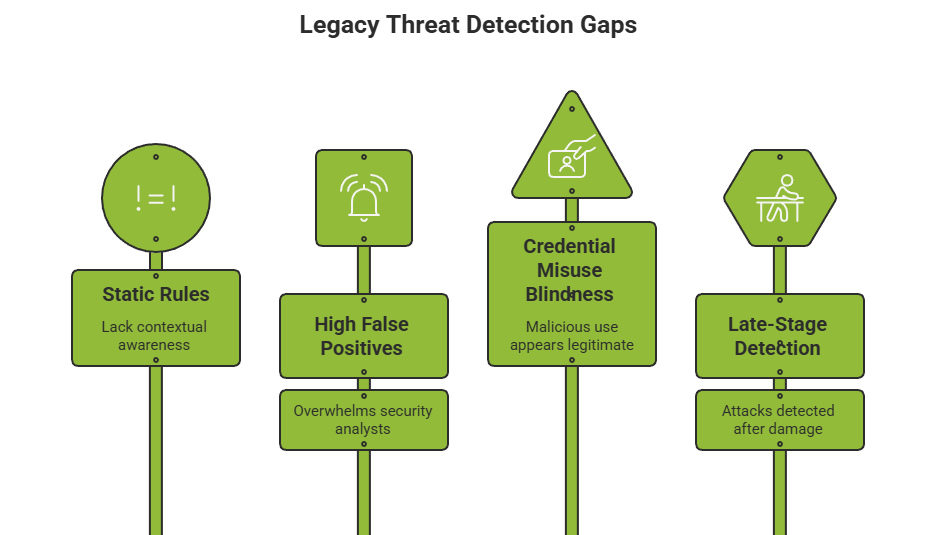
Key Gaps in Legacy Approaches
- Static rules lack context
They do not account for user roles, peer behavior, or environmental changes. - High false-positive rates
Minor deviations trigger alerts, overwhelming SOC analysts and masking real threats. - Blindness to credential misuse
Valid credentials used maliciously appear legitimate to rule-based systems. - Late-stage detection
Attacks are often detected only after lateral movement or data access has occurred.
With cloud workloads, SaaS platforms, remote users, and API-driven services becoming the norm, threat detection must understand behavioral patterns, intent, and deviation, not just events.
What Is Behavioral Threat Analytics?
Behavioral Threat Analytics is a security discipline that focuses on how entities behave over time, rather than what tools or techniques attackers use.
It continuously analyzes behavioral signals across:
- Users
- Devices
- Service accounts
- Applications
- Network and cloud resources
At its core, BTA:
- Builds behavioral baselines for each entity
- Learns normal operational patterns
- Detects deviations that increase risk
- Prioritizes threats based on behavior-driven confidence
Instead of asking:
“Is this activity known to be malicious?”
Behavioral analytics asks:
“Does this activity make sense for this user, device, or system in this context?”
This enables detection of unknown, zero-day, and insider-driven threats that evade traditional controls.
How Behavioral Threat Analytics Works
Behavioral Threat Analytics functions as a layered analytical pipeline, where each layer adds intelligence and context.
1. Data Ingestion and Normalization
Effective behavioral analysis depends on broad and deep telemetry. BTA ingests data from:
- Identity and access management systems
- Endpoint detection and response tools
- Network traffic and flow data
- Cloud infrastructure and SaaS logs
- Application and database activity
- Authentication and privilege usage logs
Data is normalized and enriched to ensure consistent analysis across disparate sources.
2. Behavioral Baseline Modeling
Machine learning models establish dynamic behavioral baselines that reflect how entities normally operate.
Baselines are created for:
- Individual users
- Peer groups (role-based comparison)
- Endpoints and workloads
- Service and API accounts
Behavioral attributes include:
- Login frequency, timing, and geography
- Resource access patterns
- Command and process execution sequences
- Data access and transfer volumes
- Privilege usage behavior
Baselines evolve continuously, adapting to role changes, seasonal workloads, and infrastructure growth.
3. Anomaly and Risk Detection
When observed behavior deviates from established norms, BTA identifies:
- Behavioral outliers
- Temporal anomalies
- Sudden pattern changes
- Multi-step behavioral chains
Examples:
- A finance user accessing engineering repositories
- A service account initiating interactive sessions
- Lateral movement across unrelated systems
- Gradual data aggregation followed by exfiltration
Instead of producing single alerts, BTA assigns entity-centric risk scores that reflect cumulative behavioral risk.
4. Contextual Correlation and Threat Intelligence
Behavioral anomalies are correlated with:
- Threat intelligence indicators
- MITRE ATT&CK techniques and tactics
- Historical incidents and entity relationships
- Attack path and kill-chain progression
This correlation:
- Increases detection accuracy
- Reduces noise and false positives
- Enables early-stage threat identification
SOC teams receive prioritized, context-rich detections, not raw alerts.
Key Threats Detected Using Behavioral Analytics
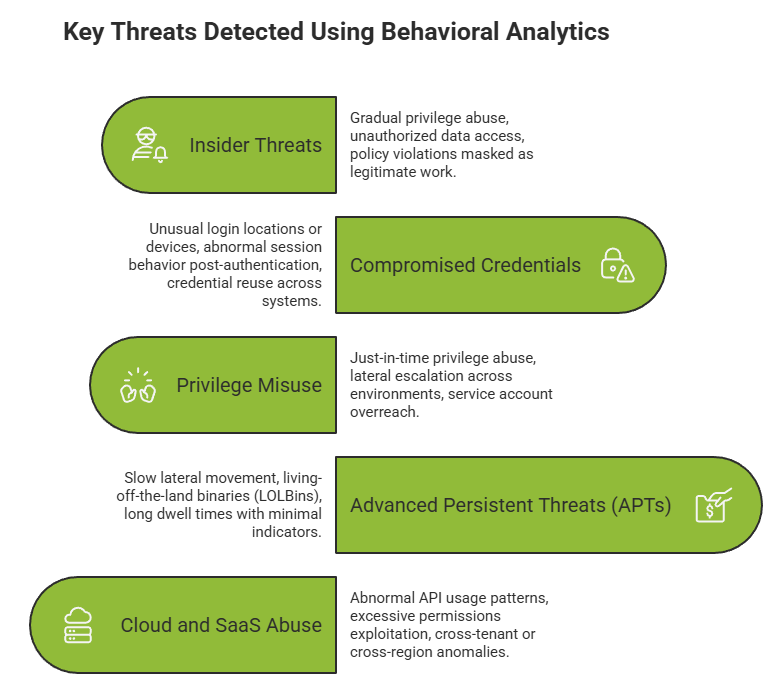
Behavioral Threat Analytics is especially effective against stealthy and misuse-based threats, including:
Insider Threats
- Gradual privilege abuse
- Unauthorized data access
- Policy violations masked as legitimate work
Compromised Credentials
- Unusual login locations or devices
- Abnormal session behavior post-authentication
- Credential reuse across systems
Privilege Misuse
- Just-in-time privilege abuse
- Lateral escalation across environments
- Service account overreach
Advanced Persistent Threats (APTs)
- Slow lateral movement
- Living-off-the-land binaries (LOLBins)
- Long dwell times with minimal indicators
Cloud and SaaS Abuse
- Abnormal API usage patterns
- Excessive permissions exploitation
- Cross-tenant or cross-region anomalies
These threats often lack malware or exploits, making behavioral signals the most reliable detection mechanism.
Why Behavioral Threat Analytics Is Critical Today
Several macro trends have made behavioral analytics indispensable:
- Identity is the new attack surface
- Remote work has expanded trust boundaries
- Cloud and SaaS environments change continuously
- Attackers increasingly use legitimate tools
- SOC teams must do more with fewer resources
Behavioral analytics enables:
- Earlier detection in the attack lifecycle
- Reduced alert fatigue
- Risk-based prioritization
- Faster Mean Time to Detect (MTTD) and Respond (MTTR)
It shifts security operations from event-centric monitoring to risk-centric decision-making.
Seceon’s Approach to Behavioral Threat Analytics
Seceon embeds Behavioral Threat Analytics as a foundational capability within its AI-powered security platform.
How Seceon Delivers Behavioral Intelligence
- AI-Native Architecture
Behavioral models are built into, correlation, and response workflows. - Continuous Entity Risk Scoring
Users, devices, and sessions are dynamically assessed in real time. - Cross-Domain Behavioral Correlation
Behavioral insights span endpoints, network, cloud, identity, and applications. - Automated Detection and Response
High-risk behavioral patterns trigger orchestrated containment actions. - Enterprise-Scale ML
Designed to operate efficiently across high-volume, complex environments.
Seceon enables SOC teams to move from reactive alert handling to behavior-driven threat hunting and automated response.
From Alerts to Intelligence: The Future of Threat Detection
As attackers continue to evade static controls, security must evolve toward intent-aware defense. Behavioral Threat Analytics represents this shift-where understanding behavior, context, and risk replaces chasing isolated alerts.
Organizations adopting behavioral analytics gain:
- Visibility into hidden and emerging threats
- Stronger defense against unknown attacks
- Improved SOC efficiency and confidence
- Measurable improvements in detection and response outcomes
In a world where systems, users, and attackers constantly change, behavior remains the most consistent indicator of compromise.
