In an era where cyberattacks evolve at machine speed and security teams drown in thousands of daily alerts, traditional Security Information and Event Management (SIEM) systems are showing their age. What was once revolutionary-centralized logging and correlation-has become a bottleneck. Security analysts spend 40% of their time chasing false positives, while sophisticated threats slip through rule-based detection systems that cannot adapt to novel attack patterns.
The numbers tell a sobering story: the average enterprise processes over 11,000 security alerts per day, yet only 22% of these alerts are investigated, and fewer than 4% are deemed credible threats. This signal-to-noise crisis isn’t just inefficient-it’s dangerous. While analysts wade through alert queues, adversaries exploit the gaps, with average dwell times still exceeding 16 days for undetected breaches.
Enter next-generation SIEM solutions-intelligent platforms that don’t just collect data but understand it, contextualize it, and act on it autonomously. By integrating artificial intelligence, machine learning, and automated response capabilities, these systems are transforming security operations from reactive firefighting into proactive threat hunting. The question for modern enterprises isn’t whether to upgrade their SIEM, but how quickly they can make the transition to platforms designed for today’s threat landscape.
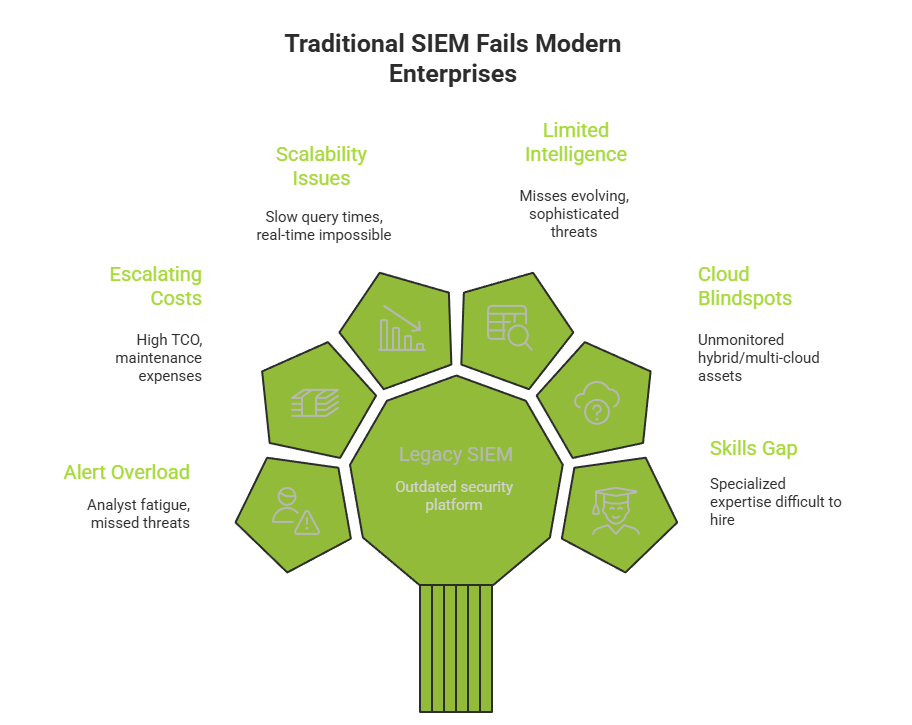
Legacy SIEM platforms are struggling to keep pace with today’s sophisticated threat landscape. Built for on-premises data centers and perimeter-based security, these systems face insurmountable challenges in the age of cloud computing, remote work, and AI-powered attacks:
The result? Organizations spend more while remaining vulnerable to modern attack techniques. A recent study found that 70% of security leaders consider their current SIEM inadequate for detecting advanced threats.
Next-generation SIEM represents a fundamental shift from reactive monitoring to proactive threat hunting. Key differentiators include:
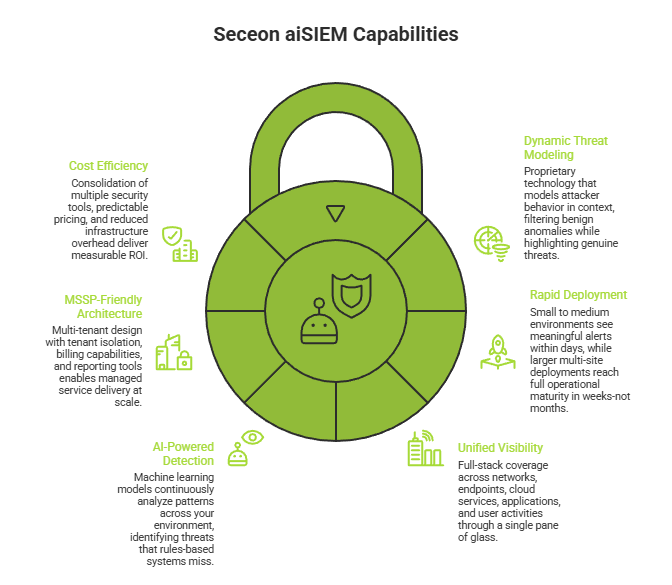
Seceon’s aiSIEM platform exemplifies the next-generation approach with several standout capabilities that address the critical gaps in traditional SIEM:
Dynamic Threat Modeling (DTM): Proprietary technology that models attacker behavior in context, filtering benign anomalies while highlighting genuine threats. Unlike static rules, DTM understands the relationship between events and adapts to new attack patterns automatically. This dramatically reduces false positives while ensuring real threats receive immediate attention.
Rapid Deployment: Small to medium environments see meaningful alerts within days, while larger multi-site deployments reach full operational maturity in weeks-not months. This speed-to-value eliminates the painful 6-12 month implementation cycles typical of legacy platforms.
Unified Visibility: Full-stack coverage across networks, endpoints, cloud services, applications, and user activities through a single pane of glass. aiSIEM eliminates the need to pivot between multiple consoles, providing security teams with complete context for every investigation.
AI-Powered Detection: Machine learning models continuously analyze patterns across your environment, identifying threats that rules-based systems miss. The platform learns from every alert, improving accuracy and adapting to your unique environment over time.
MSSP-Friendly Architecture: Multi-tenant design with tenant isolation, billing capabilities, and reporting tools enables managed service delivery at scale. MSSPs can efficiently manage hundreds of clients from a single platform while maintaining strict data separation.
Cost Efficiency: Consolidation of multiple security tools, predictable pricing, and reduced infrastructure overhead deliver measurable ROI. Organizations typically see positive ROI within 6-9 months of deployment.
Organizations implementing next-generation SIEM report significant improvements:
A major African bank achieved these results after implementing AI/ML and DTM capabilities, identifying compromised credentials and abnormal data transfers that their previous system missed entirely.
Unified Data Ingestion Next-gen platforms gather intelligence from diverse sources-logs, network traffic, endpoints, cloud services, and applications-ensuring comprehensive visibility without blind spots.
Behavioral Analytics Rather than relying on known signatures, modern SIEM establishes baselines for users, devices, and applications. Deviations trigger investigation, enabling zero-day and insider threat detection.
Threat Intelligence Integration Real-time feeds provide context about emerging patterns, malicious actors, and exploitation trends, allowing teams to anticipate rather than just react.
Compliance Automation Simplified adherence to GDPR, HIPAA, PCI DSS, and other frameworks through automated reporting and audit trails.
Alert fatigue is crippling security operations centers. Next-generation SIEM addresses this through:
The impact extends beyond efficiency-reduced turnover, improved morale, and more effective security operations result from freeing analysts from routine work.
While next-generation SIEM requires investment, TCO comparisons reveal substantial savings:
As organizations accelerate cloud adoption, security strategies must evolve. Traditional perimeter-based defenses are obsolete when applications, data, and users are distributed across multiple cloud platforms and geographic locations. Next-generation SIEM provides the visibility and control essential for cloud-first enterprises:
This comprehensive cloud coverage ensures that security operations maintain effectiveness regardless of where workloads execute, eliminating the dangerous blind spots that emerge as organizations migrate to the cloud.
The evolution continues with emerging capabilities that will further transform security operations:
These advances will shift security operations from reactive defense to predictive protection, with AI handling routine tasks while humans focus on strategic security improvements and complex investigations.
When evaluating next-generation SIEM platforms, consider:
The shift to next-generation SIEM isn’t just a technology upgrade-it’s a fundamental transformation in security operations. From reactive alert triage to proactive threat hunting, from manual investigation to AI-assisted analysis, modern platforms deliver the intelligence, automation, and unified visibility needed for today’s threat landscape.
Platforms like Seceon aiSIEM demonstrate how this vision translates into practical security operations that protect enterprises effectively and efficiently. As digital transformation accelerates and attack surfaces expand, security teams relying on legacy tools will increasingly fall behind.
The organizations that modernize their security operations now will be best positioned to defend against sophisticated cyber threats while optimizing costs and team productivity. In an era where cybersecurity is a fundamental business imperative, next-generation SIEM isn’t optional-it’s essential.