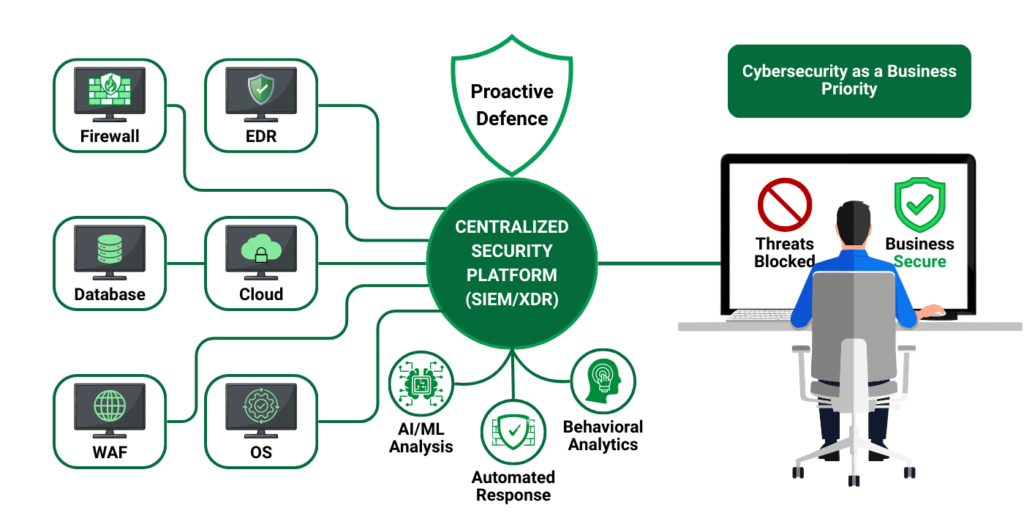
In today’s digital world, cybersecurity is no longer just an IT problem, it is a business survival requirement. Organizations are deploying multiple tools such as firewalls, EDR, databases, operating systems, cloud platforms, WAFs, proxies, and more. However, simply deploying tools does not guarantee security.
What truly matters is how effectively you monitor, correlate, and respond to security events.
Below is a practical, experience-driven view of cybersecurity awareness that every organization should understand.
Centralized Monitoring Is Mandatory, Not Optional
Modern environments generate massive amounts of security data. Monitoring each tool separately is inefficient, risky, and unsustainable.
A centralized monitoring platform (SIEM/XDR) provides:
- Unified visibility across all tools
- Faster detection of attacks
- Better correlation of multi-stage threats
- Reduced operational overhead
Without centralized monitoring, attackers often remain invisible until real damage is done.
Monitoring Individual Tool Consoles Is Not Practical
Organizations use dozens of security and IT tools:
- Network devices
- Firewalls
- EDR
- Databases
- Operating systems
- Cloud services
It is humanly impossible to continuously monitor every individual console. Important alerts get missed, dashboards are ignored, and incidents slip through.
A centralized platform eliminates this problem by bringing all telemetry into one place.
EPS-Based Licensing Is Costly – Device-Based Makes More Sense
Centralized monitoring often increases EPS (Events Per Second), which can significantly increase SIEM costs.
A more practical approach:
- Device-based licensing as the base
- Additional cost only for high-EPS devices (e.g., firewalls, proxies, WAFs)
This model provides predictable costs while still allowing full visibility.
You Cannot Afford Experts for Every Tool
Each security tool requires specialized expertise. Hiring experts for:
- Firewall
- EDR
- Cloud
- Database
- Network
…is extremely expensive and unrealistic.
Centralized monitoring reduces this dependency by:
- Normalizing logs
- Applying unified detections
- Enabling smaller teams to manage complex environments effectively
Your Central Platform Must Detect Attacks Across All Tools
A centralized security platform must:
- Detect cyberattacks
- Identify suspicious activities
- Correlate events across multiple tools
- Highlight business-impacting incidents
It should not act as a log storage system, but as a detection and response brain for the organization.
Lack of Cybersecurity Knowledge Is a Major Risk
One of the biggest threats today is lack of awareness:
- Employees fall for phishing
- Misconfigurations remain unnoticed
- Basic security practices are ignored
Cybersecurity awareness must exist at all levels, not only within the SOC.
Demand Complete Documentation From Vendors
Organizations should strictly ask vendors for:
- Complete product usage documentation
- Log reference guides
- Event and activity descriptions
- Security-relevant log fields
Every security-related activity must generate logs. These logs are the backbone of centralized monitoring and SIEM-based detection.
Security Capabilities Are Often License-Dependent
Many vendors:
- Provide limited detections in basic licenses
- Unlock advanced security only with higher-cost plans
Organizations must clearly understand:
- What detections are included
- What security gaps exist at lower tiers
- Whether visibility is being artificially restricted
Security should not become optional due to licensing.
Basic Licenses Must Still Log Cyberattacks
At a minimum:
- Every vendor should generate logs for any cyberattack
- Logging should not be disabled in basic licenses
Without logs, detection and investigation become impossible, no matter how advanced your SIEM is.
AI-Driven Attacks Can Easily Bypass Signature-Only Tools
Attackers now use AI to design attack patterns that:
- Evade traditional signatures
- Look like normal user behavior
- Change dynamically
To handle this, centralized security platforms must analyze:
- Signatures
- Behavioral changes
- Machine learning patterns
- AI-driven correlations
Relying only on static rules is no longer sufficient.
Cybersecurity Must Be a Business Priority
The most important point: organizations must understand the value of cybersecurity.
Every organization should:
- Deploy basic security hygiene tools at the right places
(WAF, advanced firewalls, EDR, proxy, etc.) - Collect all logs and telemetry centrally
- Let SIEM/XDR perform correlation and detection
- Run regular cybersecurity awareness training for employees
- Maintain in-house cybersecurity experts, not just tools
Conclusion
Cybersecurity is not about buying more products, it is about visibility, correlation, intelligence, and people.
Centralized monitoring, combined with awareness and skilled professionals, transforms security from a reactive function into a proactive defense strategy.
Tools alone don’t protect organizations.
People, processes, and centralized intelligence do.
