In today’s digital landscape, cybersecurity compliance has evolved from a checkbox exercise into a complex, continuous challenge. Organizations must navigate multiple regulatory frameworks simultaneously with distinct requirements, deadlines, and substantial penalties for non-compliance. The traditional approach of manual compliance management through spreadsheets and quarterly reviews is no longer viable for modern enterprises.
Cybersecurity compliance automation transforms this burden into a strategic advantage, enabling organizations to maintain continuous compliance, reduce operational costs, minimize human error, and allow security teams to focus on genuine threat protection rather than administrative tasks.
Cybersecurity compliance automation leverages specialized platforms to continuously monitor, manage, and maintain adherence to regulatory frameworks and security standards. Rather than manually tracking requirements and scrambling to gather evidence during audit periods, automation handles these tasks systematically and in real-time.
The transformation is analogous to moving from manual monthly checkbook balancing to real-time banking apps that track every transaction and alert you instantly to issues. Automation converts compliance from a periodic burden into an integrated, ongoing component of security operations.
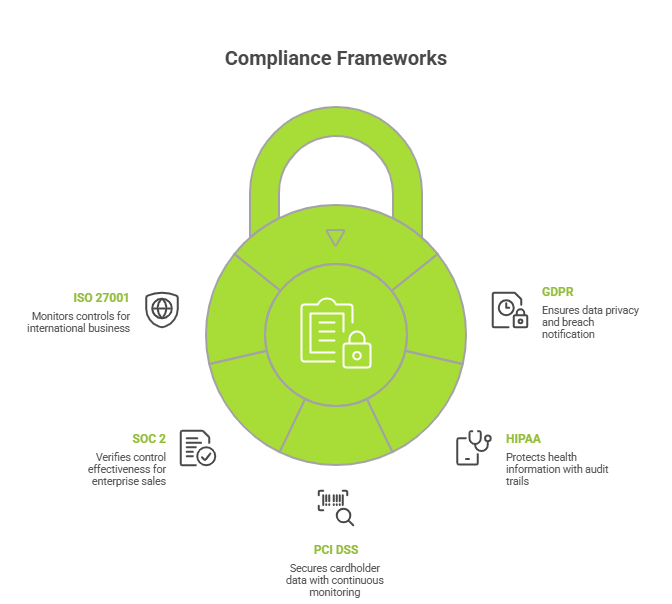
Today’s enterprises typically manage compliance across multiple frameworks, including GDPR for European data, HIPAA for healthcare information, PCI DSS for payment processing, SOC 2 for enterprise security controls, and ISO 27001 for information security management. Each framework encompasses hundreds of requirements with distinct documentation needs and audit schedules.
Organizations typically allocate 30-50% of security team resources to compliance activities. For a five-person security team, this represents the equivalent of two full-time employees performing administrative work instead of protecting against actual threats.
The financial impact extends beyond labor costs to include extensive audit preparation time, elevated consultant and auditor fees, multiple compliance tool investments, penalties for missed deadlines, and potential revenue loss from failed certifications.
Manual compliance processes are inherently error-prone. A single overlooked requirement or missed configuration change can result in failed audits, regulatory penalties, eroded customer trust, delayed product launches, and lost business opportunities.
GDPR requires explicit consent for data collection, 72-hour breach notification, and comprehensive data protection measures. Penalties reach up to €20 million or 4% of global revenue. Automation is essential for meeting the breach notification timeline and managing data subject requests at scale.
HIPAA mandates extensive audit logging of all Protected Health Information access. Automation continuously monitors access patterns, creates comprehensive audit trails, and ensures proper encryption across all PHI systems. Violations can cost up to $1.5 million annually per category.
PCI DSS requires quarterly vulnerability scans and continuous monitoring of cardholder data environments. Automation handles scanning, tracks vulnerability remediation, and monitors network traffic in real-time while generating compliance reports.
SOC 2 audits require 6-12 months of evidence collection. Automation reduces audit preparation from months to weeks by continuously collecting evidence and monitoring control effectiveness. SOC 2 certification is often a prerequisite for enterprise sales.ISO 27001 requires monitoring 93 controls across 14 domains. Automation verifies control implementation, tracks risk treatment, and identifies gaps before audits. This globally recognized certification is essential for international business and government contracts.
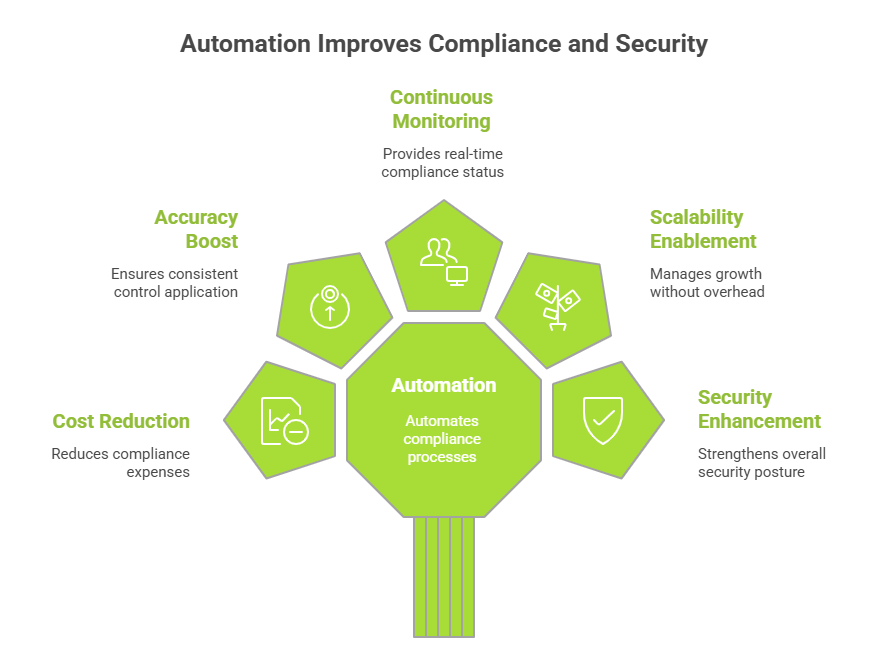
Compliance automation reduces costs by 40-60% through multiple mechanisms. Manual evidence collection that once required weeks now happens automatically in the background. Audit preparation time shrinks from months to weeks. External consultant fees decrease substantially, and security professionals redirect their efforts toward high-value security work rather than administrative compliance tasks.
Automation ensures consistent application of security controls across all systems regardless of configuration, timing or personnel. It provides real-time compliance status rather than outdated point-in-time assessments, creates complete audit trails without gaps, and follows standardized evidence collection processes that eliminate oversights.
Traditional quarterly or annual audits create dangerous compliance gaps where organizations remain unaware of their compliance status until auditors arrive. Automation fundamentally changes this by monitoring security controls 24/7, immediately detecting configuration drift, collecting evidence continuously, and identifying compliance gaps proactively for remediation before audits.
As organizations expand, compliance complexity traditionally multiplies unsustainably. Each new system, application, or data store adds compliance requirements. Automation breaks this pattern by enabling organizations to add systems without proportional compliance overhead increases, manage multiple frameworks simultaneously without additional headcount, and adapt rapidly to new regulations without complete program overhauls.
Compliance automation strengthens actual security beyond audit success. Continuous monitoring detects security issues faster than manual reviews, automated remediation workflows address problems quickly, and comprehensive visibility reveals risks that might otherwise remain hidden. Integration with security tools creates a unified approach where compliance and security mutually reinforce each other.
Effective compliance automation platforms must deliver unified dashboard management for multiple frameworks through a single interface, automated evidence collection that captures configurations and system states without manual intervention, real-time monitoring with immediate alerts for compliance violations, intelligent risk assessment with actionable remediation recommendations, streamlined audit management with collaborative workspaces and automated reporting, and comprehensive integration capabilities with cloud platforms, security tools, and existing infrastructure.
Successful implementation begins with framework prioritization based on business requirements, followed by stakeholder engagement across security, IT, legal, and business units. Organizations should establish a baseline compliance posture, implement the platform with a phased rollout starting with the highest priority framework, configure automated monitoring and evidence collection, integrate with existing security and IT tools, and measure continuous improvement through key performance indicators
Organizations implementing comprehensive compliance automation typically observe initial time savings within three months as teams reduce manual evidence collection and generate first automated reports. Within six months, audit preparation time decreases noticeably and compliance violations are remediated faster, allowing security teams more time for proactive initiatives. Full ROI is typically achieved within twelve months with significantly reduced compliance costs and continuous audit-readiness across multiple frameworks.
Long-term benefits include manageable compliance scaling during organizational growth, the ability to add new frameworks without proportional resource increases, compliance as a competitive advantage rather than a burden, and seamless integration of security and compliance operations.
The compliance landscape continues growing more complex with emerging regulations, evolving frameworks, and intensifying enforcement. Organizations relying on manual processes will find themselves increasingly overwhelmed, unable to meet regulatory demands while defending against sophisticated cyber threats.
Compliance automation has transitioned from a luxury to a business necessity. The question is no longer whether to automate compliance, but how quickly organizations can implement automation to protect their operations, reduce costs, and maintain stakeholder trust.
Organizations that thrive will transform compliance from a reactive obligation into a proactive, integrated security strategy component. Modern platforms like Seceon make this transformation practical and achievable for organizations of all sizes, offering AI-powered threat detection, continuous monitoring, automated evidence collection, and unified compliance management across all major frameworks.
The future of compliance is automated. Organizations that embrace this reality today position themselves for sustainable success in an increasingly regulated digital environment.