Managed Service Providers (MSPs) and Managed Security Service Providers (MSSPs) have become critical partners for organizations navigating today’s complex digital environments. As businesses expand cloud infrastructure, support remote workforces, and adopt new digital platforms, the attack surface continues to grow. Many organizations lack the internal expertise and resources required to monitor, detect, and respond to cyber threats effectively.
This shift has transformed the role of service providers. MSPs and MSSPs are no longer responsible only for IT infrastructure management; they are now expected to deliver comprehensive cybersecurity protection. From monitoring networks and endpoints to responding to incidents and supporting regulatory compliance, service providers play a central role in protecting their clients’ digital ecosystems.
In today’s threat landscape, cybersecurity capabilities have become a core differentiator for MSPs and MSSPs seeking to deliver reliable and trusted managed services.
Unlike internal security teams that focus on a single organization, MSPs and MSSPs must secure multiple client environments simultaneously. Each client may operate different technologies, compliance frameworks, and risk profiles, which creates significant operational complexity.
Service providers must manage large volumes of security alerts generated from endpoints, networks, identity systems, and cloud environments. Without efficient correlation and prioritization, security teams can quickly become overwhelmed by alert fatigue.
At the same time, threat actors increasingly target service providers because of the privileged access they hold to multiple client environments. A successful compromise of a service provider can allow attackers to move laterally across several organizations, amplifying the potential impact.
For this reason, cybersecurity strategies for MSPs and MSSPs must focus on centralized visibility, scalable monitoring, and intelligent threat detection.
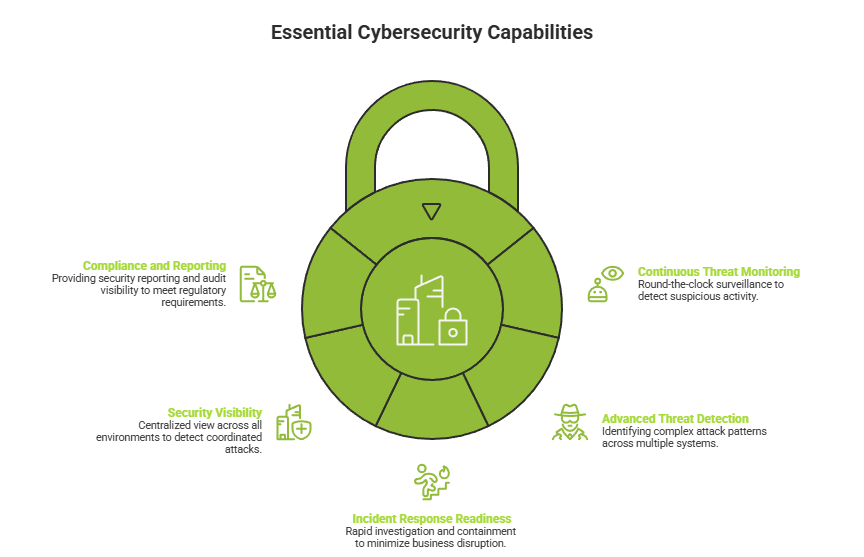
To effectively secure client environments, MSPs and MSSPs must implement a security framework that integrates monitoring, detection, response, and compliance capabilities.
Key capabilities include:
Delivering these capabilities consistently across multiple clients is essential for maintaining effective managed security operations.
As MSPs and MSSPs grow their client base, scaling security operations becomes increasingly complex. Teams must monitor thousands of endpoints, numerous cloud services, and distributed network infrastructures while maintaining rapid detection and response.
One of the most significant challenges is managing alert volume. Modern IT environments generate a constant stream of security alerts, many of which may be false positives. Analysts can spend valuable time reviewing low-risk alerts instead of focusing on genuine threats.
Other common scaling challenges include:
To overcome these challenges, service providers must adopt security architectures that support automation, intelligent correlation, and centralized operations.
Automation has become essential for managing cybersecurity at scale. By automating repetitive analysis tasks and response actions, MSPs and MSSPs can improve operational efficiency while reducing analyst workload.
Artificial intelligence and behavioral analytics further enhance threat detection by identifying patterns and anomalies that traditional rule-based systems may miss.
Modern security operations increasingly rely on:
These capabilities allow service providers to detect threats earlier, respond faster, and manage large-scale client environments more efficiently.
A strong cybersecurity strategy for MSPs and MSSPs requires a multi-layered defense model. Visibility across endpoints, networks, cloud infrastructure, and user behavior is essential to understanding potential attack paths.
Effective frameworks typically include:
This integrated approach helps service providers move from reactive security monitoring toward proactive threat prevention.
As digital transformation continues across industries, the demand for managed security services will continue to grow. Organizations increasingly rely on service providers to secure complex environments that include hybrid infrastructure, cloud platforms, and distributed workforces.
Future cybersecurity strategies for MSPs and MSSPs will likely focus on:
Service providers that adopt scalable, intelligent security architectures will be better positioned to deliver consistent protection across diverse client environments while maintaining operational efficiency.
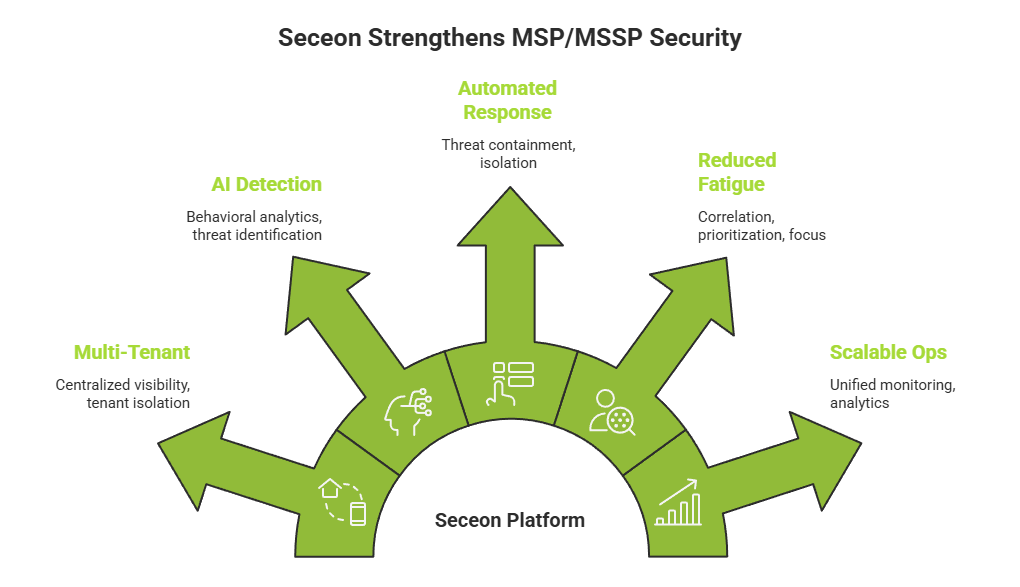
For MSPs and MSSPs managing multiple client environments, security platforms must provide scalability, visibility, and automation without increasing operational complexity. Seceon’s platform is designed to support service providers in delivering advanced security capabilities while maintaining efficient operations.
Seceon helps MSPs and MSSPs by enabling:
By combining threat visibility, automation, and intelligent analytics, Seceon enables service providers to deliver stronger, more efficient cybersecurity protection for their clients.
Cybersecurity has become one of the most critical services delivered by MSPs and MSSPs. As organizations continue to expand their digital infrastructure and adopt cloud-driven technologies, the need for scalable and intelligent security operations will only grow.
Service providers must be prepared to manage complex multi-client environments while detecting threats quickly and responding efficiently. Achieving this level of security requires integrated platforms, automation, and advanced analytics that can reduce operational complexity and improve threat visibility.
By adopting modern cybersecurity strategies and leveraging intelligent security technologies, MSPs and MSSPs can strengthen their role as trusted partners-helping organizations navigate an increasingly complex and evolving threat landscape while maintaining resilience and operational stability.