

India’s oil and gas sector has entered a new operational era. By 2026, the industry is no longer defined only by physical infrastructure and digital transformation, but by hyper-connected IT, OT, and IoT environments powered by AI-driven operations. While these advances have improved efficiency, predictive maintenance, and asset utilization, they have also expanded the attack surface dramatically.
Cybersecurity in the energy sector is no longer an IT concern. It is now a matter of national resilience, operational safety, and economic stability.
Recent data highlights a stark shift in the threat landscape. Ransomware attacks targeting energy organizations have increased by more than 900 percent, while connected assets across IT, OT, and IIoT environments now exceed 11 million endpoints. At the same time, attackers are no longer focused solely on immediate disruption. Many are embedding themselves quietly inside environments, mapping systems and staging attacks that could trigger cascading failures.
The cost of delay is severe. Traditional SOCs often take months to detect breaches, while regulatory frameworks such as CERT-In 2025 and DPDP Act now mandate rapid detection, reporting, and accountability, with penalties reaching INR 250 crore per breach.
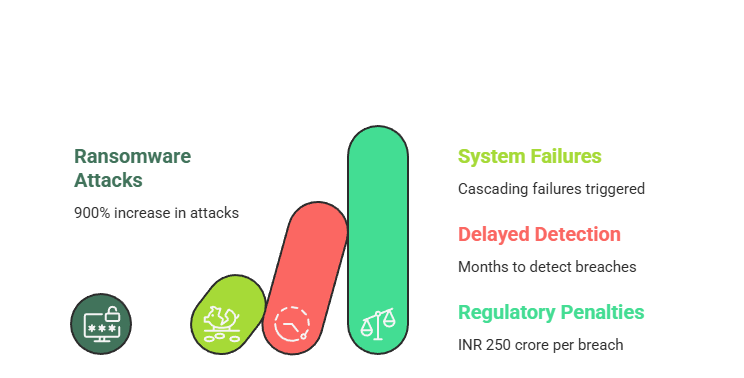
Most energy organizations still rely on security architectures designed for IT-only environments. These models struggle in modern energy ecosystems for three key reasons.
First, human-led SOCs cannot operate at machine speed. Manual investigations and siloed tools create blind spots where attackers can remain undetected for extended periods.
Second, IT and OT environments remain fragmented. Legacy SCADA systems, PLCs, and industrial protocols were never designed with security telemetry or behavioral analysis in mind, making traditional monitoring ineffective.
Third, compliance-driven security is no longer sufficient. Periodic audits and checkbox controls fail to detect real-time threats or demonstrate continuous readiness, which regulators now expect.
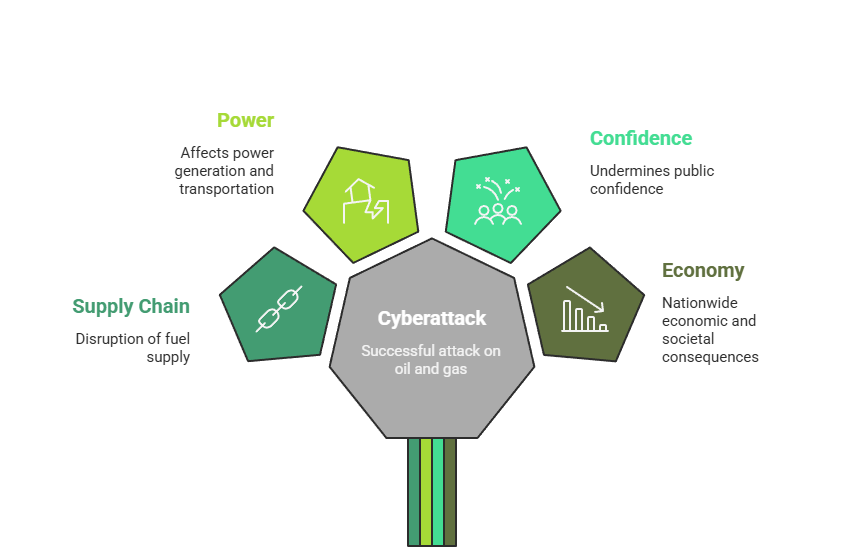
Cyber incidents in the oil and gas sector extend far beyond data loss. A single successful attack can disrupt fuel supply chains, affect power generation and transportation, and undermine public confidence during periods of geopolitical tension.
With the energy sector projected to contribute nearly 20 percent of India’s GDP by the end of 2026, even short-lived disruptions can have nationwide economic and societal consequences. Cybersecurity, therefore, must be treated as a strategic capability, not an operational afterthought.
Recent incidents targeting Indian energy organizations reveal consistent attack patterns.
Initial access is often achieved through credential resale, phishing, or exploitation of exposed services. Once inside, attackers establish persistence using unmanaged or shared administrative access, then move laterally across IT and OT environments. Command execution frequently abuses legitimate industrial protocols, allowing attackers to blend into normal operational traffic.
By the time impact occurs, whether ransomware or sabotage, attackers have already achieved deep situational awareness. At that stage, response latency becomes the difference between containment and catastrophe.
India’s regulatory environment has evolved rapidly. CERT-In now mandates continuous audit readiness, strict breach notification timelines, and accountability at the board level. The DPDP Act elevates cybersecurity failures into financial and legal risk.
This shift means organizations must demonstrate continuous visibility, rapid detection, and provable response, rather than periodic compliance snapshots. Security must operate continuously, across IT and OT, without disrupting safety-critical operations.
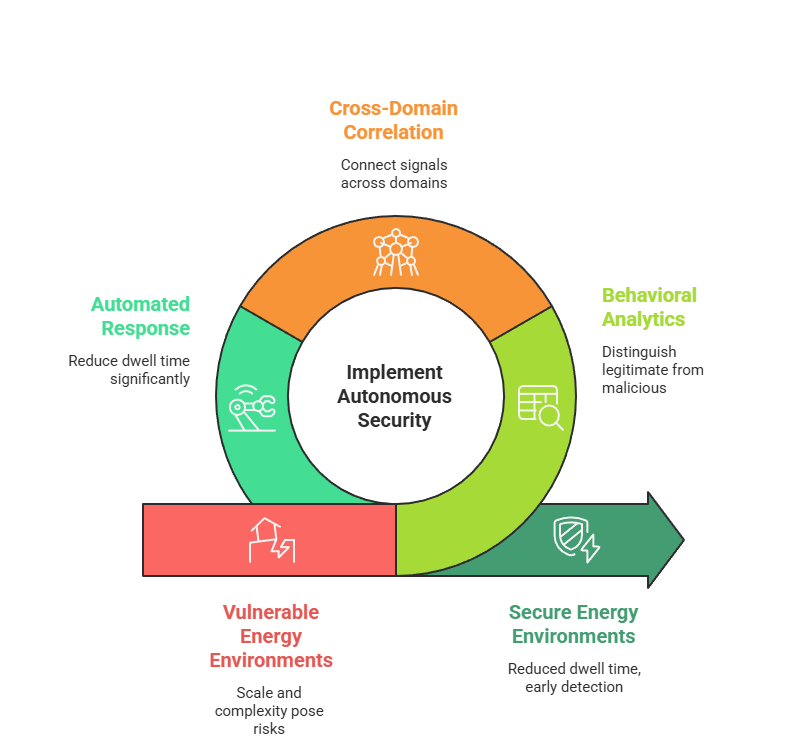
Given the scale and complexity of modern energy environments, autonomous, AI-driven security is no longer optional.
Behavioral analytics allow security systems to distinguish legitimate operational activity from malicious behavior, even when attackers use valid credentials or trusted tools. Cross-domain correlation connects signals across endpoints, networks, identities, and industrial systems, revealing attack progression early.
Most critically, automated response reduces dwell time from months to minutes or seconds, enabling containment without waiting for human intervention.
Organizations that adopt unified, AI-driven security models report transformative outcomes. Detection times drop from months to minutes, response actions execute in seconds instead of hours, and false positives fall dramatically. Automated compliance reporting replaces weeks of manual preparation with near real-time readiness.
Equally important, security teams regain focus. Instead of drowning in alerts, analysts concentrate on real threats and strategic risk reduction.
To remain resilient in the face of escalating threats and regulatory pressure, energy leaders must prioritize:
India’s energy sector stands at a crossroads. Fragmented tools, manual processes, and legacy defenses are no longer sufficient to protect hyper-connected, geopolitically sensitive infrastructure.
A unified, AI-driven, autonomous security model is now a strategic necessity. It enables energy organizations to protect operations, meet regulatory mandates, and defend the backbone of India’s economy without compromising safety or performance.
