Denmark stands among Europe’s most digital and connected economies – but that very strength has created one of the continent’s widest attack surfaces.
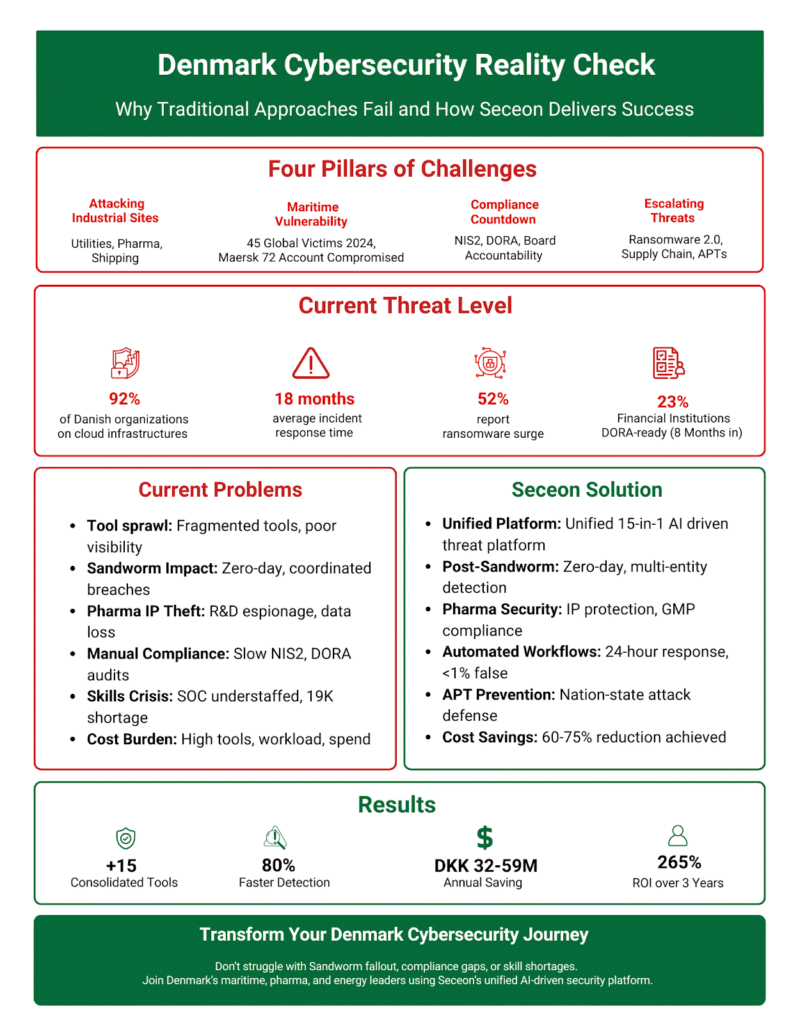
With 92% of Danish organizations now running on cloud infrastructure and Industry 4.0 transforming manufacturing and energy, cyber risks are scaling faster than defenses.
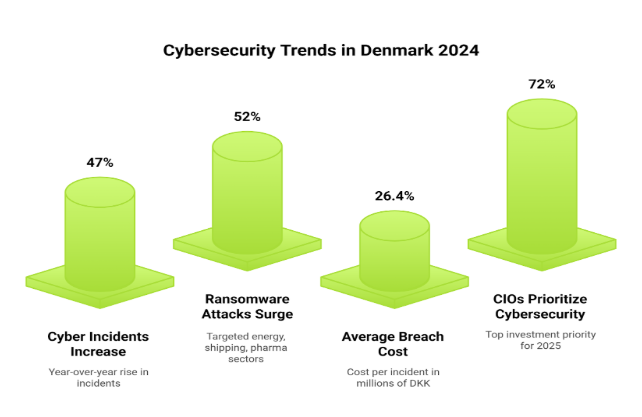
In 2024 alone:
As the EU NIS2 Directive (effective Oct 2025) enforces 24-hour reporting and board-level accountability, Denmark faces a parallel challenge: more than 7,000 unfilled cybersecurity roles.
Automation and AI are no longer optional; they’re essential.
Explore the full insights in our whitepaper: Denmark’s Digital Defense preventing billions in cyber losses
The 2017 NotPetya attack on Maersk cost Denmark nearly DKK 2 billion and revealed the fragility of industrial and maritime networks.
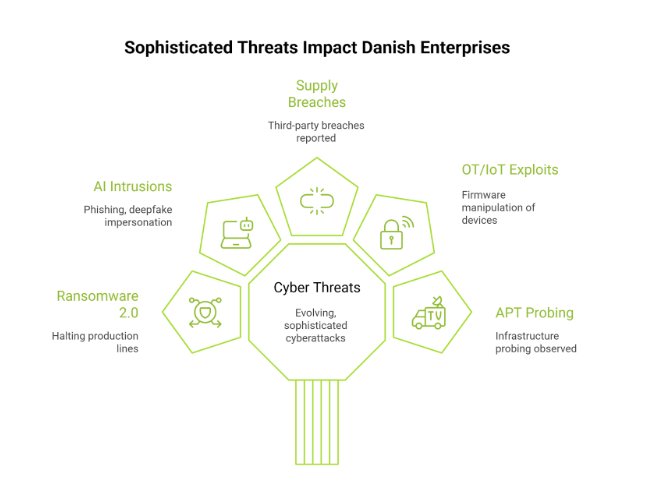
Eight years later, adversaries have grown smarter:
Average recovery now stretches 28 days, with 33% of affected firms suffering multi-site outages.
Denmark’s digital economy needs unified, real-time defense – not a patchwork of tools.
Security teams manage 11-20 disconnected tools, creating over 10,000 alerts per day – 85% of them false positives.
With limited specialists, operational fatigue is the new risk surface.
Seceon’s AI-driven Open Threat Management (OTM) platform directly addresses this.
By unifying SIEM, SOAR, XDR, UEBA, OT/IoT visibility, and compliance automation, it cuts:
Dynamic Threat Modeling (DTM) and autonomous response allow 2-3 analysts to achieve the output of 20+.
Denmark’s enterprises must now align with:
Seceon’s aiCompliance CMX360 automates these obligations, mapping controls, validating continuously, and generating real-time audit dashboards, reducing prep time by 75%.
Compliance has shifted from checkbox to board-level differentiator.
Across Europe, Seceon customers achieve:
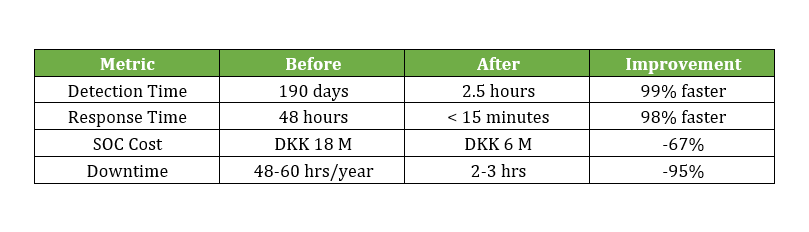
Each avoided ransomware incident (average DKK 40–70 M loss) pays for the platform for a decade.
Denmark’s transformation from the 2017 Maersk crisis to today’s AI-driven security renaissance proves that cyber defense is national infrastructure.
A single breach can ripple through shipping lanes, wind grids, and pharmaceutical supply chains – impacting GDP itself.
Seceon’s Open Threat Management Platform empowers Danish enterprises to move from reactive detection to predictive, automated resilience – unifying compliance, visibility, and AI-driven defense under one roof.