
State, Local, Tribal, and Territorial (SLTT) governments operate the systems that keep American society functioning: 911 dispatch centers, water treatment plants, transportation networks, court systems, and public benefits portals. When these digital systems are compromised, the impact is immediate and physical. Citizens cannot call for help, renew licenses, access healthcare, or receive social services.
Yet these agencies now face a widening gap.They are battling nation-state level cyber threats while working with some of the smallest budgets, leanest teams, and most outdated infrastructure in the country.
This blog examines the state of SLTT cybersecurity today and explains why unified, AI-driven platforms like Seceon’s aiSIEM, aiXDR, and SOAR are becoming essential for resilience in the public sector.
A Threat Landscape Defined by High Stakes and Limited Resources
SLTT governments are essential to national critical infrastructure, yet they remain deeply vulnerable. The cyber threat environment between 2024 and 2025 is shaped by four major issues.
Ransomware continues to be the most damaging threat to SLTT agencies. Attackers know that local governments cannot afford downtime. A successful attack can disrupt:
A major shift is also taking place. Attackers are increasingly targeting Operational Technology such as pumps, industrial controllers, and water treatment devices. Disrupting these systems instantly puts pressure on leaders to pay ransoms because the consequences are so visible to the public.
SLTT government networks are not centralized. They are sprawling collections of:
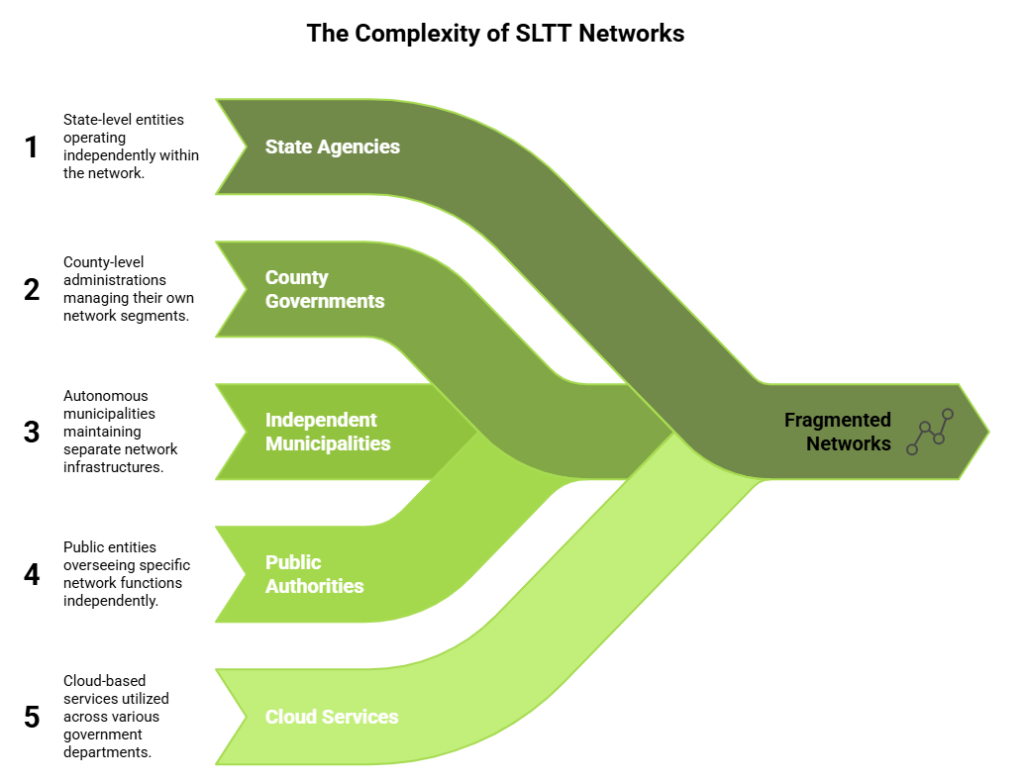
Most state CISOs do not have full visibility or control over every connected environment. A single small-town network with weak security often becomes the entry point that attackers use to move laterally into statewide databases such as DMV systems or voter registration logs.
Lack of unified oversight is one of the most exploited weaknesses in U.S. government cybersecurity.
SLTT governments cannot match private sector salaries for cybersecurity professionals. As a result:
Meanwhile, attackers are operating with automated and AI-generated attack chains capable of spreading in less than 48 minutes. Human-only defense cannot keep pace.
Many SLTT environments still run:
These systems usually:
They are mission critical, but they are also highly vulnerable.
Why Traditional Tools Are Failing SLTT Agencies
To keep up with rising threats, many SLTT organizations have accumulated separate tools such as SIEM, EDR, NDR, IDS, and SOAR platforms. Instead of solving the problem, this has often created:
SLTT agencies do not need more tools. They need clarity, automation, and a single platform that can reduce workload, connect signals, and stop attacks in real time.
How Seceon’s Unified Platform Addresses SLTT Cyber Realities
Seceon’s aiSIEM, aiXDR, and SOAR platform delivers a unified, AI-driven approach that fits the needs of public sector environments with limited staff, fragmented networks, hybrid IT and OT systems, and legacy infrastructure.
Here are the primary reasons SLTT governments are adopting Seceon rapidly.
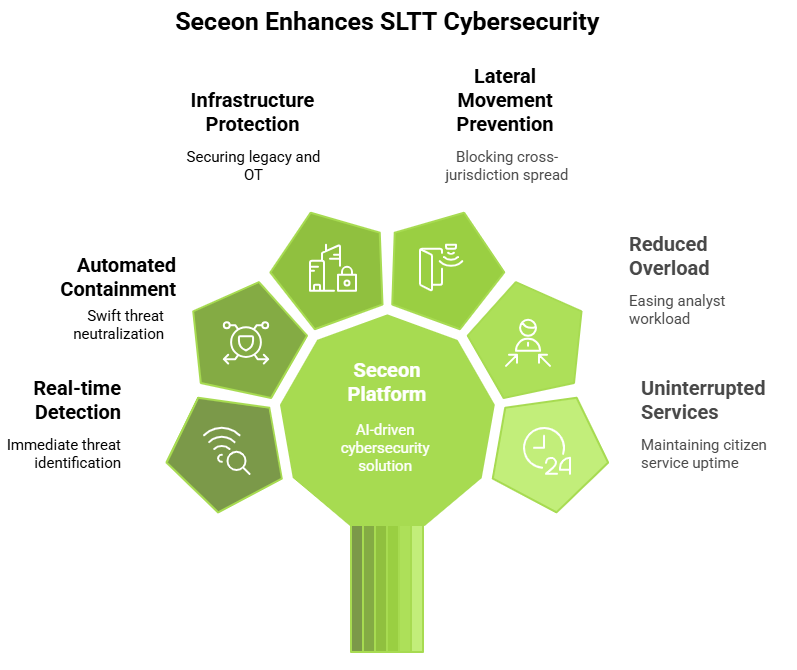
A county with a three-person IT team cannot maintain a 24 hour security operations center. Seceon fills that gap with an always-on AI engine that:
If ransomware executes at 2 AM, Seceon isolates and blocks the threat immediately without waiting for a human analyst.
This reduces burnout and transforms small teams into effective defenders.
SLTT agencies rely heavily on devices and systems that cannot support modern endpoint detection. Seceon addresses this with:
These capabilities allow monitoring of:
If an industrial controller begins communicating with an unusual destination, Seceon detects and alerts instantly without requiring software agents.
Seceon ingests signals from:
It correlates these into a single pane of glass, giving leaders the first unified view across all jurisdictions.
This eliminates the lateral movement blind spots that attackers commonly exploit.
SLTT budgets are tight, and procurement cycles are long. Seceon reduces operational and financial burden by consolidating:
into one platform with one license and one interface.
This provides:
For agencies funded by taxpayers, this consolidation is a major advantage.
SLTT governments are facing one of the most intense threat landscapes in their history. But with unified, AI-driven platforms like Seceon, they can finally:
Cybersecurity has become inseparable from public safety and operational continuity. A unified platform approach is now essential.
As threats accelerate, Seceon delivers the automation and intelligence SLTT agencies need to safeguard the services millions of Americans depend on every day.
