
Automated Threat Response

Automated Threat Response

Cyberattacks are becoming more sophisticated, frequent, and damaging than ever before. Organizations today face ransomware attacks, phishing campaigns, insider threats, advanced persistent threats (APTs), credential theft, cloud security breaches, and zero-day exploits on a daily basis. While security teams work tirelessly to protect critical assets, the sheer volume of security alerts often overwhelms analysts and slows incident response efforts.

The challenge is simple: attackers operate at machine speed, while many organizations still rely on manual processes to investigate and respond to threats.

This is where Automated Threat Response (ATR) becomes a game-changing cybersecurity capability.

Automated Threat Response enables organizations to detect, investigate, contain, and remediate cyber threats in real time without requiring constant human intervention. By leveraging Artificial Intelligence (AI), Machine Learning (ML), Security Orchestration, Automation, and Response (SOAR), Security Information and Event Management (SIEM), and Extended Detection and Response (XDR), organizations can significantly reduce response times and stop cyberattacks before they cause major damage.

Modern cybersecurity platforms are increasingly integrating AI-driven threat detection and automated remediation capabilities to eliminate manual bottlenecks and improve security operations efficiency. Seceon’s Open Threat Management (OTM) platform, for example, combines SIEM, SOAR, XDR, UEBA, and threat intelligence to deliver automated threat detection, containment, and response from a unified platform.

This guide explores Automated Threat Response, its benefits, key technologies, challenges, best practices, and why it has become a critical component of modern cybersecurity strategies.

What Is Automated Threat Response?

Automated Threat Response is the process of using technology-driven workflows, intelligence, analytics, and predefined security actions to automatically identify, investigate, and mitigate cyber threats.

Instead of requiring security analysts to manually review every alert and determine an appropriate response, automated systems can immediately execute actions based on predefined policies and threat intelligence.

These actions may include:

  • Blocking malicious IP addresses
  • Isolating compromised endpoints
  • Disabling compromised user accounts
  • Terminating suspicious processes
  • Updating firewall rules
  • Quarantining infected devices
  • Launching investigation workflows
  • Triggering incident response playbooks

The goal is to minimize the time between threat detection and remediation.

Why Automated Threat Response Is Critical

Cybercriminals are increasingly leveraging automation to conduct attacks at scale. Organizations that rely solely on manual response processes often struggle to keep pace.

The Growing Volume of Security Alerts

Security Operations Centers (SOCs) process thousands of alerts daily.

Many security teams experience:

  • Alert fatigue
  • Limited staffing
  • Investigation delays
  • Missed threats
  • Long response times

Automated response helps eliminate repetitive manual tasks and allows analysts to focus on high-priority incidents.

Faster Threat Containment

The average cyberattack can spread across an organization’s environment within minutes.

Manual investigations may take hours or even days.

Automated response enables organizations to:

  • Detect attacks immediately
  • Contain threats instantly
  • Reduce attacker dwell time
  • Prevent lateral movement

This significantly reduces potential damage.

Improved Security Efficiency

Security teams can automate routine response activities while maintaining consistency and accuracy.

This results in:
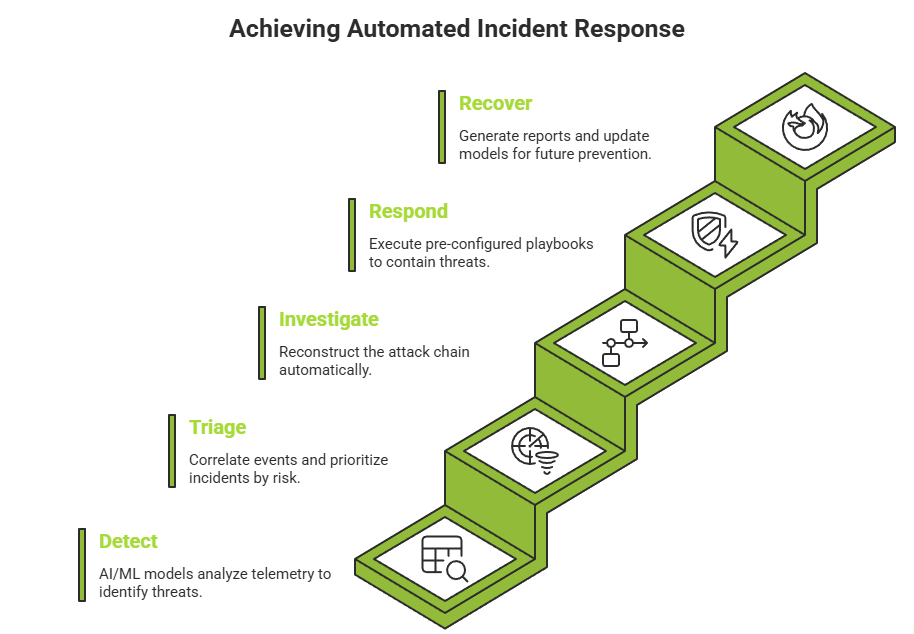
  • Lower operational costs
  • Reduced workload
  • Increased productivity
  • Faster incident resolution

response

How Automated Threat Response Works

Automated Threat Response involves several interconnected stages.

Step 1: Data Collection

Security systems continuously collect telemetry from:

  • Endpoints
  • Servers
  • Cloud environments
  • Firewalls
  • Applications
  • Network devices
  • Identity systems
  • Email platforms

This data provides visibility into organizational activity.

Step 2: Threat Detection

AI-powered analytics identify suspicious behavior.

Detection methods include:

  • Signature-based detection
  • Behavioral analytics
  • Threat intelligence correlation
  • Machine learning anomaly detection
  • User and Entity Behavior Analytics (UEBA)

Modern platforms use AI and machine learning to identify threats in real time and reduce false positives.

Step 3: Threat Investigation

Automated systems enrich alerts with context, including:

  • User information
  • Device details
  • Network activity
  • Historical behavior
  • Threat intelligence data

This accelerates decision-making.

Step 4: Automated Response

Once a threat is confirmed, automated playbooks execute predefined actions.

Examples include:

  • Endpoint isolation
  • Account lockout
  • Malware removal
  • Network segmentation
  • Ticket creation
  • Compliance notifications

Step 5: Continuous Monitoring

Security platforms continue monitoring systems to verify that remediation actions were successful.

Key Technologies Behind Automated Threat Response

Security Information and Event Management (SIEM)

SIEM platforms aggregate logs and events from across the organization.

SIEM provides:

  • Real-time monitoring
  • Event correlation
  • Security analytics
  • Centralized visibility

AI-driven SIEM solutions enhance threat detection accuracy while reducing alert noise.

Security Orchestration, Automation, and Response (SOAR)

SOAR serves as the foundation of automated response.

SOAR platforms:

  • Automate workflows
  • Execute playbooks
  • Coordinate response actions
  • Integrate security tools

Research shows SOAR systems automate security activities through predefined playbooks and orchestration processes that accelerate incident response.

Extended Detection and Response (XDR)

XDR provides visibility across:

  • Endpoints
  • Networks
  • Cloud services
  • Applications
  • Identities

XDR enables more effective automated response by correlating security data across multiple environments.

User and Entity Behavior Analytics (UEBA)

UEBA identifies suspicious activity by analyzing user and system behavior.

Common use cases include:

  • Insider threats
  • Account compromise
  • Privilege abuse
  • Lateral movement detection

Threat Intelligence

Threat intelligence feeds provide:

  • Known malicious IPs
  • Malware indicators
  • Threat actor activity
  • Emerging attack techniques

This intelligence improves automated decision-making.

Benefits of Automated Threat Response

Reduced Mean Time to Detect (MTTD)

Organizations can identify threats faster through continuous monitoring and automated analytics.

Reduced Mean Time to Respond (MTTR)

Automated response actions significantly shorten remediation timelines.

Lower Security Costs

Automation reduces reliance on large security teams and repetitive manual processes.

Enhanced Threat Accuracy

Machine learning models continuously improve detection capabilities.

Improved Compliance

Automated logging and reporting support compliance requirements such as:

  • GDPR
  • HIPAA
  • PCI-DSS
  • NIST
  • ISO 27001

Reduced Alert Fatigue

Automation filters and prioritizes alerts, allowing analysts to focus on critical incidents.

Organizations using AI-driven platforms often report improved visibility, lower alert noise, and more efficient security operations.

Common Use Cases for Automated Threat Response

Ransomware Prevention

Automated systems can:

  • Detect encryption activity
  • Isolate infected endpoints
  • Block command-and-control communications

Before ransomware spreads.

Phishing Attack Mitigation

Automated response can:

  • Remove malicious emails
  • Block phishing domains
  • Disable compromised accounts

Insider Threat Detection

Behavioral analytics can identify:

  • Unusual access patterns
  • Data exfiltration attempts
  • Privilege misuse

Cloud Security Protection

Automated controls can:

  • Detect misconfigurations
  • Identify unauthorized access
  • Enforce security policies

Credential Theft Prevention

Systems can:

  • Detect abnormal login activity
  • Trigger multifactor authentication
  • Lock compromised accounts

Challenges of Automated Threat Response

Despite its advantages, organizations must address several challenges.

False Positives

Poorly tuned automation may trigger unnecessary actions.

Organizations should continuously refine detection policies.

Integration Complexity

Many businesses use multiple security tools that must work together effectively.

Lack of Visibility

Incomplete visibility can lead to inaccurate response actions.

Skills Gaps

Security teams need expertise in automation design and workflow management.

Evolving Threats

Attackers continuously adapt their techniques to evade detection.

Best Practices for Implementing Automated Threat Response

Start with High-Confidence Use Cases

Begin automation with scenarios such as:

  • Malware containment
  • Credential compromise
  • Known threat intelligence matches

Define Clear Playbooks

Document response procedures for common incidents.

Integrate Threat Intelligence

Enhance decision-making with real-time threat intelligence feeds.

Leverage AI and Machine Learning

Use advanced analytics to improve detection accuracy.

Continuously Test and Optimize

Regularly review workflows and response outcomes.

Maintain Human Oversight

Automation should support analysts, not replace them entirely.

The Role of AI in Automated Threat Response

Artificial Intelligence has become a cornerstone of modern cybersecurity.

AI enables:

Real-Time Threat Analysis

Millions of security events can be analyzed simultaneously.

Predictive Threat Detection

AI identifies suspicious patterns before attacks occur.

Intelligent Response Decisions

Machine learning models recommend or execute optimal response actions.

Adaptive Security

AI continuously learns from new threats and attack behaviors.

Platforms utilizing AI, Machine Learning, and Dynamic Threat Models help organizations proactively identify threats and automate remediation with greater precision.

How Seceon Enables Automated Threat Response

Organizations seeking comprehensive automated threat response capabilities require a platform that unifies visibility, detection, investigation, and remediation.

Seceon’s Open Threat Management (OTM) Platform delivers:

  • AI-powered threat detection
  • Automated threat containment
  • Unified SIEM, SOAR, and XDR
  • User and Entity Behavior Analytics (UEBA)
  • Threat intelligence integration
  • Cloud and hybrid environment visibility
  • Continuous compliance monitoring
  • Automated remediation workflows

The platform is designed to ingest telemetry across endpoints, networks, cloud environments, applications, and identities while providing proactive detection and automated stopping of cyber threats. It consolidates numerous security capabilities into a single platform and automates threat response through built-in playbooks and AI-driven analytics.

Seceon’s AI-driven approach enables organizations to:

  • Reduce response times
  • Eliminate security silos
  • Improve SOC efficiency
  • Minimize alert fatigue
  • Enhance cybersecurity posture

The Future of Automated Threat Response

Cybersecurity is rapidly moving toward autonomous security operations.

Future innovations include:

  • Autonomous SOCs
  • AI-generated response playbooks
  • Predictive threat intelligence
  • Self-healing security systems
  • Zero Trust automation
  • Advanced behavioral analytics
  • Automated compliance enforcement

As attack surfaces continue to expand, organizations will increasingly depend on automated threat response technologies to maintain resilience against emerging cyber threats.

Frequently Asked Questions (FAQs)

1. What is Automated Threat Response in cybersecurity?

Automated Threat Response (ATR) is a cybersecurity process that automatically detects, investigates, and responds to security threats without requiring extensive manual intervention. It uses technologies such as Artificial Intelligence (AI), Machine Learning (ML), Security Orchestration, Automation, and Response (SOAR), and Extended Detection and Response (XDR) to identify and contain threats in real time.

2. Why is Automated Threat Response important?

Automated Threat Response is important because cyberattacks can spread within minutes, while manual investigations often take hours or days. Automation helps organizations reduce response times, minimize security risks, prevent data breaches, and improve overall cybersecurity efficiency.

3. How does Automated Threat Response work?

Automated Threat Response works by collecting security data from endpoints, networks, cloud environments, applications, and users. Advanced analytics and threat intelligence identify suspicious activities, while predefined response playbooks automatically execute actions such as isolating devices, blocking malicious IP addresses, or disabling compromised accounts.

4. What is the difference between threat detection and threat response?

Threat detection focuses on identifying potential security threats and suspicious activities within an environment. Threat response involves taking action to contain, investigate, and remediate those threats. Automated Threat Response combines both processes to provide faster and more effective cybersecurity protection.

5. What technologies are used in Automated Threat Response?

Several cybersecurity technologies support Automated Threat Response, including:

  • Security Information and Event Management (SIEM)
  • Security Orchestration, Automation, and Response (SOAR)
  • Extended Detection and Response (XDR)
  • User and Entity Behavior Analytics (UEBA)
  • Threat Intelligence Platforms
  • Artificial Intelligence (AI)
  • Machine Learning (ML)

Together, these technologies help organizations identify, prioritize, and mitigate cyber threats automatically.

6. Can Automated Threat Response stop ransomware attacks?

Yes. Automated Threat Response can help detect ransomware behavior, isolate infected endpoints, block malicious communications, and prevent ransomware from spreading across the network. Early detection and automated containment significantly reduce the impact of ransomware attacks.

7. How does AI improve Automated Threat Response?

AI improves Automated Threat Response by analyzing large volumes of security data in real time, identifying anomalies, reducing false positives, and enabling faster decision-making. Machine learning algorithms continuously learn from new attack patterns, improving detection accuracy and response effectiveness.

8. What are the benefits of Automated Threat Response?

Key benefits include:

  • Faster threat detection and containment
  • Reduced Mean Time to Detect (MTTD)
  • Reduced Mean Time to Respond (MTTR)
  • Lower security operations costs
  • Reduced alert fatigue
  • Improved compliance reporting
  • Enhanced protection against advanced cyber threats

9. Is Automated Threat Response suitable for small and mid-sized businesses?

Yes. Automated Threat Response solutions help small and mid-sized businesses strengthen their cybersecurity defenses without requiring large security teams. Automation allows organizations with limited resources to respond to threats quickly and efficiently.

10. How does Seceon support Automated Threat Response?

Seceon’s Open Threat Management (OTM) Platform combines AI-powered threat detection, SIEM, SOAR, XDR, UEBA, and threat intelligence into a unified cybersecurity solution. The platform automates threat investigation, containment, and remediation, helping organizations improve security operations and reduce cyber risk.

11. What is the role of SOAR in Automated Threat Response?

SOAR (Security Orchestration, Automation, and Response) plays a central role in Automated Threat Response by automating workflows, coordinating security tools, and executing predefined response actions. This helps security teams respond to incidents more efficiently and consistently.

12. What is the future of Automated Threat Response?

The future of Automated Threat Response includes autonomous security operations, AI-driven threat hunting, predictive threat intelligence, self-healing systems, and advanced behavioral analytics. These innovations will enable organizations to proactively defend against increasingly sophisticated cyber threats.

Conclusion

Automated Threat Response is transforming cybersecurity by enabling organizations to detect, investigate, contain, and remediate threats in real time.

As cyberattacks become faster and more sophisticated, manual response processes are no longer sufficient. Organizations need intelligent, automated solutions capable of responding at machine speed while maintaining accuracy and control.

By integrating AI, Machine Learning, SIEM, SOAR, XDR, UEBA, and threat intelligence, automated threat response reduces risk, improves operational efficiency, lowers security costs, and strengthens overall cyber resilience.

Organizations that embrace automated threat response today will be better prepared to defend against tomorrow’s cyber threats while ensuring continuous protection, compliance, and business continuity.


Footer-for-Blogs-3

Leave a Reply

Your email address will not be published. Required fields are marked *

Categories

Seceon Inc