
As organizations increasingly rely on cloud storage for hosting applications, software packages, updates, and static assets, attackers are finding new ways to exploit abandoned or misconfigured cloud resources.
New reporting from Cybersecurity News highlights a growing bucket hijacking attack, where threat actors take control of deleted or unclaimed cloud storage buckets that are still referenced by active applications and websites.
Unlike traditional cloud attacks that exploit software vulnerabilities, bucket hijacking abuses poor cloud resource management, turning trusted storage locations into malware distribution or phishing infrastructure.
Cloud storage buckets are commonly used to host:
When a bucket is deleted but applications continue referencing it, attackers can register the same bucket name and begin serving malicious content from what appears to be a trusted source.
Because the application still points to the original bucket name, users and systems unknowingly retrieve attacker-controlled content.
According to the report, bucket hijacking exploits orphaned cloud storage references rather than vulnerabilities in cloud platforms themselves.
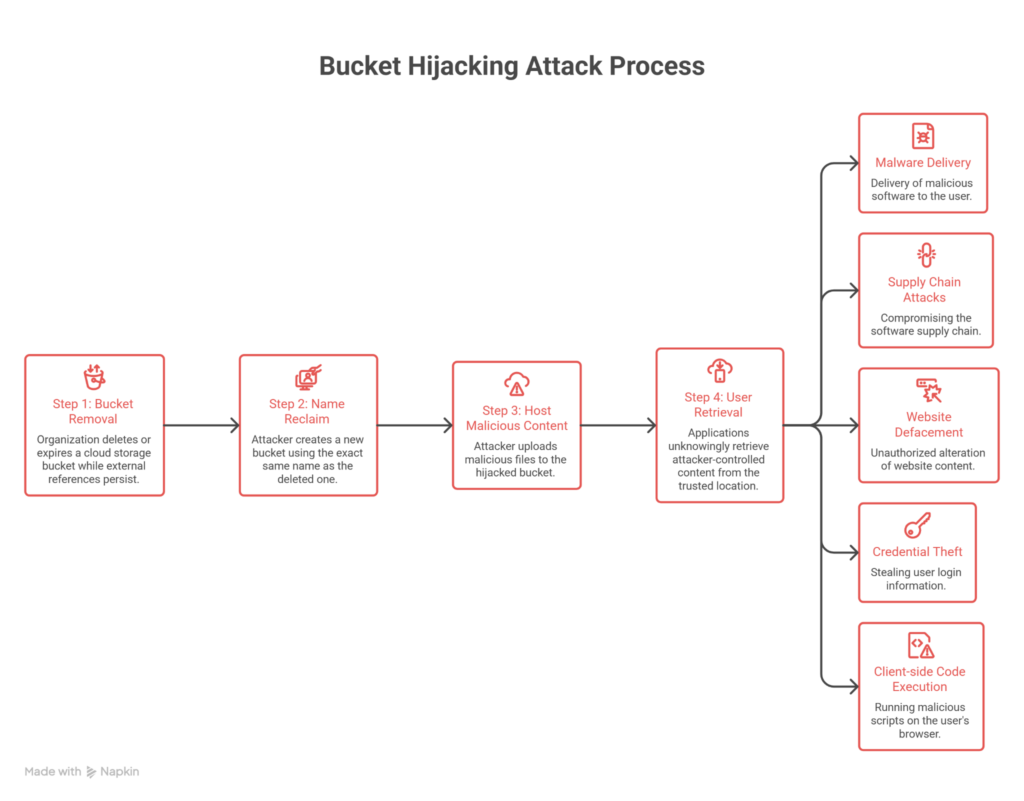
An organization deletes a cloud storage bucket or allows it to expire.
However, applications, websites, scripts, or software updates continue referencing that bucket.
Once the bucket name becomes available, an attacker creates a new bucket using the exact same name.
Since cloud storage providers often allow previously deleted bucket names to be reused, the attacker effectively assumes ownership of the resource.
The attacker uploads malicious content to the hijacked bucket.
Depending on what the original bucket served, this may include:
Applications requesting those resources unknowingly retrieve attacker-controlled content.
Because applications continue trusting the original bucket location, users receive malicious resources without realizing the source has changed.
This creates opportunities for:
The attack succeeds by exploiting trust rather than software vulnerabilities.
Bucket hijacking presents a unique challenge because the infrastructure itself appears legitimate.
Several characteristics contribute to its effectiveness:
This makes the attack difficult to detect using vulnerability scanners alone.
The rise of bucket hijacking demonstrates that cloud security extends beyond configuration and access controls.
Organizations must also maintain visibility into:
Without continuous governance, abandoned resources can become unexpected attack vectors.
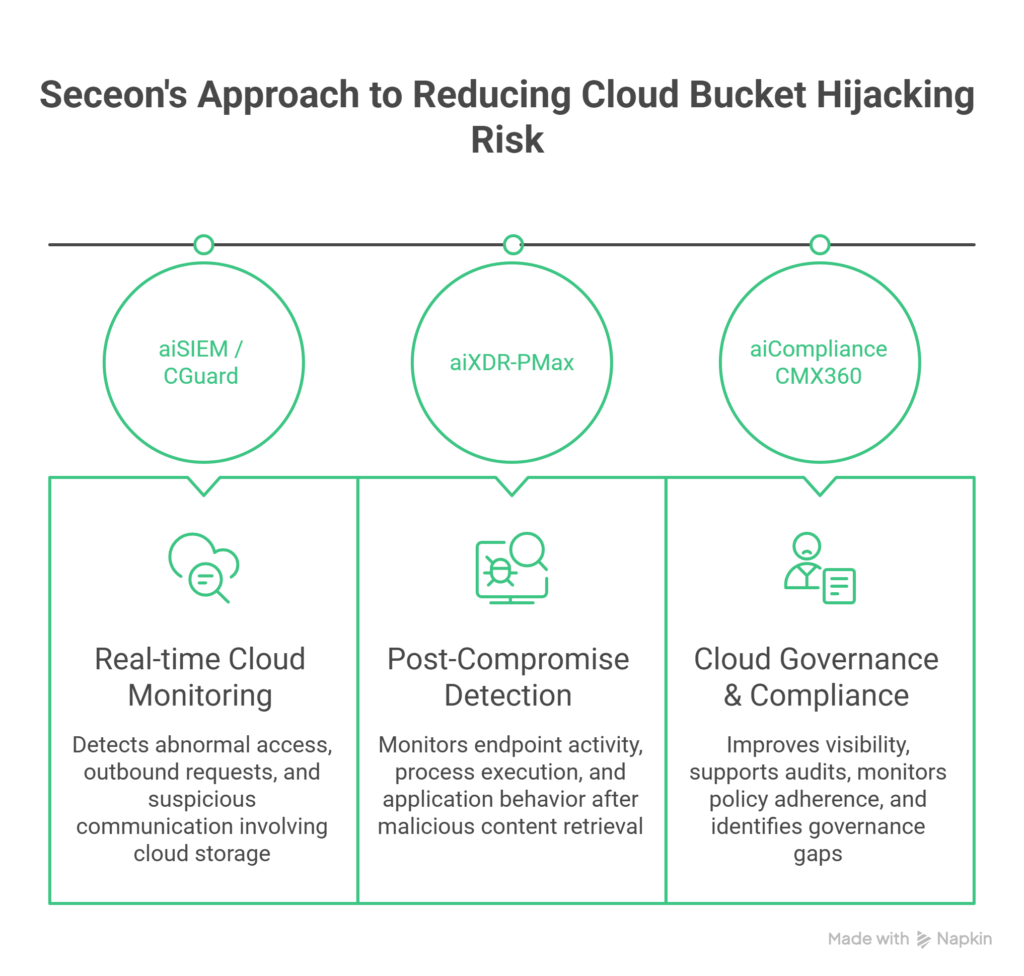
Preventing bucket hijacking requires visibility into cloud assets, outbound communication, application behavior, and security governance.
Seceon’s aiSIEM / CGuard helps organizations:
By correlating cloud activity across users, applications, and infrastructure, Seceon helps uncover suspicious behavior that may indicate cloud resource abuse.
Seceon’s aiXDR-PMax provides visibility into:
This enables organizations to detect attacks even after malicious resources are delivered.
Cloud asset governance plays an important role in preventing bucket hijacking.
Seceon’s aiCompliance CMX360 helps organizations:
Maintaining governance over cloud resources reduces the likelihood of orphaned assets becoming attack vectors.
Bucket hijacking demonstrates that not every cyberattack begins with exploiting a vulnerability. Sometimes, attackers simply wait for organizations to abandon resources that are still trusted by applications and users.
As cloud adoption continues to grow, managing the lifecycle of cloud assets becomes just as important as securing them.
Organizations should regularly audit cloud storage references, remove unused dependencies, and continuously monitor cloud environments for signs of resource abuse.
In today’s cloud-first world, maintaining trust requires more than securing active infrastructure. It also means ensuring that forgotten resources cannot become tomorrow’s attack surface.