Ransomware has evolved into one of the most damaging cyber threats facing modern enterprises. Today’s ransomware groups use advanced tactics such as credential compromise, lateral movement, data exfiltration, and double-extortion strategies to maximize operational and financial impact.
Organizations across industries continue to face increasing pressure from sophisticated ransomware campaigns targeting hybrid environments, cloud workloads, remote users, and connected devices. As enterprise infrastructures become more complex, attackers are exploiting visibility gaps and fragmented security operations to remain undetected for longer periods.
The focus for security teams is no longer just recovery after an attack. Modern enterprises require proactive cybersecurity strategies built around early threat detection, continuous monitoring, AI-driven analytics, and automated response capabilities to reduce ransomware risk and maintain operational resilience.
Modern ransomware attacks are rarely random. Threat actors carefully plan intrusions, identify weak points, escalate privileges, and move laterally across environments before launching encryption payloads.
Many organizations still rely on fragmented security infrastructures that generate isolated alerts without proper correlation. This creates visibility gaps that attackers exploit to remain undetected for extended periods.
At the same time, enterprise environments have become significantly more complex due to:
These changes make it difficult for traditional security models to detect ransomware activity early enough to prevent disruption.
Modern ransomware operators also use advanced techniques such as:
Organizations that fail to identify suspicious activity during the early stages of compromise often face larger operational, financial, and reputational consequences.
Compromised credentials remain one of the leading causes of ransomware breaches.
Attackers frequently target privileged accounts because they provide broader access to critical systems, backup infrastructure, and sensitive enterprise data.
Implementing strong identity security controls helps organizations significantly reduce unauthorized access risks.
Key measures include enforcing multi-factor authentication (MFA), limiting excessive user privileges, removing inactive accounts, and continuously monitoring authentication activity for suspicious behavior.
Organizations should also adopt Zero Trust principles that continuously verify users and devices rather than automatically trusting internal network activity.
This approach helps restrict lateral movement and limits the spread of ransomware inside enterprise environments.
Traditional signature-based security solutions struggle to detect modern ransomware variants that constantly evolve to evade detection.
AI-driven cybersecurity technologies provide stronger detection capabilities by analyzing behavior patterns across massive volumes of telemetry data.
Instead of relying solely on known attack signatures, behavioral analytics identify abnormal activity such as:
AI-powered analytics also help reduce false positives and improve alert prioritization, enabling SOC teams to focus on high-risk incidents faster.
This significantly improves mean time to detect (MTTD) and helps organizations respond to ransomware threats before encryption occurs.
Speed is critical during a ransomware attack.
Manual investigations often slow down containment efforts and allow attackers additional time to move across the environment.
Organizations should implement automated response workflows that can immediately isolate compromised endpoints, block malicious connections, disable suspicious accounts, and escalate critical incidents.
Automation helps reduce attacker dwell time while improving operational efficiency for security teams.
It also minimizes the burden on analysts who are already dealing with growing alert volumes and increasingly sophisticated threats.
Even with strong preventive controls, organizations must be prepared for worst-case scenarios.
A reliable backup and recovery strategy remains one of the most important components of ransomware resilience.
Backups should be protected using immutable storage, offline copies, and strict access controls to prevent attackers from tampering with recovery systems.
Organizations should also routinely test recovery procedures to ensure business continuity during real-world incidents.
Strong recovery readiness reduces downtime, minimizes operational disruption, and helps organizations avoid paying ransom demands.
Unpatched vulnerabilities continue to serve as major ransomware entry points.
Threat actors actively scan for exposed systems, outdated software, and vulnerable internet-facing applications that can be exploited for initial access.
Continuous vulnerability management helps organizations reduce their attack surface by identifying and remediating critical weaknesses before attackers can exploit them.
Security teams should prioritize vulnerabilities based on exploitability, business impact, and exposure risk rather than relying solely on static severity scores.
Organizations should also continuously assess cloud configurations, remote access infrastructure, and third-party integrations for security weaknesses.
Phishing remains one of the most effective ransomware delivery mechanisms.
Attackers increasingly use realistic social engineering techniques and AI-generated phishing content to deceive employees into opening malicious attachments or revealing credentials.
Security awareness training should become an ongoing initiative rather than a one-time exercise.
Employees should understand how to identify suspicious emails, malicious links, impersonation attempts, and unsafe browsing behavior.
At the same time, organizations should deploy advanced email security controls capable of blocking malicious attachments, sandboxing suspicious files, and filtering harmful URLs before they reach users.
Human awareness combined with strong email security significantly reduces ransomware exposure.
Modern enterprises operate across highly distributed environments that generate enormous volumes of security telemetry.
Managing security operations using disconnected tools often creates operational inefficiencies, delayed investigations, and incomplete threat visibility.
Unified cybersecurity platforms help organizations centralize threat detection, investigation, response, and analytics within a single operational framework.
This improves:
Unified operations also help organizations reduce alert fatigue while improving their ability to identify advanced ransomware activity earlier in the attack lifecycle.
Modern ransomware attacks move quickly, spread across environments, and often evade traditional security controls before organizations can respond effectively. To defend against these evolving threats, enterprises need continuous visibility, intelligent threat detection, and automated response capabilities that work across the entire attack surface.
Seceon helps organizations proactively detect and prevent ransomware through AI-driven analytics, real-time threat correlation, and unified security operations designed for hybrid and multi-cloud environments.
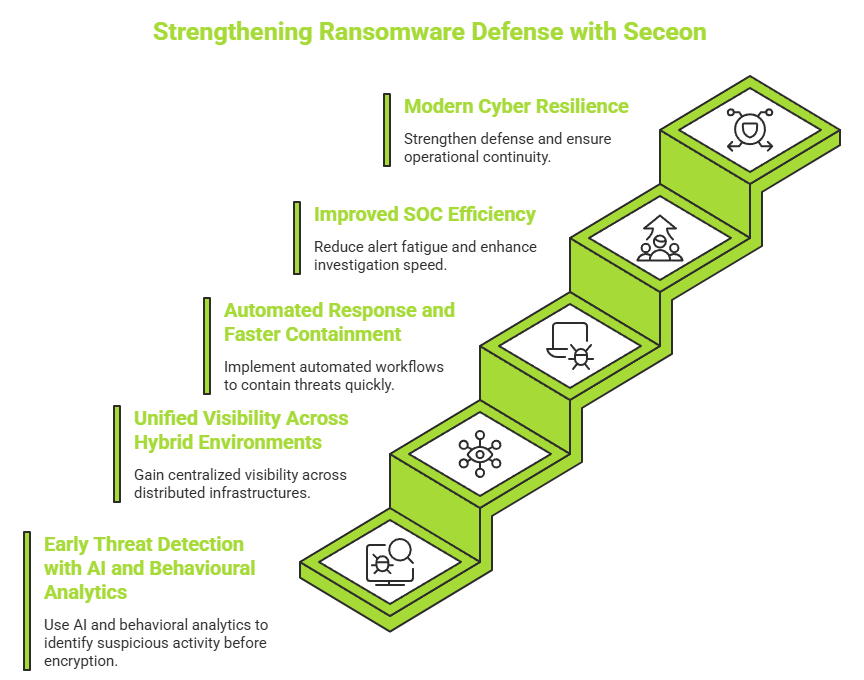
Seceon uses advanced behavioral analytics and machine learning to identify suspicious activity associated with ransomware attacks before encryption begins. By continuously analyzing authentication behavior, endpoint activity, network traffic, and user behavior, the platform helps organizations detect credential compromise, lateral movement, privilege escalation attempts, malicious PowerShell execution, and abnormal endpoint activity in real time.
Through intelligent threat correlation across multiple security layers, Seceon enables security teams to detect threats earlier and reduce attacker dwell time.
Modern enterprises operate across distributed infrastructures that include cloud workloads, remote users, SaaS applications, branch locations, and connected devices. Seceon delivers centralized visibility across endpoints, networks, cloud environments, identity systems, and remote infrastructures through a unified operational platform.
This centralized approach helps eliminate visibility gaps, simplify investigations, and improve overall incident response efficiency.
Speed is critical during ransomware incidents. Seceon helps organizations accelerate containment through automated response workflows capable of isolating compromised endpoints, blocking malicious communications, disabling suspicious accounts, and prioritizing critical incidents in real time.
Automation reduces operational overhead for SOC teams while minimizing the impact of ransomware attacks across business-critical systems.
Security teams often struggle with overwhelming alert volumes generated from disconnected security tools. Seceon reduces alert fatigue through intelligent threat correlation and AI-assisted analytics that prioritize high-risk incidents based on severity and behavioral context.
Instead of manually investigating isolated alerts, analysts gain actionable intelligence and centralized visibility that improves investigation speed and operational efficiency.
By combining AI-driven threat detection, automated response, and unified security operations within a single platform, Seceon helps organizations strengthen ransomware defense, improve operational continuity, and reduce cyber risk across today’s complex hybrid environments.
Ransomware continues to evolve into a more sophisticated and damaging threat for organizations worldwide. Defending against modern ransomware attacks requires more than traditional security tools – enterprises need proactive cybersecurity strategies built around continuous monitoring, AI-driven analytics, and automated response capabilities.
Organizations that invest in stronger identity protection, behavioral analytics, vulnerability management, and unified security operations are better positioned to detect threats early and reduce operational impact across hybrid environments.
Seceon helps enterprises modernize ransomware defense through AI-driven threat detection, centralized visibility, and automated response capabilities designed to improve cyber resilience and protect critical business operations from evolving threats.