
Linux powers everything from enterprise servers and cloud platforms to containerized workloads and critical infrastructure. While its security model is robust, vulnerabilities within the Linux kernel can have far-reaching consequences because they affect the operating system at its core.
New reporting from Cybersecurity News highlights a newly disclosed Bad Epoll zero-day vulnerability that allows attackers to achieve local privilege escalation on affected Linux systems.
The vulnerability demonstrates how attackers with limited access can potentially elevate their privileges, increasing the risk of complete system compromise.
Unlike remote exploits that focus on gaining initial access, privilege escalation vulnerabilities are designed to help attackers expand the access they already have.
An attacker who initially compromises a low-privileged account can use vulnerabilities like Bad Epoll to gain higher system privileges, opening the door to much more damaging activities.
Once elevated privileges are obtained, attackers may be able to:
For this reason, privilege escalation vulnerabilities are frequently combined with phishing attacks, stolen credentials, or other initial access techniques.
According to the report, the vulnerability resides within Linux’s epoll mechanism, a component used to efficiently monitor multiple file descriptors and handle I/O events.
The attack generally follows these stages:
The attacker first gains access to a Linux system through another attack vector such as compromised credentials, malware, or an exposed application.
At this stage, the attacker does not have administrative privileges.
The attacker abuses the flaw within the kernel’s epoll implementation to elevate privileges beyond the permissions originally assigned.
Instead of remaining a standard user, the exploit enables access to privileged system functions that would normally be restricted.
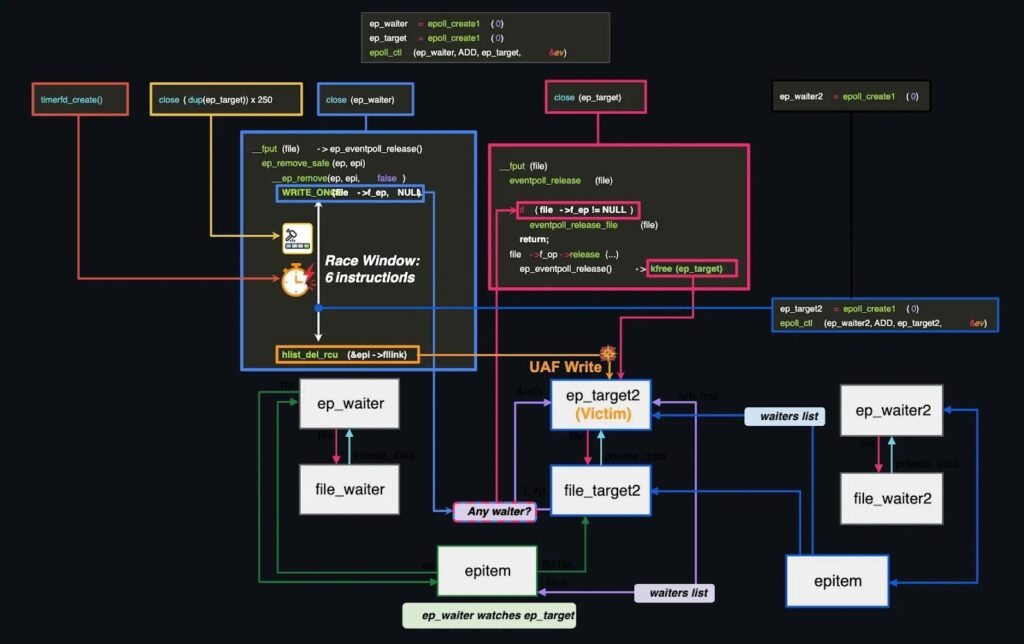
Bad Epoll Vulnerability Privilege Escalation (Source: Jaeyoung Chung)
After successful exploitation, the attacker can perform actions that require higher privileges.
Depending on the objective, this may include:
Privilege escalation transforms what might have been a limited compromise into a significantly more dangerous security incident.
Kernel-level exploitation often produces fewer obvious indicators than traditional malware.
Security teams face several challenges:
Normal-looking activity
Many exploitation steps resemble legitimate operating system behavior.
Short execution windows
Privilege escalation can occur very quickly after initial compromise.
Limited visibility
Traditional security tools may focus on user-space activity rather than kernel behavior.
Post-exploitation focus
Organizations often detect the consequences of elevated privileges instead of the exploitation itself.
Because of this, behavioral monitoring becomes essential for identifying suspicious activity before attackers fully establish control.
Bad Epoll reinforces an important cybersecurity principle.
Initial access is rarely the final objective.
Whether attackers enter through phishing, stolen credentials, vulnerable applications, or exposed services, privilege escalation is often the next step toward achieving complete control of a system.
Organizations should therefore focus not only on preventing intrusions but also on detecting unusual privilege changes, abnormal process behavior, and suspicious post-compromise activity.
While privilege escalation occurs at the operating system level, it still leaves behavioral indicators across endpoints, users, and system activity that can be correlated for early detection.
Seceon’s aiXDR-PMax helps security teams:
Behavior-based analytics help identify attacks even when exploit signatures are unavailable.
Seceon’s aiSIEM / CGuard provides centralized visibility by:
Rather than investigating isolated alerts, analysts gain a complete picture of how the attack progresses.
Organizations can use aiBAS360 to continuously validate their readiness against privilege escalation techniques by simulating:
This enables security teams to verify that defensive controls can detect and respond to attacks before they impact production systems.
The Bad Epoll zero-day highlights a critical reality of modern cyberattacks. Initial access is only the beginning.
Privilege escalation vulnerabilities allow attackers to transform limited access into complete control, making them one of the most valuable tools in an attacker’s arsenal.
For organizations running Linux workloads, continuous patching, behavioral monitoring, and rapid detection of abnormal privilege changes are essential to reducing risk.
As attackers continue targeting operating system internals, security strategies must evolve beyond perimeter defenses and focus on identifying suspicious behavior throughout the entire attack lifecycle.