Cybercriminals are no longer forcing their way through the front door. They’re walking through misconfigured cloud environments, compromised identities, exposed credentials, and unpatched systems to reach the data that matters most. Across healthcare, manufacturing, retail, government, and financial services, attackers increasingly prioritize long term data theft, operational disruption, and double-extortion over simple encryption attacks.
Ten major organizations across the globe were hit by significant cyber incidents in July 2026, exposing tens of millions of records and, in several cases, forcing operations offline entirely. The breaches ranged from dual ransomware attacks on a Fortune 500 pharmaceutical giant to a nationwide taxi network grinding to a halt.
Six of the ten incidents stemmed from an operational failure to isolate critical systems and enforce least-privilege access, rather than attackers relying on novel or highly sophisticated techniques.
July’s breach activity spanned ten organizations in eight countries, hitting industries with very different risk profiles from pharmaceutical manufacturing to municipal government. The scale varied widely: Abbott Laboratories alone saw more than 30 million records and over 1 million Social Security numbers exposed, while smaller incidents like the Town of Milford’s ransomware attack disrupted municipal services without a confirmed large-scale data loss.
What ties the incidents together is not the size of the target but the method of attack. Nearly every breach traced back to a handful of well-known, preventable weaknesses.
Rather than deploying novel zero-day exploits, most of July’s attackers relied on long-known weaknesses that continue to exist across enterprise environments, including:
These are not sophisticated nation-state techniques, they are gaps that continuous monitoring and identity governance are designed to close.
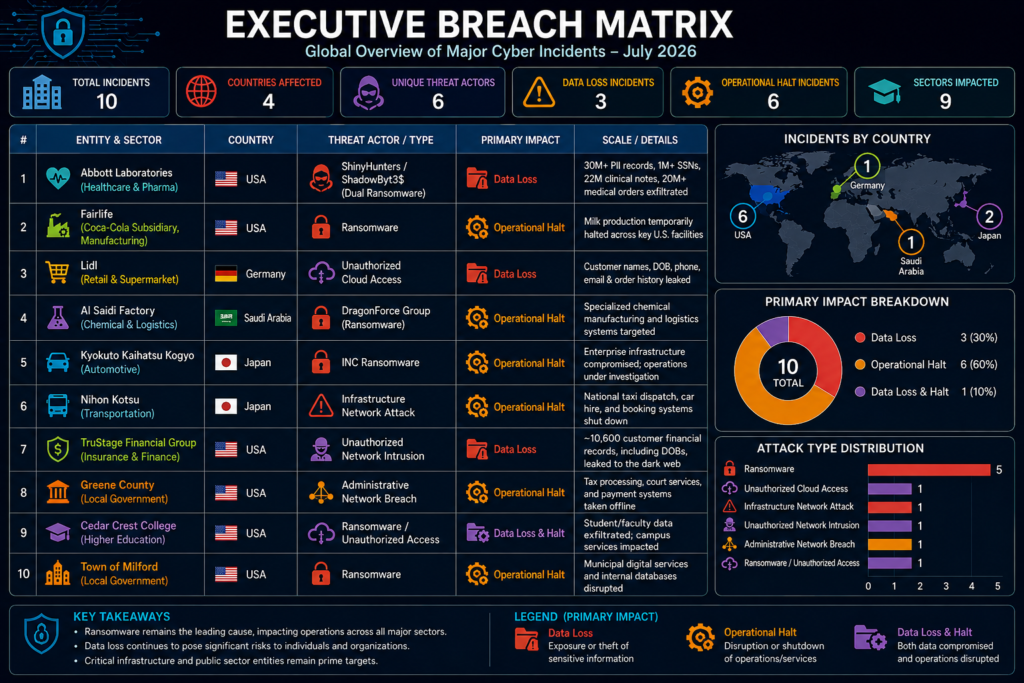
Each affected sector experienced a distinct pattern of attack and impact:
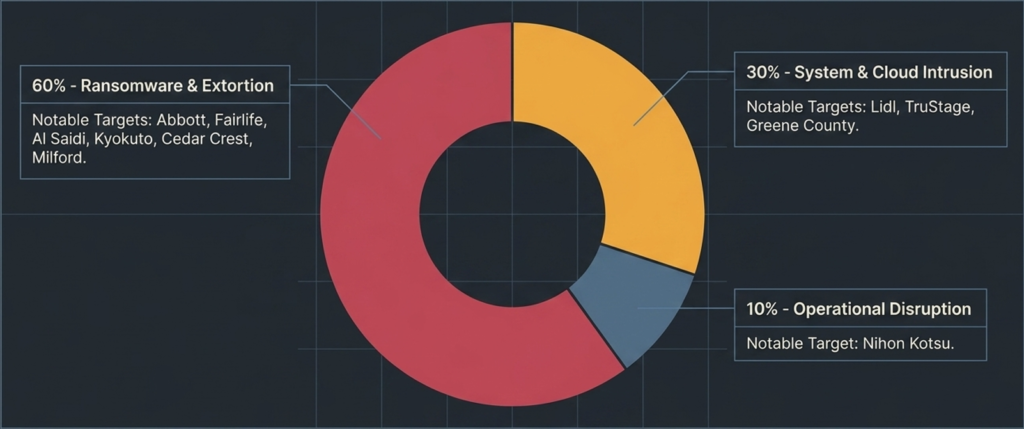
July’s breach activity reinforces a pattern that security leaders have watched build for several years now:
Seceon’s aiSIEM / CGuard helps organizations:
By correlating events from multiple security sources, organizations can identify suspicious activity before it develops into a full-scale breach.
Seceon’s aiXDR-PMax provides behavioral visibility across endpoints, identities, and cloud infrastructure by helping organizations:
Behavior-based analytics enable organizations to detect evolving ransomware and extortion techniques even when traditional signatures are unavailable.
Ten major incidents, six industries, six countries, and a single underlying story: attackers have moved past disruption for its own sake and toward long-term data theft, operational leverage, and double-extortion. Ransomware remains the headline threat, but cloud intrusion and infrastructure attacks are no longer the minority case; they’re 40% of the picture.
For security teams, the takeaway from July 2026 is straightforward: perimeter defense alone is no longer the finish line. The organizations that come through months like this intact are the ones correlating signals across their entire environment cloud, on-prem, and OT before an isolated alert becomes a double-extortion headline of their own. That is precisely the role Seceon’s OTM Platform is designed to play: unifying detection, correlation, and automated response so the next Abbott, Lidl, or Fairlife style incident is caught and contained long before it reaches this list.