
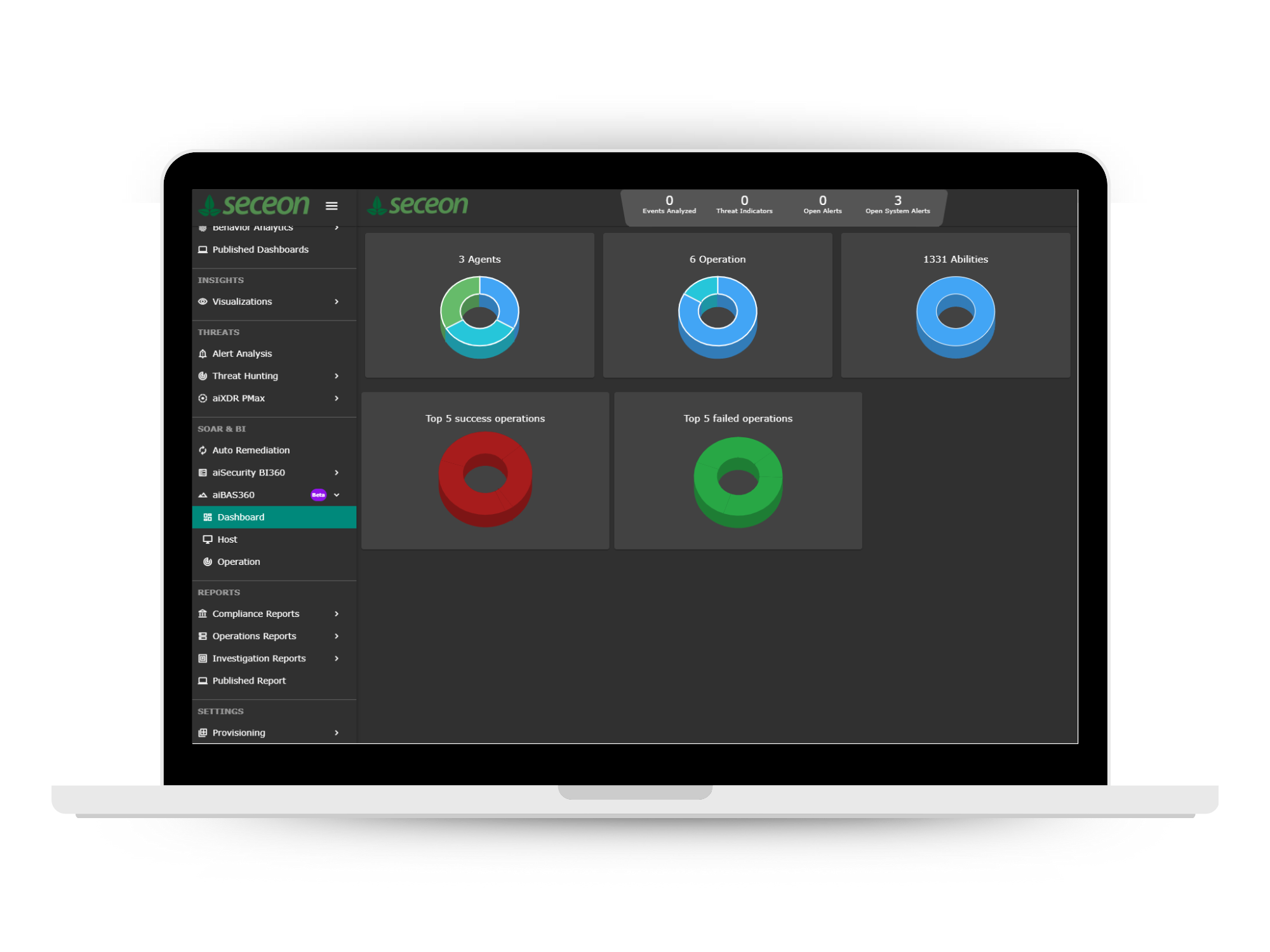

Pre-encryption detection
Catch it in the dwell-time window
Seceon identifies lateral movement, shadow copy deletion, credential harvesting and mass file staging before encryption begins, so containment can happen first.
Illustrative example.
Seceon’s aiXDR gives you and your organization the security and safety against ransomware attack that comes from accuracy, automation and versatility in threat detection. Under the hood, what really matters are the curated threat indicators and how those get rounded up with internal and external intelligence, followed by rapid remediation - real-time, notification driven and playbook based!
Book a demo
Ransomware detection alerts you the moment your files or digital information are attacked, and guides you through restoring them without damaging any data.
Ransomware is a type of malware designed to infect a computer and stay undetected until it achieves its objective. It then blocks access to your files until a digital ransom is paid.
Individuals, businesses or critical infrastructure, causing significant financial and operational damage.
Ryuk spreads via trojans like Emotet and can destroy backups to prevent recovery.
As ransomware evolves, strong cybersecurity measures are vital for everyone.
Behavioral detection spots the steps that come before encryption, and automated response contains the host in under 90 seconds.
Pre-encryption detection
Seceon identifies lateral movement, shadow copy deletion, credential harvesting and mass file staging before encryption begins, so containment can happen first.
Illustrative example.
Potential Ransomware alert
Suspicious process execution, rapid file modifications and encryption-related indicators.
Potential Ransomware in Progress alert
Rapid file renames, encryption-like writes, shadow copy manipulation and widespread access-denied errors.
Suspicious Email Attachment alert
Flags attachments commonly used to deliver ransomware, such as macro-enabled documents, password-protected archives and executables.
Threat intelligence
IOCs from 100+ sources, plus DGA prediction for malware families such as WannaCry
Automated response
aiXDR-PMax
Behavioral detection from day one, plus memory forensics for fileless techniques such as process injection and credential dumping.
Network and data
NDR exposes lateral movement and C2 traffic, while the Potential Data Exfiltration alert flags unusual outbound transfers.
aiBAS360
Continuously validates ransomware detection controls by simulating real-world attack techniques, aligned to MITRE ATT&CK.
Types of ransomware
Each brute force attack might utilize a variety of tactics to unearth confidential information. Any of the following common brute force techniques could be used against the intended victim:
Crypto RansomwareEncrypts the victim's files and demands a ransom in exchange for the decryption key, preventing access until payment is made.
Locker RansomwareBlocks the victim's system access without file encryption, showing a full-screen ransom message demanding payment for restoration.
Double ExtortionAttackers encrypt files and steal data, threatening to publish it if the ransom is not paid, increasing pressure.
RaaSEncrypts the victim's files, demanding ransom for the decryption key, restricting access until payment is made.
Ransomware attacks present several significant challenges for security teams. Select a challenge to see how it works.
Sophistication: Attackers use advanced techniques like zero-day exploits and AI, making detection and prevention difficult.
Double Extortion: Beyond encrypting files, attackers often steal data, threatening to leak it if the ransom isn’t paid.
Ethical Issues: Paying ransom funds criminal activity and may be illegal, with no guarantee of data recovery.
Service Disruption: Attacks on vital sectors like healthcare can endanger public safety and economic stability.
SME Vulnerability: Small businesses often lack the resources to implement robust cybersecurity measures.
Jurisdictional Challenges: Cross-border operations and cryptocurrency payments make it hard to track and prosecute attackers.
Lack of Awareness: Employee errors and insufficient training increase vulnerability to phishing and other attack vectors.
Rising Costs: Increased frequency of attacks drives up cybersecurity insurance premiums and financial losses from downtime and recovery.
Loss of Trust: Attacks can severely damage an organization’s reputation, leading to long-term business impacts.
Increased Accessibility: RaaS platforms enable even unskilled criminals to launch attacks, increasing the scale of incidents.
Learn how organizations identify ransomware early, detect suspicious behavior, contain attacks, and strengthen ransomware defenses with Seceon.
Organizations can look for early warning signs such as unusual file modifications, suspicious process execution, unexpected privilege escalation, abnormal data transfers, and unauthorized activity across endpoints. Correlating endpoint, network, and authentication events can help security teams recognize ransomware-related behavior before an attack progresses.
Seceon uses AI/ML-powered behavioral analytics and Dynamic Threat Modeling through its aiSIEM and aiXDR-PMax solutions to identify suspicious activity and support earlier investigation and response. Early detection depends on available telemetry and attack behavior; detection before encryption cannot be guaranteed.
Traditional antivirus commonly uses known malware signatures and other detection methods to identify malicious files. AI-powered ransomware detection can complement these controls by analyzing behavioral patterns, process activity, file operations, and related security events to identify suspicious activity associated with unfamiliar or modified threats.
Seceon combines machine learning-based behavioral analytics with AI-driven threat modeling in its aiSIEM and aiXDR solutions. This helps security teams correlate suspicious indicators and investigate potential ransomware attacks rather than relying exclusively on known signatures.
The immediate priority is to isolate affected endpoints and network segments where appropriate, block confirmed malicious communications, investigate compromised credentials, and prevent further lateral movement. Teams should also preserve relevant evidence and verify that backups are protected before beginning recovery.
Seceon aiXDR-PMax supports endpoint detection and response, while aiSIEM correlates security events to support investigation. Depending on integrations and configured response policies, Seceon can support containment actions such as endpoint isolation and blocking malicious activity. Response speed depends on the environment and incident.
Fileless ransomware techniques may misuse legitimate tools, scripts, or system memory, while lateral movement allows attackers to reach additional systems using compromised accounts or remote administration tools. Security teams should monitor process execution, authentication activity, privilege changes, and unusual connections between devices.
Seceon uses behavioral analytics and threat correlation through aiSIEM and aiXDR-PMax to help identify suspicious process activity and attack patterns across supported endpoints and other connected sources. This broader visibility can help analysts investigate related activity that individual alerts may not reveal.
Double-extortion attacks combine ransomware encryption with the theft of sensitive data, which attackers may threaten to publish. Detection requires monitoring not only file activity but also unusual outbound transfers, unexpected access to sensitive information, suspicious account behavior, and connections to potentially malicious infrastructure.
Seceon's OTM (Open Threat Management) Platform can correlate security events from supported endpoints, networks, and other connected sources. Its aiSIEM and aiXDR capabilities help teams investigate suspicious data movement alongside ransomware-related activity. Visibility depends on the telemetry and integrations available in each deployment.
Businesses should evaluate solutions for behavioral detection, endpoint and network visibility, threat intelligence, centralized event correlation, automated containment, integration support, and incident investigation capabilities. They should also maintain tested, protected backups and a documented recovery plan because detection technology alone cannot eliminate ransomware risk.
Seceon offers an integrated approach through its OTM Platform, combining aiSIEM and aiXDR-PMax capabilities for threat detection, investigation, and response. Organizations, including MSSPs managing multiple customer environments, should evaluate supported integrations, deployment options, response policies, and operational requirements before selecting a solution.
Seceon’s solution harnesses AI, automation, and threat intelligence to proactively detect, prevent, and respond to ransomware. By leveraging these technologies, it delivers robust protection, enabling organizations to quickly identify and mitigate threats before they cause harm, ensuring stronger security against ransomware attacks.
Copyright @Seceon Inc 2026. All Rights Reserved.