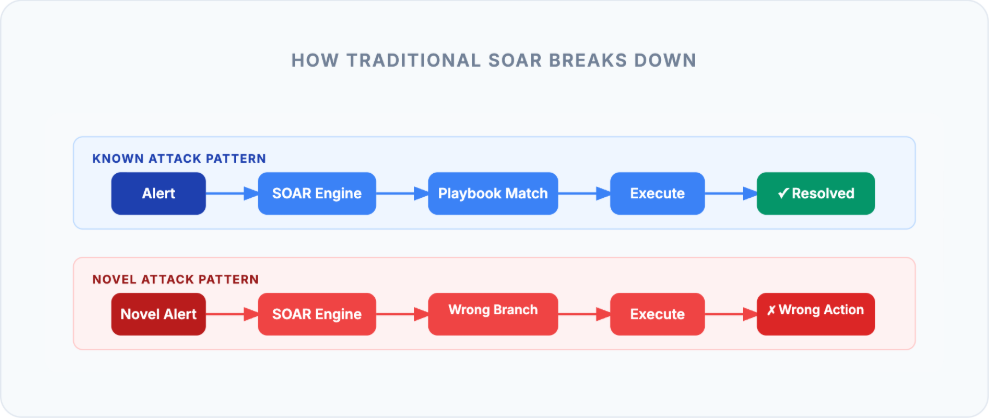
A high-severity phishing alert lands in the SOC. The analyst clicks Run Playbook and immediately knows something’s wrong. This attack came in through Microsoft Teams – the playbook was written for email. The victim isn’t an intern; it’s the CFO. None of that registers with the automation. It executes exactly as written. Perfectly. And incorrectly.
That’s not a bug. It’s the design. The attacker used a technique the playbook wasn’t written for. The payload arrived via a delivery vector the rules don’t cover. The playbook runs anyway, dutifully and wrongly, routing the case down a branch that was authored for a different threat.
This is what practitioners now call the SOAR ceiling – the structural limit of deterministic, playbook-driven automation. A phishing playbook runs identically whether the target is an intern or a CEO, regardless of how novel the payload is. The automation can’t tell the difference. The moment a novel technique appears, the playbook becomes the problem.
Traditional SOAR is only ever as good as the playbooks behind it.
And writing those playbooks? That’s the other wall. It takes engineers with deep SOAR expertise, knowledge of every integration, weeks of authoring and testing – and the moment the threat landscape shifts, the maintenance cycle starts again.
Every SOC starts the same way. Password resets become automatic. Malware containment becomes repeatable. Analysts save hours every week. Then complexity arrives – every new threat, every new integration, every business exception demands another playbook, until the automation meant to reduce engineering effort becomes another system that requires it.
The limitation isn’t SOAR. It’s static automation.
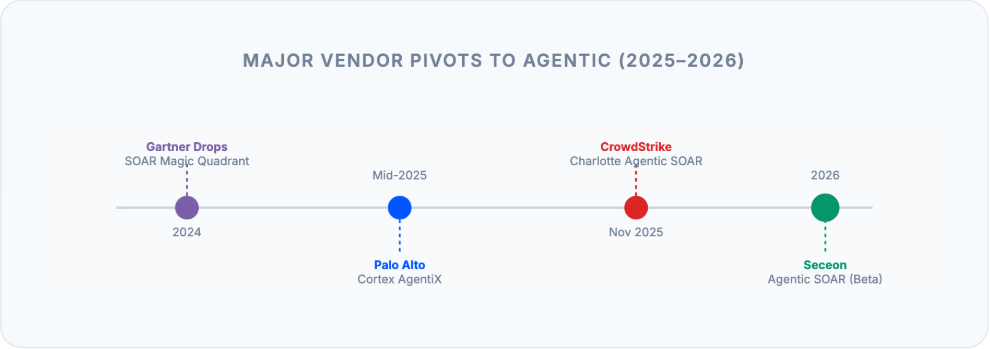
The security industry has noticed. Gartner discontinued its dedicated SOAR Magic Quadrant – a quiet acknowledgment that pure-play playbook automation has peaked as a category. The major platform vendors are pivoting: CrowdStrike launched Charlotte Agentic SOAR in November 2025, reframing analysts as supervisors of autonomous investigation rather than hands-on responders. Palo Alto trained Cortex AgentiX on 1.2 billion prior playbook executions, moving its automation beyond static, pre-authored workflows.
The direction is clear: the future of security automation is agentic – AI systems that reason, plan, and act on novel threats rather than execute pre-written scripts against expected ones.
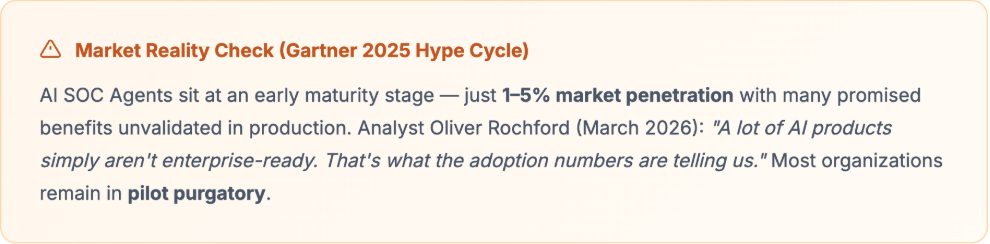
But the market is early. Gartner’s 2025 Hype Cycle for Security Operations places AI SOC Agents at an embryonic stage, with only 1 – 5% market penetration. Analyst Oliver Rochford summarized the state in March 2026: “A lot of AI products simply aren’t enterprise-ready. That’s what the adoption numbers are telling us.” Most organizations are stuck in what analysts are calling pilot purgatory – impressed by demos, blocked by production realities.
The gap between the promise and the delivery is where the real opportunity lives.
Not all “agentic” products are the same. There’s a spectrum:
Tier 1 – AI-Assisted (most of the market today): A chatbot or copilot that helps you write playbook YAML, suggests automations, or summarizes incidents. The human still builds everything. The automation still runs deterministically. The ceiling doesn’t move.
Tier 2 – AI-Augmented: The AI handles some investigation steps autonomously – enrichment, deduplication, threat scoring. But playbooks still gate every response action. The analyst still authors the logic.
Tier 3 – Genuinely Agentic: The analyst describes a use case in plain language. The AI reasons about the tenant’s real alerts, users, and connectors – asks for clarification where it’s ambiguous – and builds a complete, production-ready workflow. No drag-and-drop. No SOAR expertise required. The analyst reviews and deploys.
Seceon’s Agentic SOAR operates at Tier 3.
The core insight driving Seceon’s design isn’t just “use an LLM.” It’s that the entire loop – from analyst intent to deployed playbook – has to be grounded, validated, and safe. The playbook is modeled as a directed graph of typed nodes (triggers, tasks, conditions, actions) connected by edges. The agent never writes that graph directly; it proposes one mutation at a time, the front end applies it, and the applied result – including the real node ID the UI assigned – is fed back into the model’s context before the next step.
Describe it. The agent builds it.
An analyst types:
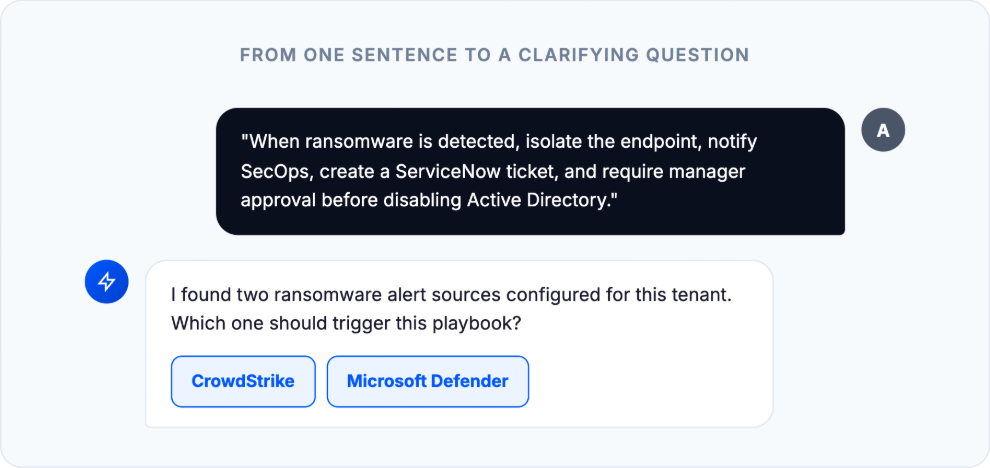
“When ransomware is detected, isolate the endpoint, notify SecOps, create a ServiceNow ticket, and require manager approval before disabling Active Directory.”
That single sentence implies four distinct node types – containment, notification, ticketing, and an approval gate – wired in the right order with the right dependencies. Every turn, the agent is grounded in two things: a live snapshot of the current workflow, and a catalog of the building blocks actually available in your environment – each node type, its category, and the exact fields it expects. The agent proposes nodes, edges, and field values strictly against that catalog. If a value isn’t present in the tenant’s real data, it leaves the field empty and flags it rather than inventing one.
Clarify first. Build once.
Before constructing anything ambiguous, the agent asks instead of guessing. Take the ransomware example above: this tenant has two ransomware alert sources configured – CrowdStrike and Microsoft Defender – and the prompt didn’t say which one. Instead of picking one or building both, the agent stops and asks:
“I found two ransomware alert sources: CrowdStrike, Microsoft Defender. Which one should trigger this playbook?”
The options aren’t invented – they’re the tenant’s actual configured sources, rendered as single-select cards. A turn is atomic: the agent either asks and stops (your answer arrives as the next turn), or it builds the complete playbook in that turn. It never half-builds and resumes blind.
Propose-then-confirm. Not autocomplete.
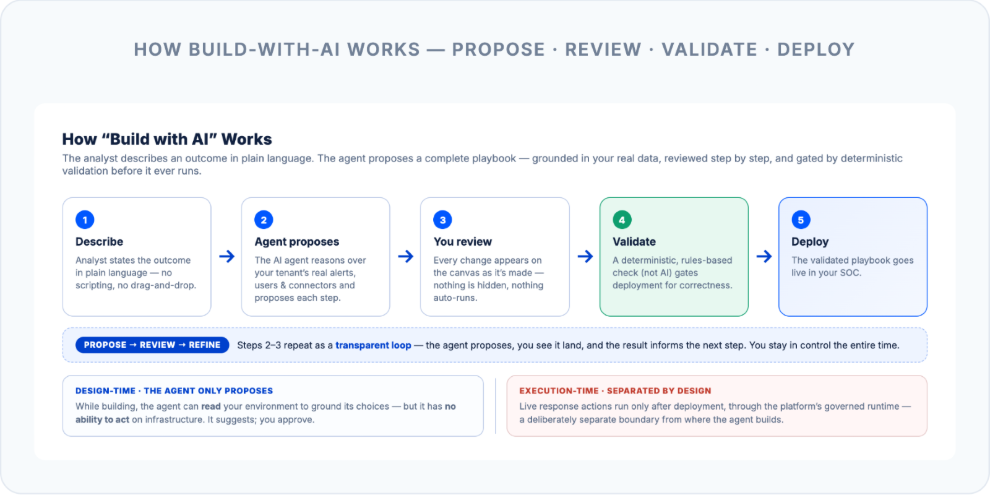
The agent doesn’t mutate the canvas. Each change is a discrete proposal – add a node, connect two, set a field – streamed to the UI, applied, and reported back with the outcome (applied / rejected / failed). Crucially, the loop waits for that result before requesting the next change – model and canvas stay in lock-step, so the agent never references something that doesn’t yet exist. Nodes are referenced by stable identity assigned on creation, never by display label – so wiring stays correct even when two nodes share a name.
Deterministic validation gates deployment.
A rules-based validator – not the LLM – checks structural correctness before any playbook can deploy: exactly one trigger present, every node reachable and connected, required fields populated, no dangling edges. The same checks run whether the playbook was generated by the agent or hand-built on the canvas. The deployment gate is deterministic and fully independent of the model’s output.
The LLM never holds credentials.
The model is reached only through an authenticated gateway that owns the model credentials, enforces per-tenant quota and billing, and gates the SOAR feature entitlement. The model sees its task, the available building blocks, and the workflow it’s shaping – never tenant credentials, connector secrets, or direct infrastructure access. It proposes; the backend executes.
Everything above rests on one principle: a propose → review → refine loop that keeps a probabilistic model and a deterministic system in lock-step. The diagram below shows it at a glance – from the analyst’s sentence, through grounded proposals and human review, to a validated, deployed playbook.
That’s the experience. Underneath it, the request crosses a specific chain of system boundaries – worth naming, because each boundary is where a safeguard lives:
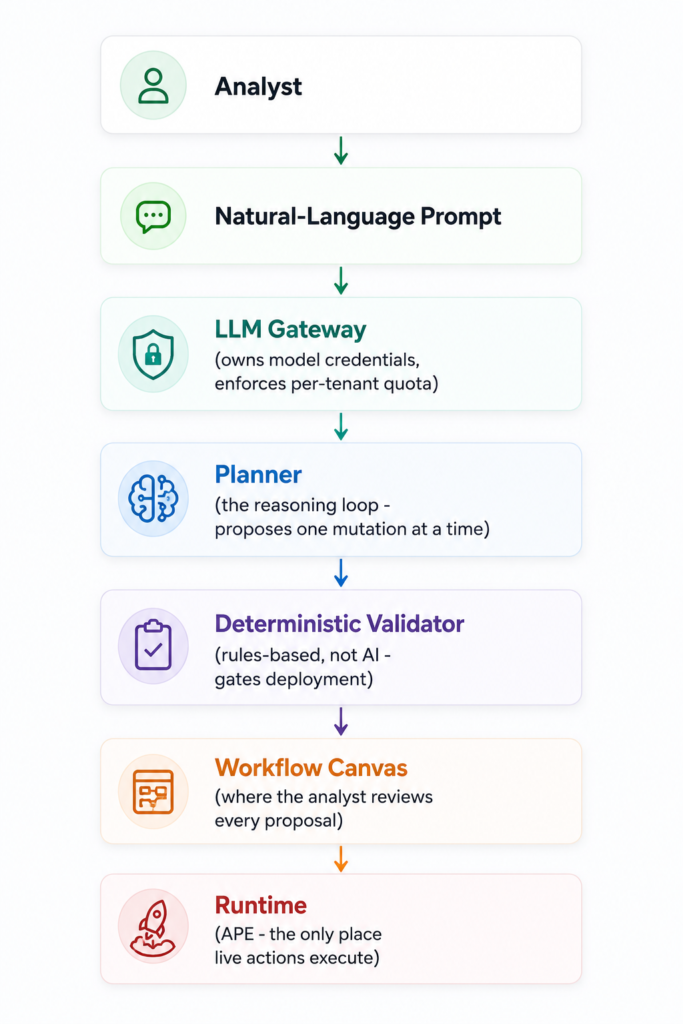
No component upstream of the Validator can deploy anything, and no component downstream of the Gateway ever holds a model credential. That’s not a policy – it’s the shape of the system.
One step at a time, always reviewed. The agent doesn’t edit the workflow directly. It proposes one change at a time – add a node, connect two, set a field – and each proposal is applied and shown on the canvas before the next one is requested. The model is never allowed to race ahead of what the analyst can see: it waits for each change to land, and the result informs its next move. The process is bounded, so a confused model can’t spin indefinitely.
The model reads your reality; it never guesses it. Each turn, the agent is grounded in the tenant’s actual environment – the real alert types, assignable users, and available connectors – and proposes values strictly from that data. If something it needs doesn’t exist in your environment, it leaves the field empty and flags it rather than inventing a plausible-looking value. When details are ambiguous, it pauses and asks with concrete, data-backed options instead of assuming.
Reading is separated from acting. While building, the agent has access only to read-only lookups of your environment – enough to ground its choices, never enough to touch infrastructure. The live response actions – isolate a host, disable a user, block an indicator – are deliberately outside the builder’s reach. A design-time agent proposes; the governed runtime, a separate boundary, is the only place actions execute.
The model never holds the keys. The agent reaches the LLM only through an authenticated gateway that owns the model credentials, enforces per-tenant quota, and gates the feature entitlement. The model sees the task and the workflow it’s shaping – never tenant credentials, connector secrets, or direct access to your systems. Compromising what the model says does not yield access to what your platform does.
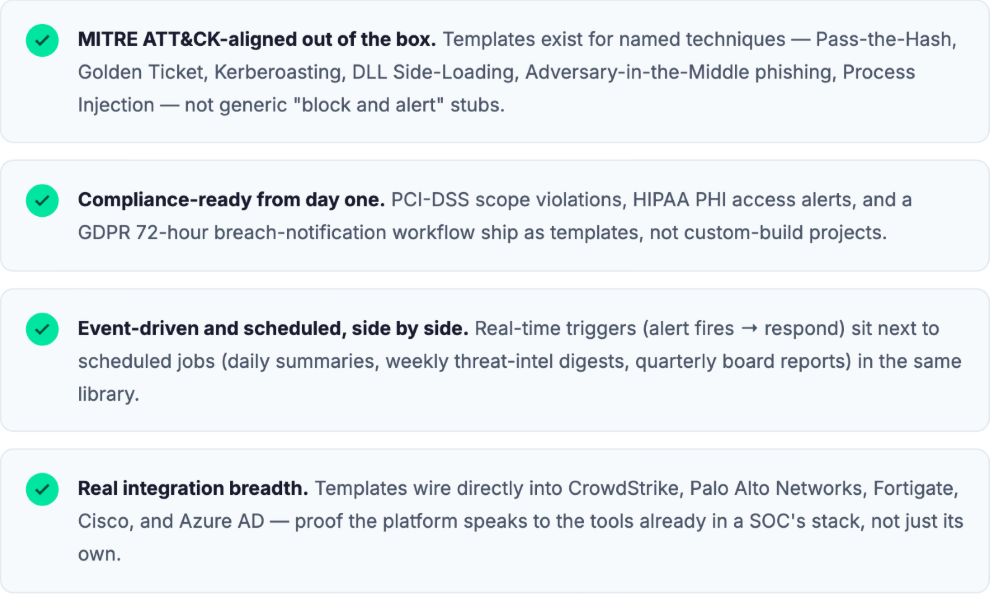
The blank-canvas problem isn’t unique to agentic AI – it’s the first wall analysts hit with any SOAR tool. Seceon solves it twice over: describe a use case and the agent builds it, or start from a vetted library and ask the agent to customize from there.
A few things worth highlighting:
A sample, not a straitjacket
| Category | Templates | A few examples |
| Threat Response | 26 | Ransomware Emergency Response · C2 Communication Response · Golden Ticket Attack Response |
| Network | 25 | DoS / DDoS Attack Response · DNS Anomaly Investigation · BGP / Routing Anomaly Alert |
| Identity | 22 | Brute Force / Failed Login Lockout · MFA Fatigue / Push Bombing · Insider Threat Account Suspension |
| Compliance | 13 | GDPR Data Breach Response · PCI-DSS Violation Response · Quarterly Board Security Report |
| Enrichment | 16 | MITRE ATT&CK Technique Tagger · GeoIP Anomaly Enrichment · Threat Hunting (IOC + UDA) |
Every template is a real, importable starting point – not a marketing screenshot. Pick one, drop it on the canvas, and ask the agent to adjust it (“add manager approval before the firewall block”) instead of starting from a blank page.

The market’s shift to agentic AI introduces a new attack surface that most vendors are not addressing honestly.
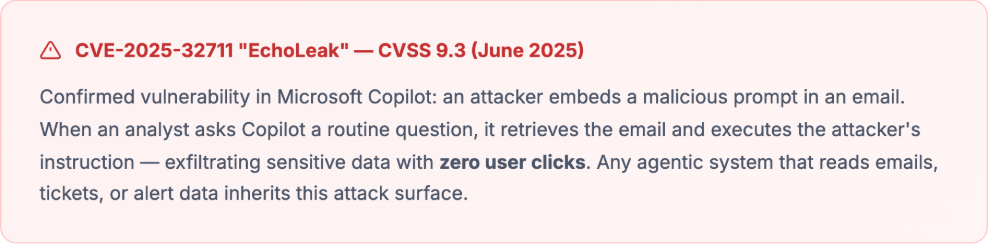
In June 2025, researchers at Aim Security disclosed CVE-2025-32711 (“EchoLeak”) – a CVSS 9.3 vulnerability in Microsoft Copilot. The attack: an adversary embeds a malicious prompt in an email. When an analyst asks Copilot a routine question, Copilot retrieves and processes the email, and the attacker’s instruction executes – exfiltrating sensitive organizational data with zero user clicks required. This is indirect prompt injection, and any autonomous security agent that reads emails, tickets, or alert data as part of triage inherits this attack surface.
A second vector: memory poisoning. Research published at NeurIPS 2025 (MINJA) demonstrated >95% success rates injecting persistent attacker-controlled instructions into agent memory through vector databases. If an agentic SOAR system stores enrichment results, threat intel, or prior context in a retrieval corpus, a sufficiently crafted adversarial document can persist across sessions and influence future autonomous decisions.
OWASP has classified these under its Agentic Applications Top 10 (ASI06).
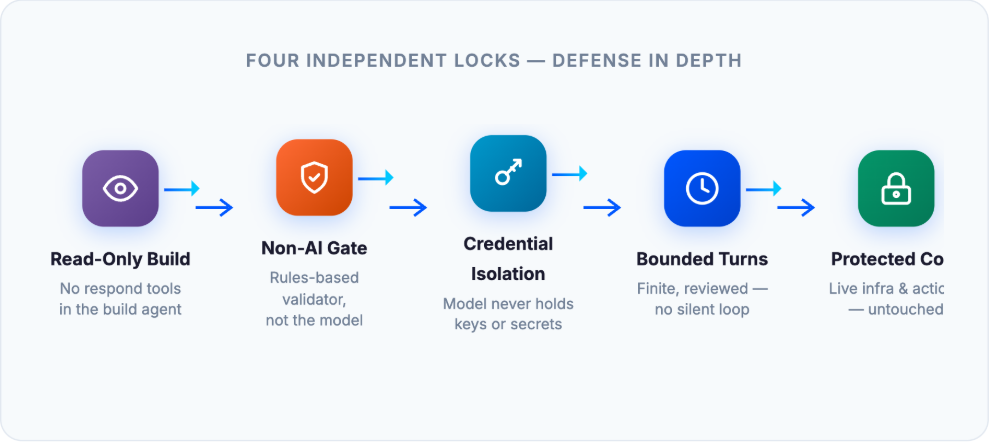
The honest position: agentic AI in a SOC is a more powerful target than a traditional SOAR, because a compromised agent acts – not just recommends. Seceon answers this structurally rather than with prompt-level hope. Four independent locks sit between any prompt – legitimate or hijacked – and the platform’s live infrastructure:
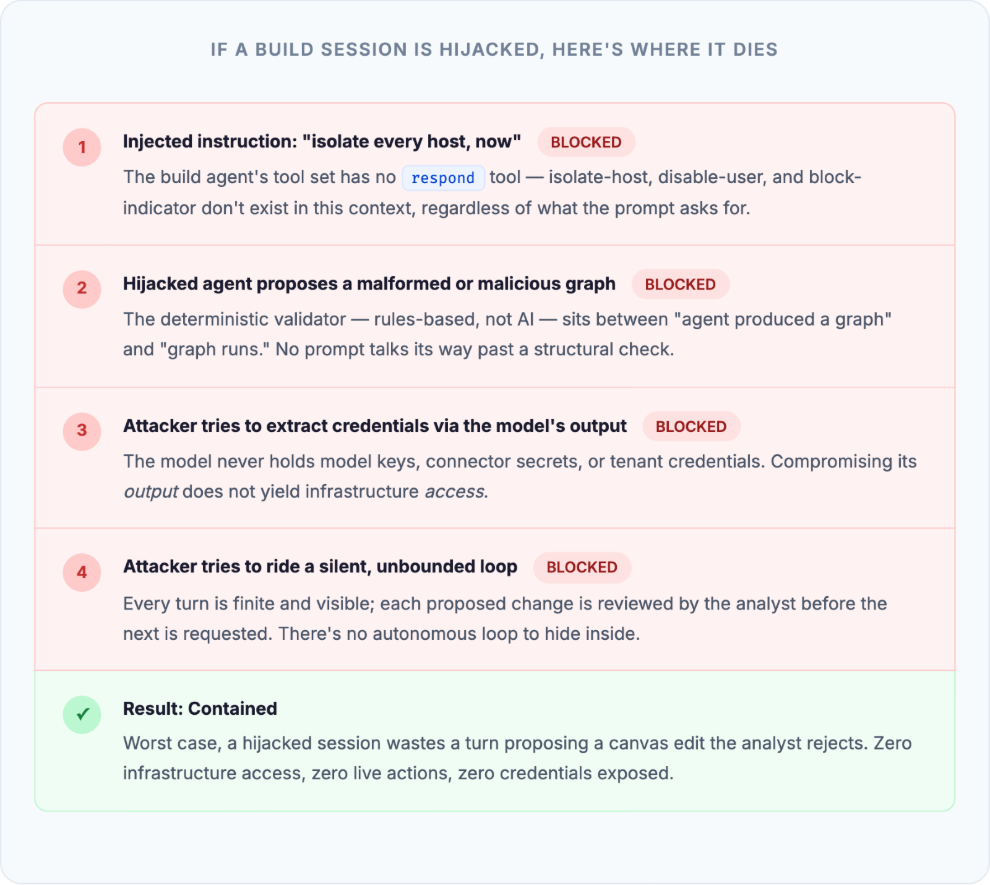
If a build session is hijacked, here’s where it dies: an injected instruction to isolate hosts or disable users finds no matching tool to call (Lock 1) – even a malformed graph that slips through fails the deterministic validator (Lock 2) – any attempt to extract credentials from the model’s output comes up empty, since it never held them (Lock 3) – and a silent, unbounded loop has nowhere to hide, since every turn is reviewed before the next begins (Lock 4). Worst case, a hijacked session wastes one turn proposing a canvas edit the analyst rejects.
Not every decision should be delegated to the model. The smart boundary between autonomous and human-gated action isn’t a limitation of the product – it’s the security posture. This is the moat.
Not every decision should be delegated to the model. The smart boundary between autonomous and human-gated action isn’t a limitation. It’s the security posture. This is the moat.
| Vendor | Current Approach | What’s Agentic | What Remains Playbook-Bound |
| CrowdStrike Charlotte | AI reasoning + human guardrails | Autonomous investigation, triage | Response actions still need analyst approval by default |
| Palo Alto Cortex AgentiX | Trained on 1.2B prior executions, moves beyond static workflows | Investigation automation | Platform lock-in; deep Palo Alto stack dependency |
| Splunk SOAR | Mature playbook engine | AI copilot layer added | Playbook authoring still required; deep SIEM dependency |
| Swimlane / Tines / Torq | Modern no-code/low-code SOAR | Natural-language workflow hints | Logic still authored by humans; AI is assistive |
| Seceon Agentic SOAR | Tenant-grounded, clarify-first, propose-then-confirm | Full playbook generation from natural language | Live remediation scoped to execution phase (by design) |
The critical differentiator isn’t whether a vendor has “AI.” It’s whether the AI is grounded in your real data, transparent about what it’s building, and validated by deterministic rules – not just generating plausible-looking YAML that may or may not reflect your actual environment.
The market is moving fast. Here’s where it’s going – and what matters:
1. Autonomous SOC pipelines, not just playbook generators.
The next evolution isn’t just building playbooks faster – it’s agents that continuously monitor, triage, investigate, and contain across the full alert lifecycle without a human in the loop for routine cases. The analyst’s role shifts from execution to exception handling.
2. Guardian agents as a design pattern.
Gartner predicts that “guardian agents” – AI whose job is to monitor and constrain other AI – will capture 10 – 15% of the agentic AI market by 2030. In a security context, this means AI that audits what the SOAR agent proposes before it acts. Expect this to become a compliance requirement, not a nice-to-have.
3. Prompt injection will become a security control boundary.
As agentic systems read from emails, tickets, threat feeds, and documents, the injection surface grows. The teams that ship agentic SOAR safely will be those who treat every external document as an untrusted input – not just malware.
4. Category consolidation continues.
Gartner dropping the SOAR Magic Quadrant signaled that standalone SOAR is converging with SIEM, XDR, and threat intelligence. The winning platforms will be those that embed agentic capability across the full detection-to-response chain – not just in the playbook editor.
5. The production-readiness gap is the real competition.
With 1–5% market penetration and most organizations in pilot mode, the vendor who gets enterprises from pilot to production – safely, measurably, without the horror stories – wins the next five years. That means grounded outputs, deterministic validation, and honest guardrails. Not just better demos.
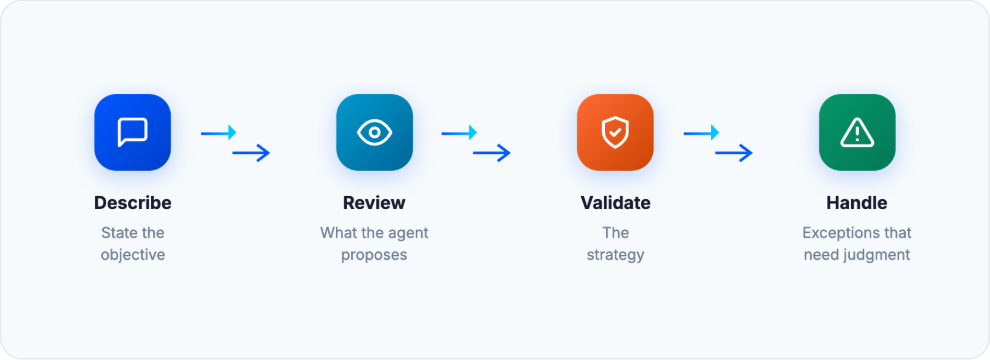
The analyst’s job is changing, too. Less time wiring workflows, more time directing them:
AI becomes an engineering assistant – not an autonomous operator.
SOAR was a breakthrough that hit a structural ceiling. The industry knows it. The major vendors are pivoting. But “agentic AI” is not a single thing – it’s a spectrum from AI-assisted authoring to genuinely autonomous reasoning, and most of what ships today is closer to the former.
The future belongs to systems that can take a single sentence – “when ransomware is detected, isolate the endpoint, notify SecOps, create a ticket, and require approval before disabling Active Directory” – and turn it into a validated, deployed workflow grounded in your environment’s real data, without requiring a SOAR engineer, a drag-and-drop session, or a week of testing.
That future is already running in production.
The first generation of SOAR automated repetitive work. The next generation automates reasoning. This is the last playbook you’ll ever write.