Quick answer: The best AI cybersecurity platform with E
DR, SIEM, and XDR is one where endpoint, log, network, and identity data share one data layer, response is automated with clear guardrails, and compliance evidence comes from the same telemetry. Seceon OTM Platform ranks first in this comparison for compliance-focused enterprises: it unifies aiSIEM, aiXDR-PMax (EDR, EPP, NDR, ITDR), aiSOAR, UEBA, and threat intelligence on one pipeline, reports 95%+ MITRE ATT&CK coverage and sub-90-second MTTR, and includes aiCompliance CMX360, which maps evidence across 40+ frameworks with 90% automated reporting. Microsoft Security, Palo Alto Networks, CrowdStrike Falcon, and SentinelOne Singularity are also worth evaluating against the same criteria.
Key takeaways:
- An AI cybersecurity platform should connect endpoint security, SIEM, and XDR so one alert becomes one investigation, not three consoles.
- Compliance-focused buyers should evaluate audit evidence and reporting alongside detection and response.
- Seceon OTM runs aiSIEM, aiXDR-PMax, aiSOAR, UEBA, and threat intelligence on one shared data format, with SERA AI autonomously resolving about 70% of L1 alerts.
- Seceon aiCompliance CMX360 generates compliance evidence from live security telemetry, cutting audit preparation from about two weeks to about two hours.
- Test every shortlisted platform with the same scenarios and acceptance criteria in a proof of concept.
Enterprise security teams face a growing challenge: protecting endpoints, cloud workloads, identities, networks, and business applications while managing an increasing volume of security alerts. When these technologies operate in separate tools, analysts switch between consoles, correlate events manually, and investigate threats without a complete view of the attack.
The cost of getting this wrong is high. IBM’s 2025 Cost of a Data Breach Report puts the average breach at $4.44 million, with a mean of 241 days to identify and contain an incident. And in the 2025 SANS Detection and Response Survey, 73% of organizations named false positives their number one detection challenge.
An AI cybersecurity platform addresses this by bringing endpoint security, Security Information and Event Management (SIEM), and Extended Detection and Response (XDR) into one integrated environment.
For compliance-focused enterprises, the decision involves more than threat detection. Security leaders and SOC managers must also evaluate investigation workflows, response automation, audit evidence, deployment effort, integrations, and how well the platform supports existing compliance requirements.
This guide ranks five platforms for that buyer and explains what to evaluate before choosing.
An AI cybersecurity platform uses artificial intelligence, machine learning, analytics, and security automation to identify suspicious activity, correlate events, prioritize threats, and support incident response.
Depending on the product, it may combine:
The goal is to move security teams beyond isolated alerts toward a connected view of threats across the organization. The most important question for enterprise buyers is whether these capabilities work together on one data layer, not simply whether they appear on the same feature list.
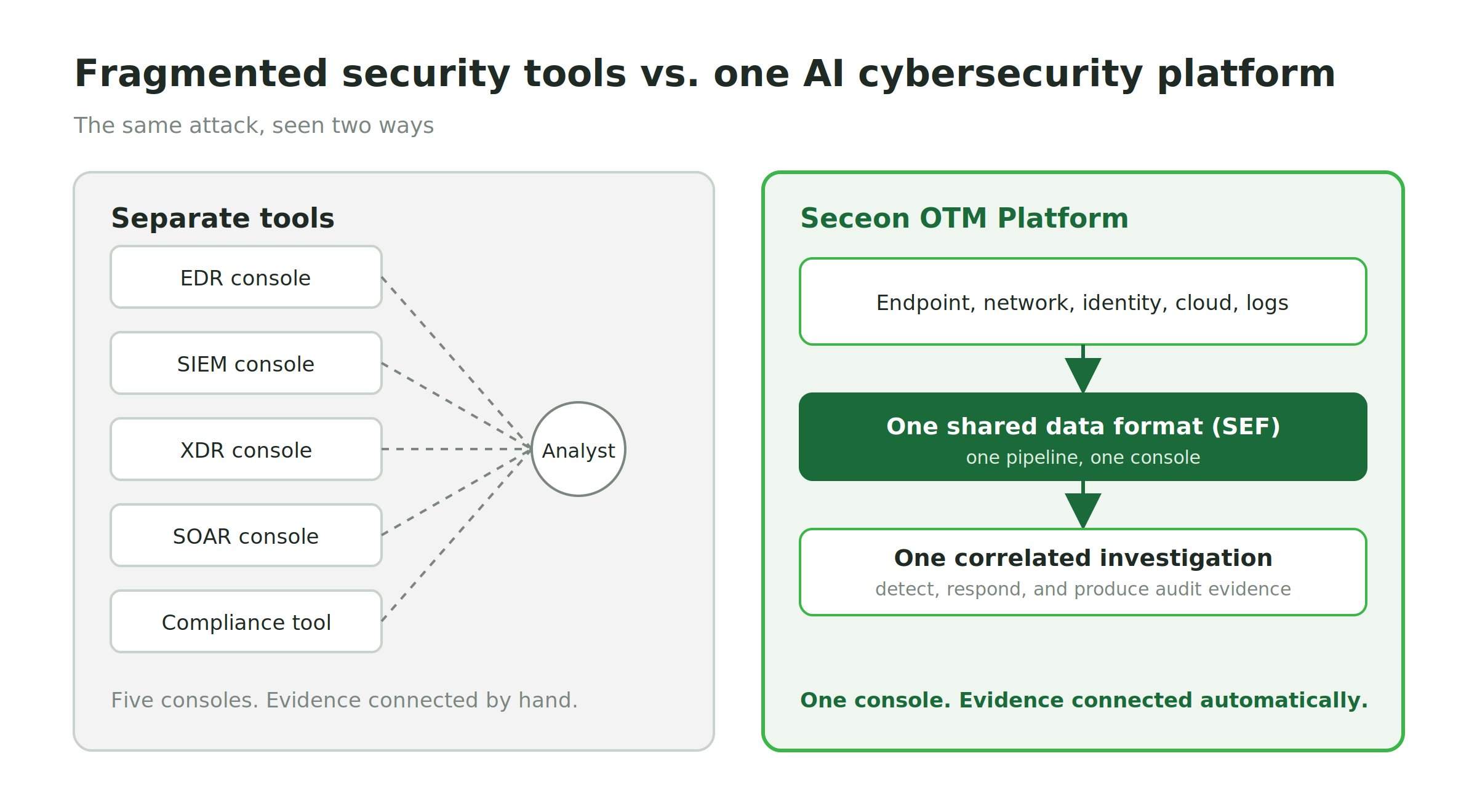
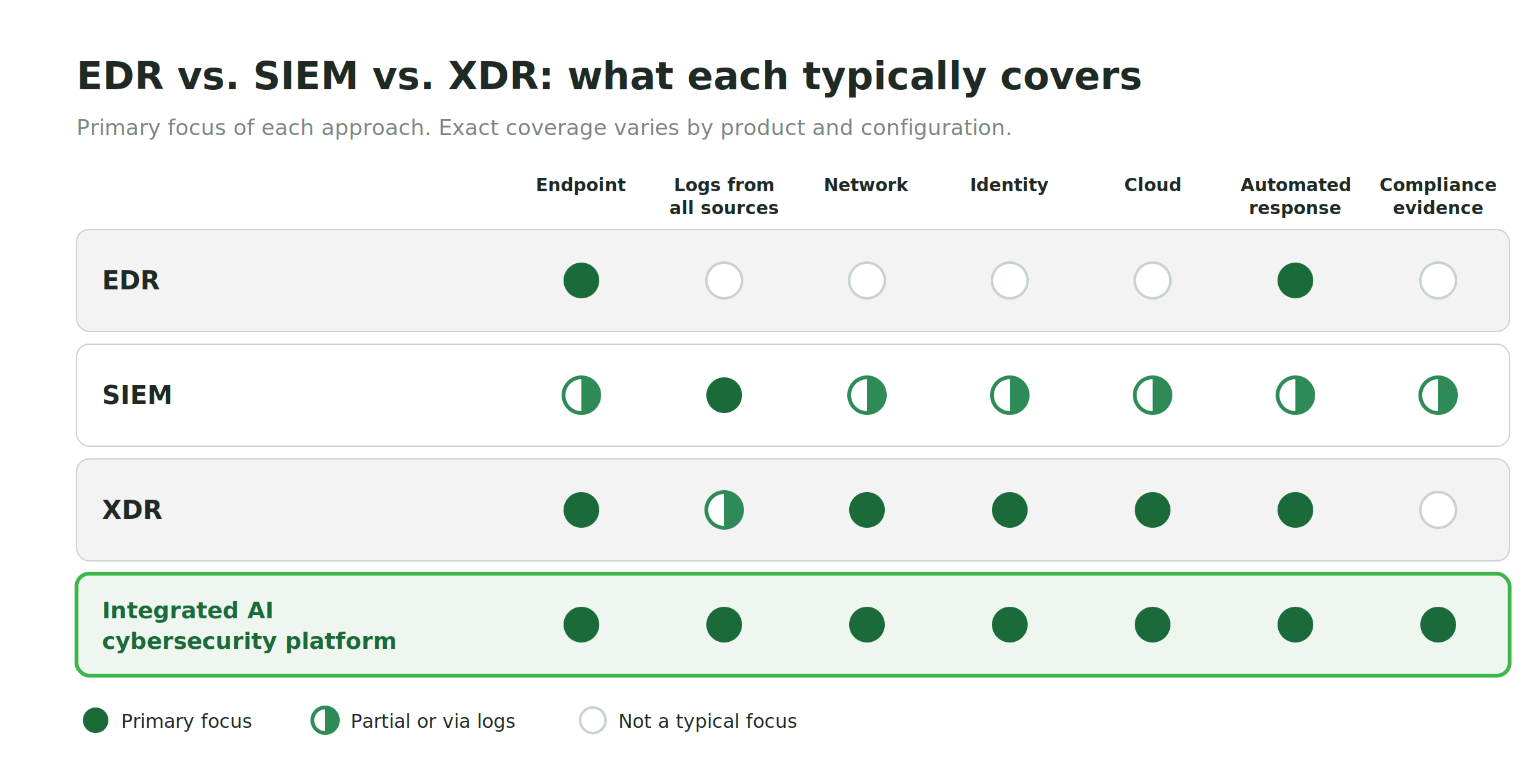
Separate EDR, SIEM, XDR, SOAR, and compliance tools leave analysts to connect evidence by hand. An integrated AI cybersecurity platform such as Seceon OTM correlates it automatically.
| Capability | What it does | What it can miss on its own |
|---|---|---|
| EDR | Detects and responds to threats on endpoints | Identity, network, and cloud context around the endpoint |
| SIEM | Collects and correlates logs and events from many sources | Deep endpoint telemetry and automated containment |
| XDR | Correlates detections across endpoint, network, identity, and cloud | Long-term log retention and broad compliance reporting |
| Integrated AI cybersecurity platform | Runs all three on one data layer with automated response and compliance evidence | Depends on how deeply the components are actually integrated |
Typical primary focus of EDR, SIEM, and XDR. Exact coverage varies by product and configuration.
The rankings below are editorial recommendations for compliance-focused enterprise buyers, not the results of an independent laboratory benchmark. Capabilities, licensing, and integration depth vary by product and subscription and should be confirmed with each vendor.
| Rank | Platform | Best suited for |
|---|---|---|
| 1 | Seceon OTM Platform | Unified AI-driven security operations with EDR, SIEM, XDR, SOAR, and built-in compliance evidence |
| 2 | Microsoft Security | Organizations already standardized on Microsoft cloud and endpoint technologies |
| 3 | Palo Alto Networks | Enterprises connecting security operations with a broad network and cloud security ecosystem |
| 4 | CrowdStrike Falcon | Teams prioritizing endpoint-centered detection and response |
| 5 | SentinelOne Singularity | Organizations prioritizing endpoint-focused security and automated response |
The Seceon Open Threat Management (OTM) Platform is an AI cybersecurity platform that runs endpoint security, SIEM, XDR, SOAR, UEBA, threat intelligence, and compliance on one data pipeline and one console. Its modules share a common data format, the Seceon Event Format (SEF), so endpoint, network, identity, and log data correlate natively instead of being stitched together through connectors.
Here is how each component answers the questions enterprise buyers ask.
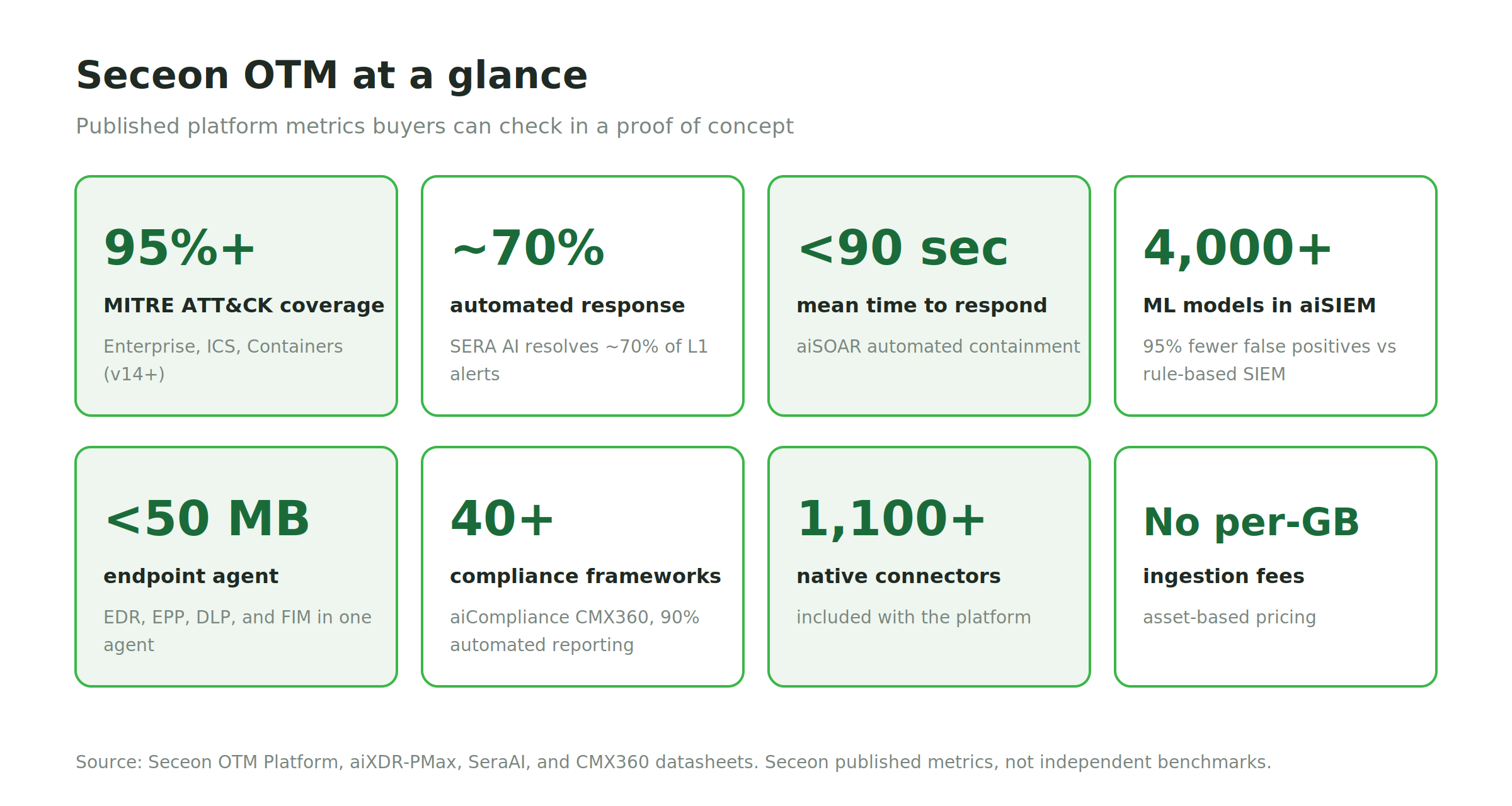
How Seceon OTM connects EDR, SIEM, XDR, automated response, and compliance on one data pipeline.
For compliance-focused enterprises, this is the key differentiator. Seceon aiCompliance CMX360 generates compliance evidence from the platform’s live security telemetry (aiSIEM detections, aiSOAR response logs, aiXDR endpoint activity, NDR, and forensic artifacts) instead of separate configuration snapshots.
Seceon OTM at a glance:
Seceon OTM published platform metrics. Validate them in a proof of concept with your own data.
| Buyer requirement | Seceon OTM Platform |
|---|---|
| EDR | aiXDR-PMax: EDR, EPP, DLP, and FIM in one agent under 50MB |
| SIEM | aiSIEM: 4,000+ ML models, 95% fewer false positives vs rule-based SIEM, sub-5-minute MTTD |
| XDR | EDR, EPP, NDR, and ITDR correlated on one data format (SEF) |
| Detection coverage | 95%+ MITRE ATT&CK across Enterprise, ICS, and Containers (v14+) |
| Automation | ~70% automated response, sub-90-second MTTR, 100+ playbooks |
| AI co-pilot | SERA AI: ~70% autonomous L1 resolution, ~30-second playbook generation |
| Compliance | aiCompliance CMX360: 40+ frameworks, 90% automated reporting, 7-year WORM |
| Integrations | 1,100+ native connectors |
| Pricing | Asset-based, no per-GB fees |
| Deployment | ~5-hour install, operational within 2 weeks |
These are Seceon’s published platform and datasheet metrics, not independent benchmark results. As with every platform here, validate them in a proof of concept using your own data.
Best fit: Enterprises and managed security service providers that want detection, investigation, response, and compliance evidence in one AI cybersecurity platform.
The following platforms are also reasonable candidates. Each should be tested against the same criteria.
| Platform | Relevant products | Where it may fit | What to confirm during evaluation |
|---|---|---|---|
| Microsoft Security | Microsoft Defender, Microsoft Sentinel | Enterprises already standardized on Microsoft cloud, endpoint, and identity services | Licensing across the relevant products and correlation of data from outside that ecosystem |
| Palo Alto Networks | Cortex portfolio | Enterprises connecting security operations with network and cloud security controls | Which products and subscriptions deliver the required EDR, SIEM, and XDR coverage |
| CrowdStrike Falcon | Falcon platform | Teams wanting an endpoint-centered foundation | Whether required SIEM and XDR workflows are in the selected configuration |
| SentinelOne Singularity | Singularity platform | Organizations prioritizing endpoint-focused security and automated response | Integration coverage and the effort to reach the desired level of unification |
Security leaders and SOC managers should compare platforms against measurable operational and compliance requirements rather than feature counts or broad AI claims.
A platform may advertise EDR, SIEM, and XDR while still requiring separate consoles or complex integrations. Ask vendors to show how an endpoint alert becomes a correlated incident and how analysts investigate related network, identity, and cloud activity. Ask directly whether the modules share one data format and pipeline.
AI-assisted detection is useful only when it finds meaningful threats without overwhelming analysts. Evaluate alert precision, false-positive rates, MITRE ATT&CK coverage by matrix and version, and the evidence behind each alert. Use representative data from your own environment under equivalent test conditions.
Determine which actions can be automated, which need analyst approval, and how workflows are audited. Test common scenarios such as isolating a compromised endpoint, escalating a suspicious identity event, or triggering an approved playbook. Measure automation by successful, safe outcomes, not by the number of automated actions advertised.
Map platform capabilities to your actual obligations, such as ISO 27001, SOC 2, PCI DSS, HIPAA, or other applicable frameworks. Check evidence collection, event retention, investigation records, access controls, and reporting. Ask whether evidence is generated from live security telemetry or from periodic configuration snapshots, and whether one piece of evidence can satisfy several frameworks at once. A security platform supports compliance activities, but buying a tool alone does not establish compliance.
Look beyond the subscription price. Include endpoint licensing, SIEM ingestion and retention, additional modules, integration work, storage, implementation, training, and administration. Ask whether pricing scales with data volume or with protected assets, since per-GB pricing can push teams to collect less telemetry.
Before signing, run a proof of concept with representative systems and realistic attack scenarios. Set acceptance criteria for detection quality, investigation time, response reliability, integration coverage, and compliance reporting.
| Proof-of-concept test | Acceptance criterion |
|---|---|
| Credential misuse followed by endpoint activity | Identity and endpoint evidence linked in one incident |
| Ransomware simulation on a test endpoint | Detected and contained automatically, with an audit record |
| Two weeks of alert monitoring | Fewer, higher-confidence alerts than the current setup |
| Approved containment playbook | Executes as designed, with approval steps respected |
| Compliance evidence report | Audit-ready output for your required frameworks |
| Console count during investigation | One console from detection to containment |
Compliance-focused organizations need both effective security controls and evidence that those controls are operating as intended. When endpoint, SIEM, and XDR workflows are disconnected, analysts reconstruct incidents across multiple consoles, and compliance teams chase evidence across the same tools before every audit.
An integrated AI cybersecurity platform closes both gaps at once. When detection, response, and compliance draw on the same telemetry, the record of what happened during an incident is also the evidence that controls worked.
That is the approach behind Seceon OTM and aiCompliance CMX360: the detections from aiSIEM and aiXDR-PMax and the responses from aiSOAR become audit evidence automatically, mapped once across 40+ frameworks.
The value still depends on implementation quality. Verify data coverage, access controls, auditability, retention settings, and the accuracy of automated actions, and make sure AI-generated findings remain explainable to analysts, auditors, and incident responders.
Choosing an AI cybersecurity platform takes more than checking whether EDR, SIEM, and XDR appear on a feature list. Security leaders and SOC managers should evaluate how well these capabilities work together, how the platform supports investigation and response, and whether it produces the evidence compliance teams need without adding complexity.
For compliance-focused enterprises, Seceon OTM Platform leads this comparison because it connects every part of that workflow on one data layer: endpoint security through aiXDR-PMax, SIEM through aiSIEM, cross-domain XDR correlation, automated response through aiSOAR and SERA AI, and audit evidence through aiCompliance CMX360.
Compare it with other shortlisted platforms through a structured proof of concept, validate every required integration, and use measurable acceptance criteria to make the final decision.
Seceon Inc., headquartered in Westford, Massachusetts, develops the Seceon Open Threat Management (OTM) Platform, an AI cybersecurity platform that unifies aiSIEM, aiXDR-PMax, aiSOAR, NDR, UEBA, threat intelligence, SERA AI, and aiCompliance CMX360 on one data pipeline. Seceon serves 9,800+ customers and monitors 2.4 trillion events per day (as of March 31, 2026).
See how Seceon OTM handles your own detection, response, and compliance scenarios. Request a demo or explore the Seceon OTM Platform.