Quick answer: The best AI SOC platform for OT and IoT security in 2026 is Seceon’s Open Threat Management (OTM) platform with aiSecOT360 and SeraAI. It is the only option in this comparison that runs IT and OT detection, SOAR response and an autonomous AI analyst on one engine. It monitors 70+ industrial protocols passively and deploys fully air-gapped. Claroty, Nozomi Networks, Dragos, Armis and Microsoft Defender for IoT are strong OT visibility tools, but each sends its alerts to a separate SIEM and SOAR.
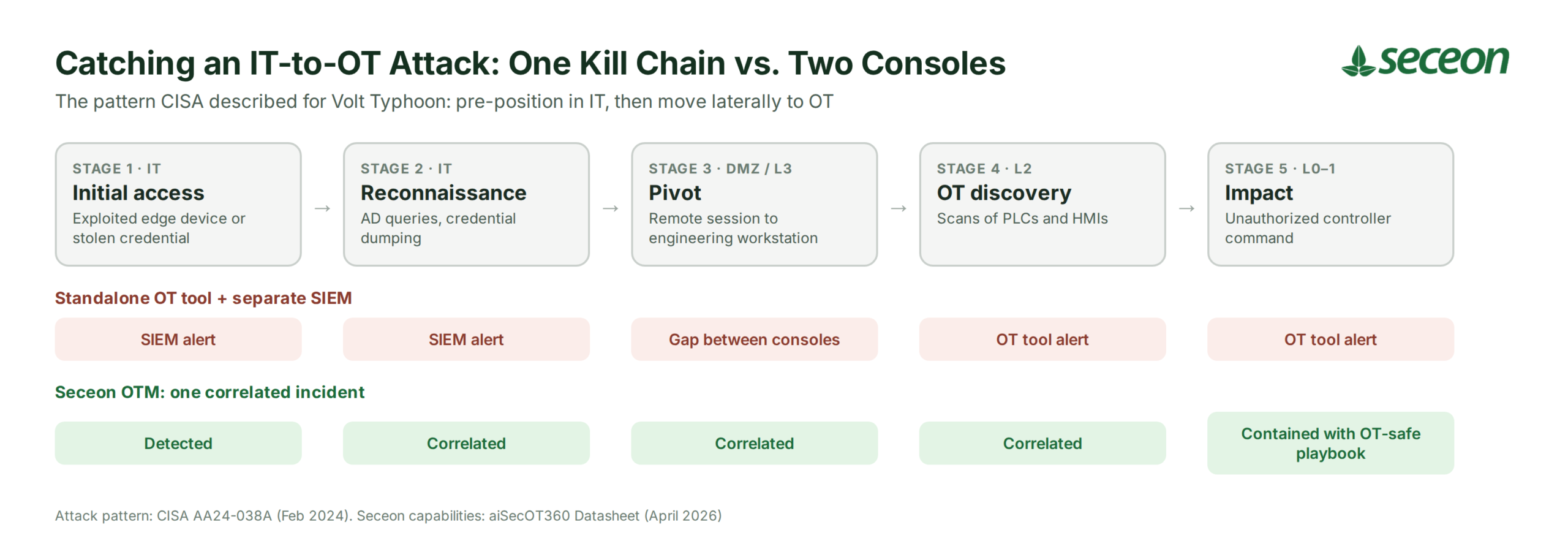
Attackers no longer start in the plant. According to a joint CISA, NSA and FBI advisory, Volt Typhoon actors pre-positioned themselves on IT networks to enable lateral movement to OT assets. In some victim environments they kept access for at least five years (CISA AA24-038A). An attack that crosses from IT into OT is invisible to a team that watches the two worlds in separate tools.
That is why AI SOC platforms are now judged on how well they connect IT, OT, IoT and ICS telemetry, and how safely they automate response around physical processes. This guide compares six platforms for enterprise security leaders and SOC teams.
Disclosure: this guide is published by Seceon. Competitor details come from vendor documentation, public filings and independent sources as of October 2026.
| Rank | Platform | Verdict | Main limitation for an AI SOC |
|---|---|---|---|
| 1 | Seceon OTM (aiSecOT360 + SeraAI) | Best overall: unified IT/OT AI SOC with autonomous L1 resolution and OT-safe response | None of the single-domain gaps below; SIEM, SOAR, NDR and OT security on one platform |
| 2 | Claroty (xDome / CTD) | CPS visibility and exposure management | Built to feed an existing SIEM; cloud and on-premises are separate products |
| 3 | Nozomi Networks | OT/IoT visibility and threat detection | Now owned by industrial automation vendor Mitsubishi Electric; relies on a separate SOC stack |
| 4 | Dragos | OT threat detection and intelligence | IT/OT correlation happens in a third-party SIEM such as Splunk or Sentinel |
| 5 | Armis (ServiceNow) | Asset discovery and cyber exposure management | Integration into ServiceNow still in progress after the April 2026 close |
| 6 | Microsoft Defender for IoT | OT monitoring for Microsoft-centric estates | Legacy on-premises management console no longer downloadable since January 1, 2025 |
Quick answer: AI SOC platforms use machine learning and AI agents to collect security telemetry, correlate it into incidents, investigate alerts and trigger response with less manual analyst work. Autonomous SOC platforms go further: AI agents triage and resolve routine alerts on their own and escalate only confirmed threats. Seceon’s SeraAI, for example, resolves 70% or more of L1 alerts without analyst intervention.
A traditional security operations center relies on analysts to read alerts, query logs and run playbooks by hand. AI cybersecurity changes the division of labor. Models baseline normal behavior, correlate weak signals into one incident, and explain the attack chain in plain language. SOC automation then contains the threat in seconds rather than hours.
Quick answer: OT and ICS systems control physical processes, so security tools must observe them passively, understand industrial protocols, and never take an automated action that could stop production or create a safety risk. IT-only AI SOC platforms usually lack OT protocol visibility, and OT-only tools usually lack IT correlation and automated response.
Operational technology breaks three assumptions that IT security relies on:
IoT adds scale: building management systems, cameras, medical devices and campus sensors that rarely appear in an IT asset inventory.
We scored each platform on three criteria that matter most to enterprise security operations teams protecting OT and IoT.
| Criterion | What we looked for |
|---|---|
| Automation depth | Autonomous L1 triage, AI-generated investigations, native SOAR, OT-safe response with interlocks and human approval |
| Visibility | Passive asset discovery, industrial protocol coverage, Purdue Level 0–4 monitoring, IoT and building systems, IT/OT correlation |
| Platform fit | On-premises and air-gapped deployment, data-diode support, compliance with IEC 62443, NERC CIP and NIST SP 800-82, number of tools required |
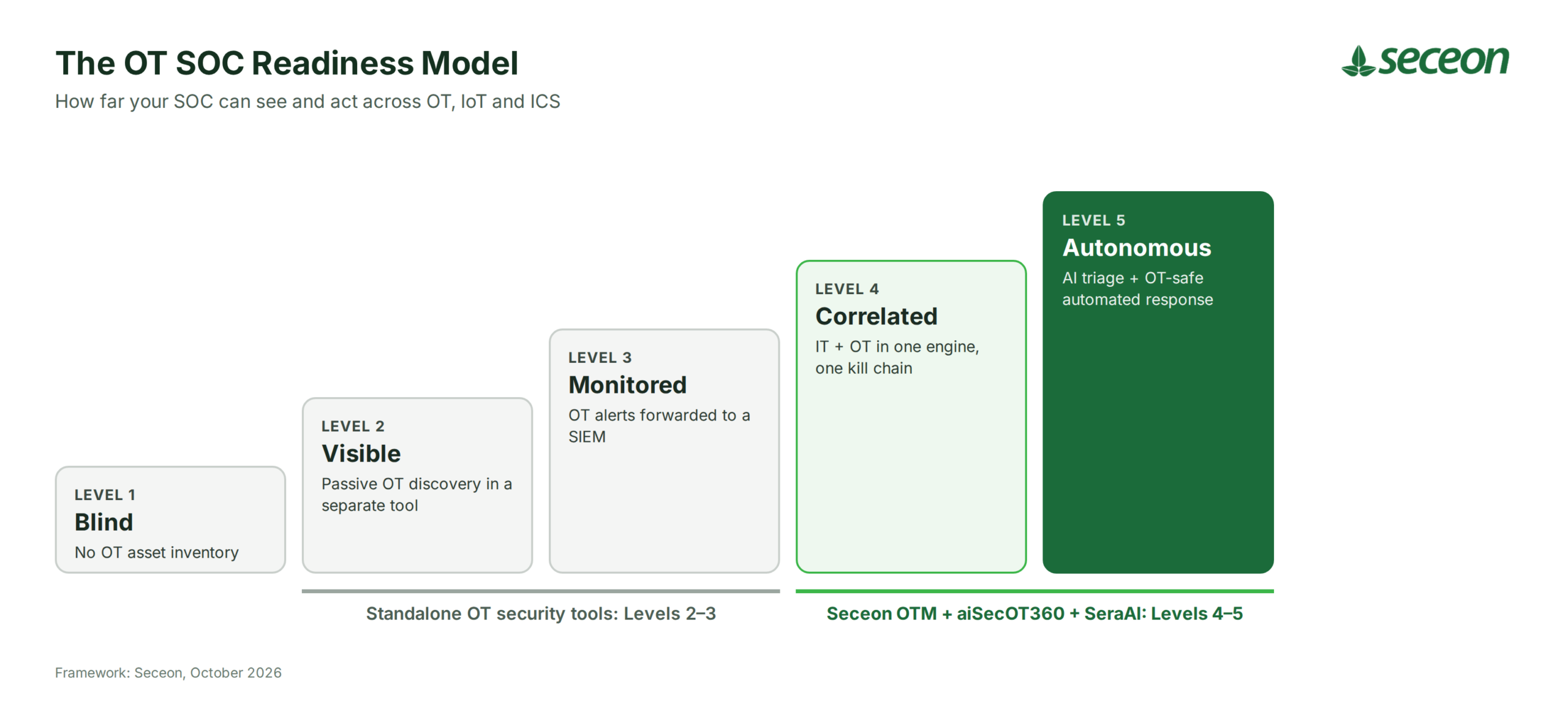
We also mapped each platform to the OT SOC Readiness Model, a five-level framework Seceon uses to describe how far a SOC can see and act across OT:
| Level | Name | What the SOC can do |
|---|---|---|
| 1 | Blind | No OT asset inventory; OT is invisible to the SOC |
| 2 | Visible | Passive OT asset discovery in a separate OT tool |
| 3 | Monitored | OT alerts forwarded to a SIEM; IT and OT investigated in different consoles |
| 4 | Correlated | IT and OT events correlated in one engine with a single kill chain |
| 5 | Autonomous | An AI SOC triages, investigates and executes OT-safe response, with humans approving irreversible actions |
Standalone OT security tools typically take a SOC to Level 2 or 3. Reaching Levels 4 and 5 requires IT and OT detection, SOAR and AI investigation on the same platform.
Quick answer: Seceon’s Open Threat Management (OTM) platform is the best AI SOC platform for OT and IoT security because it combines passive OT/IoT visibility (aiSecOT360), IT/OT correlation in one detection engine (aiSIEM), OT-safe automated response (aiSOAR) and an autonomous AI analyst (SeraAI) on a single platform that can run fully air-gapped.
Most OT security products stop at visibility and forward alerts elsewhere. Seceon takes the whole SOC to the plant floor. aiSecOT360 watches industrial networks passively, aiSIEM correlates what it sees with IT, identity and cloud activity, SeraAI investigates, and aiSOAR responds with OT safety built in.
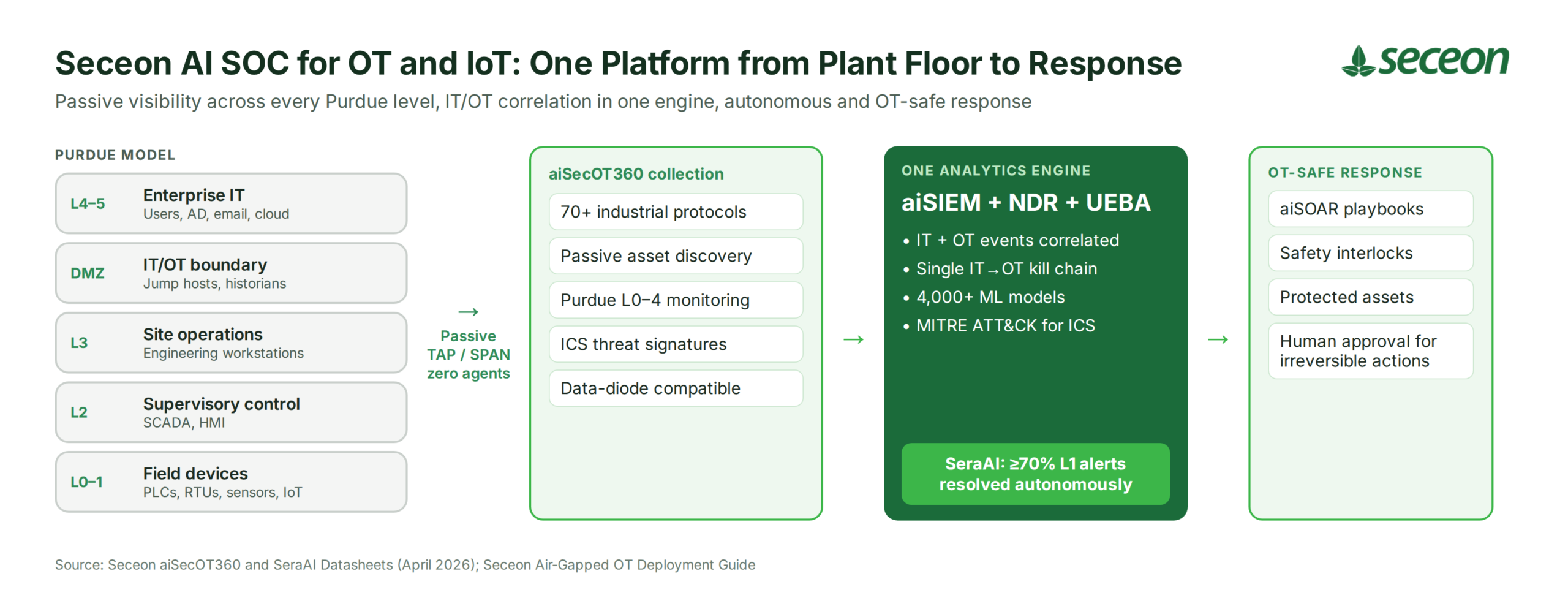
aiSecOT360 shares the aiSIEM engine with IT detection, so OT findings are correlated with IT threats in the same console. An attacker who starts in IT and pivots to OT is caught at every stage, which is exactly the pattern CISA described for Volt Typhoon.
aiSecOT360 also carries ICS-specific threat signatures for TRITON/TRISIS, Industroyer2/CRASHOVERRIDE, Volt Typhoon and Stuxnet-class attack patterns, with custom ICS signature development.
| Specification | Seceon OTM (aiSecOT360 + SeraAI) |
|---|---|
| Deployment | Passive TAP/SPAN; zero agents on OT devices |
| Industrial protocols | 70+ (process control, building automation, industrial Ethernet, energy, transport) |
| IT/OT correlation | Native, shared aiSIEM engine |
| Autonomous L1 resolution | 70% or more (SeraAI) |
| Playbook generation | About 30 seconds from natural language |
| OT baseline | Within 7 days |
| Air-gapped | Yes, including on-premises AI; data-diode compatible |
| Compliance | NERC CIP v7, IEC 62443, NIST SP 800-82 |
Best fit: Energy and utilities, manufacturing, oil and gas, water, rail, healthcare and government SOCs that need one AI SOC across IT, OT and IoT, including air-gapped sites.
Quick answer: Claroty, Nozomi Networks, Dragos, Armis and Microsoft Defender for IoT are OT and IoT visibility and detection tools. Each forwards its findings to a separate SIEM and SOAR for IT correlation and response. That keeps most SOCs at Level 3 of the OT SOC Readiness Model, while Seceon’s unified platform reaches Levels 4 and 5.
What it is: A cyber-physical systems (CPS) protection platform for asset inventory, exposure management, network protection and threat detection.
Where it falls short as an AI SOC:
How Seceon compares: Seceon aiSecOT360 delivers OT visibility, IT/OT correlation and SOAR response in one console, deployable on-premises or air-gapped from a single platform.
What it is: An OT, IoT and cyber-physical systems security vendor offering asset visibility, threat detection and AI-assisted analysis.
Where it falls short as an AI SOC:
How Seceon compares: Seceon is independent of any industrial equipment vendor and correlates OT activity with IT, identity, cloud and endpoint telemetry on one engine.
What it is: An industrial cybersecurity platform for OT asset visibility, vulnerability management, threat detection and response playbooks, backed by Dragos threat intelligence.
Where it falls short as an AI SOC:
How Seceon compares: In Seceon, OT findings flow into the same aiSIEM engine natively. There are no syslog pipelines or analytics rules to build, and one kill chain spans IT and OT.
What it is: A cyber exposure management platform that discovers and monitors connected assets across IT, OT, IoT and medical devices.
Where it falls short as an AI SOC:
How Seceon compares: Seceon combines asset discovery with real-time detection, AI investigation and automated, OT-safe response in one platform.
What it is: Microsoft’s OT and IoT network monitoring service, managed through the Azure portal and integrated with Microsoft security tools.
Where it falls short as an AI SOC:
How Seceon compares: Seceon runs all processing, including its SeraAI language model, on-premises or fully air-gapped, with no cloud dependency and support for unidirectional data diodes.
Quick answer: In real OT and IoT attack scenarios, Seceon detects and responds on one platform, while standalone OT tools detect in one console and depend on a separate SIEM and SOAR to correlate and act. The difference shows most clearly when an attacker moves from IT into OT.
| Use case | Seceon OTM (aiSecOT360 + SeraAI) | Standalone OT tool + separate SIEM/SOAR |
|---|---|---|
| IT-to-OT pivot (the Volt Typhoon pattern) | One aiSIEM engine links the IT credential theft, the jump to an engineering workstation and the OT command into a single kill chain | OT tool sees the OT step; the IT steps live in the SIEM, and analysts join them by hand |
| Unauthorized PLC command or setpoint change | Protocol-aware detection across 70+ industrial protocols; aiSOAR runs OT-safe response actions with safety interlocks | OT tool raises an alert; response depends on a separately configured SOAR |
| Compromised building or medical IoT device | Passive discovery of BMS, campus and medical IoT; SeraAI investigates and resolves routine alerts autonomously | Device appears in the OT/IoT inventory; triage stays manual in the SOC |
| Air-gapped substation or plant | Dual-stage collection with data-diode support; full SIEM, SOAR and AI run on-premises | OT sensors can run on-premises, but SIEM, SOAR or AI services may need connectivity |
| NERC CIP / IEC 62443 audit | IEC 62443 security levels per zone and conduit, plus NERC CIP evidence, from the same platform | OT tool reports OT posture; audit evidence is assembled across tools |
| Platform | Passive OT/IoT discovery | IT/OT correlation | Native SOAR with OT-safe response | AI in the SOC | Highest OT SOC Readiness level on its own |
|---|---|---|---|---|---|
| Seceon OTM | Yes, 70+ industrial protocols | Native, one aiSIEM engine | Yes, aiSOAR with OT safety interlocks | SeraAI: ≥70% autonomous L1 resolution | Level 5: Autonomous |
| Claroty | Yes | Through a third-party SIEM | Through third-party tools | Claire AI security agent | Level 3: Monitored |
| Nozomi Networks | Yes | Through a third-party SIEM | Limited, OT-focused | AI-assisted analysis | Level 3: Monitored |
| Dragos | Yes | Through a third-party SIEM | Response playbooks; SOAR through third parties | EmberAI | Level 3: Monitored |
| Armis | Yes | Through ServiceNow and third-party tools | Through ServiceNow workflows | AI-powered exposure management | Level 3: Monitored |
| Microsoft Defender for IoT | Yes | Through Microsoft Sentinel | Through Microsoft security tools | Microsoft security AI | Level 3: Monitored |
Readiness levels reflect what each product delivers without a separate SIEM and SOAR. Competitors can reach Level 4 only by integrating additional platforms.
| Buyer | Top pick | Why |
|---|---|---|
| Energy and utilities (substations, SCADA) | Seceon OTM | NERC CIP v7 and IEC 62443 support, air-gapped deployment with data diodes, energy protocols such as DNP3, IEC 61850, IEC 60870-5 and ICCP |
| Manufacturing and pharma | Seceon OTM | Passive monitoring with zero agents on PLCs and HMIs; IT/OT correlation stops ransomware before it reaches the plant floor |
| Healthcare and smart buildings | Seceon OTM | BMS, campus IoT and medical device visibility in the same SOC as IT, with autonomous L1 triage |
| Government and critical infrastructure SOCs | Seceon OTM | Sovereign, fully on-premises AI with no dependency on overseas AI services |
| MSSPs offering OT SOC services | Seceon OTM | Multi-tier multi-tenancy with per-tenant baselines across IT and OT customers |
Quick answer: For enterprises that need an AI SOC across OT, IoT and ICS, Seceon OTM with aiSecOT360 and SeraAI is the strongest choice in 2026. It is the only platform in this comparison that reaches Level 5 of the OT SOC Readiness Model on its own: passive OT visibility, IT/OT correlation in one engine, autonomous L1 resolution and OT-safe automated response, deployable fully air-gapped.
Claroty, Nozomi Networks, Dragos, Armis and Microsoft Defender for IoT are capable OT visibility tools. Each still relies on a separate SIEM and SOAR to correlate IT and OT and to act, and three of the five have changed owners or retired on-premises components since 2025. Attackers like Volt Typhoon move from IT into OT. The SOC that stops them has to see both in one place.
See Seceon aiSecOT360 and SeraAI on your OT network. Request a demo at seceon.com.