Mid-sized businesses face a cybersecurity challenge that is often underestimated. They may operate hundreds or thousands of endpoints, support remote and hybrid employees, use cloud applications, and manage sensitive customer or financial information. Yet their security teams are frequently much smaller than those of large enterprises.
This imbalance creates a practical problem: organizations need continuous threat detection and response, but they may not have enough analysts to monitor alerts, investigate suspicious behavior, and respond to incidents around the clock.
Traditional antivirus software remains useful for blocking known malicious files, but modern attacks can involve compromised credentials, malicious scripts, legitimate administrative tools, ransomware, and suspicious activity that does not match a known malware signature. Security teams need greater visibility into endpoint behavior and a reliable process for investigating potential threats.
This is where endpoint detection and response (EDR) solutions become important. EDR technology monitors endpoint activity, identifies suspicious behavior, supports investigations, and enables response actions such as isolating a compromised device. Managed EDR services add the expertise and operational support needed to monitor and respond to threats without requiring a business to build a full in-house security operations center (SOC).
For mid-sized businesses, choosing the right service involves more than comparing software features. Buyers must understand the difference between EDR software, managed EDR, and managed detection and response (MDR); determine who is responsible for responding to incidents; assess integration requirements; and compare the total cost of ownership.
This guide compares leading EDR platforms and managed security service options, explains their tradeoffs, and provides a practical framework for selecting a solution that fits a lean security team.
Endpoint detection and response solutions are cybersecurity technologies designed to monitor endpoint activity, identify suspicious behavior, investigate potential incidents, and support remediation.
An endpoint can be a laptop, desktop, server, virtual machine, or other connected device that interacts with an organization’s systems and data.
Unlike traditional antivirus, which primarily focuses on preventing or detecting known malicious files, EDR can analyze behavioral signals and activity patterns to identify potentially malicious actions. Depending on the product, this may include unusual process execution, suspicious scripts, unauthorized changes, credential-related activity, or behavior associated with ransomware.
Endpoint monitoring: Collect telemetry about processes, files, connections, and other endpoint activity.
Behavioral threat detection: Identify suspicious activity that may not be detected through signatures alone.
Threat investigation: Help analysts reconstruct activity and understand how an incident developed.
Endpoint isolation: Restrict a potentially compromised device’s network connectivity when supported and authorized.
Threat hunting: Search endpoint data for indicators of compromise and suspicious behavior.
Remediation: Support actions such as terminating malicious processes, quarantining files, and removing threats.
Reporting and visibility: Provide information about incidents, endpoint status, and security trends.
The exact feature set varies by vendor, subscription tier, operating system, and deployment configuration. Buyers should verify which functions are included in the proposed service.
Managed EDR services combine endpoint detection technology with ongoing security expertise. Instead of relying entirely on internal IT staff to review alerts and investigate incidents, a business receives some level of monitoring, analysis, guidance, or response support from an external provider.
This model can be valuable for organizations that need stronger endpoint security but lack the staffing or specialist knowledge to operate EDR effectively.
However, the term managed EDR does not describe one universal service model. Some providers primarily monitor alerts and notify the customer. Others investigate incidents, recommend containment steps, or execute approved remediation actions. A more comprehensive managed detection and response service may cover additional sources such as network traffic, cloud workloads, identity systems, and email security.
Before comparing providers, buyers should establish exactly what the service includes.
Before choosing a provider, mid-sized businesses should understand the difference between the software and the service operating it.
| Service model | What the business receives | Main tradeoff |
|---|---|---|
| EDR software | Endpoint monitoring, detections, investigation tools, and response controls | Internal staff must operate the platform |
| Managed EDR | EDR technology plus provider-led monitoring, triage, and an agreed level of response support | Service scope and response authority vary |
| Managed detection and response (MDR) | A security team that monitors, investigates, and responds to threats, often using EDR plus other telemetry | May cost more, but can cover more of the incident lifecycle |
| Managed XDR (MXDR) | Managed detection and response across multiple security layers, such as endpoints, identity, email, and cloud | Broader coverage can introduce more integration and deployment work |
A managed service does not automatically mean that the provider can take every response action on the customer’s behalf. Some providers notify the customer’s IT team and offer remediation guidance; others can contain threats directly under agreed policies.
Microsoft, for example, describes its Defender Experts MDR offering as expert-led monitoring and investigation with response options that depend on the service arrangement.
The key buying question is not simply whether 24/7 monitoring is included. It is who investigates, who acts, and how quickly a threat can be contained when your own team is unavailable.
The following providers represent different approaches to endpoint security and managed threat response. They are presented as a practical shortlist rather than a definitive ranking: suitability depends on your existing technology, endpoint estate, budget, operating systems, and required service level.
Website: Seceon
Seceon EDR Services help organizations strengthen endpoint security by identifying suspicious activity, investigating potential threats, and supporting faster incident response. As businesses increasingly rely on remote work, cloud applications, distributed networks, and connected devices, protecting endpoints has become a critical part of enterprise cybersecurity.
For organizations with limited security resources, endpoint detection and response (EDR) is about more than detecting malware. Security teams need visibility into endpoint behavior, the ability to correlate suspicious activity with other security events, and effective response workflows that help contain threats before they spread.
Seceon Inc.’s broader Open Threat Management (OTM) Platform brings together security capabilities designed to improve threat visibility and coordinate security operations. Its AI- and ML-driven approach supports threat detection and response across supported security data sources, helping organizations investigate suspicious activity and strengthen their security posture.
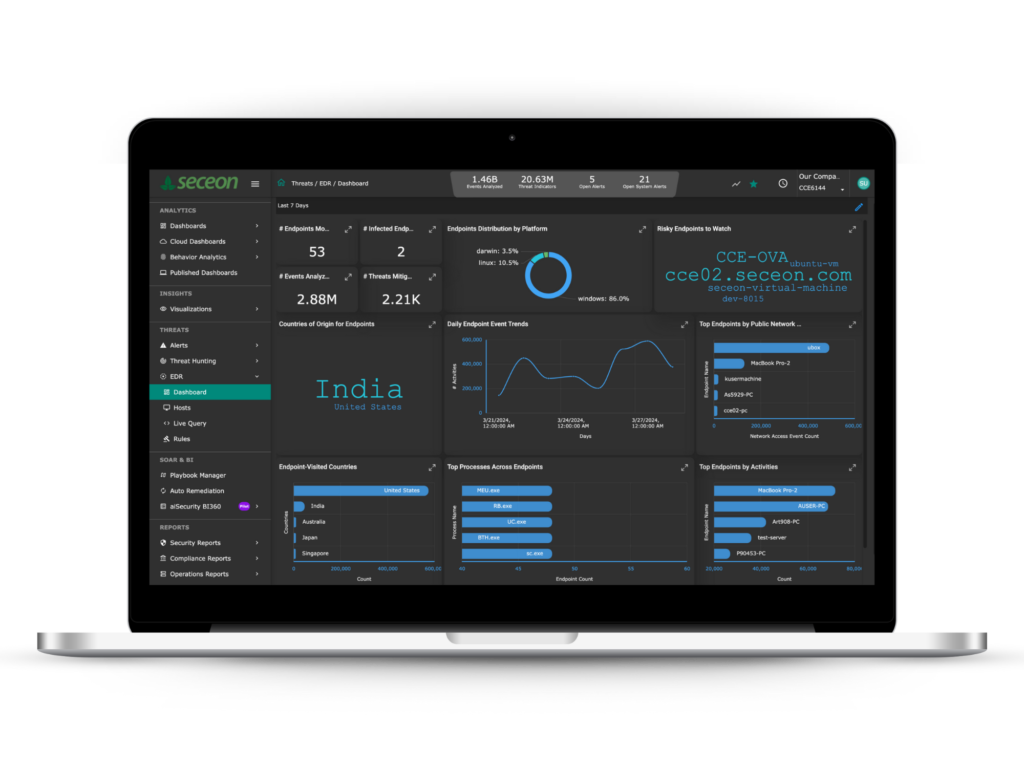
Seceon aiXDR-PMax provides endpoint monitoring and visibility to help security teams understand endpoint activity and identify potentially compromised devices. Its capabilities include monitoring endpoint status and analyzing telemetry from supported systems.
Seceon uses AI/ML-based analytics and event correlation to help identify suspicious behavior and potential threats. By connecting endpoint activity with relevant security signals, teams can investigate incidents with more context than isolated endpoint alerts may provide.
When supported detections and response policies identify a threat, Seceon can support actions such as endpoint isolation, malicious process termination, and file quarantine. The availability and execution of specific actions depend on configuration, integrations, and response policies.
Organizations do not always need to replace their current endpoint security investment. Seceon aiXDR-PMax supports integration with existing EDR and endpoint protection platforms, allowing supported telemetry to contribute to centralized detection and response workflows. Verify the required connectors and response capabilities for your current products before deployment.
Endpoint threats can be part of larger attacks involving networks, identities, cloud services, or applications. Seceon’s broader OTM approach correlates security information across supported sources to help teams investigate activity and understand the wider context of an incident.
Improved endpoint visibility: Gain a clearer view of endpoint status and suspicious activity.
Faster investigation: Use correlated security information to help analysts understand potential threats.
Coordinated response: Support containment and remediation through configured response workflows.
Reduced operational complexity: Bring endpoint-related detections into a broader security operations platform.
Flexible integration: Evaluate how Seceon can complement existing endpoint security tools.
Support for hybrid environments: Extend security monitoring across supported endpoint, network, and cloud data sources.
Seceon EDR capabilities may be relevant to:
Mid-sized businesses with limited internal security resources.
Large enterprises managing distributed endpoints and complex infrastructure.
MSPs and MSSPs seeking centralized security operations across customer environments.
IT and security teams that need better endpoint visibility and coordinated incident response.
Organizations with existing EDR tools looking to correlate endpoint telemetry with broader security data.
Traditional endpoint security can leave investigation gaps when endpoint alerts are disconnected from network, identity, and cloud events. Seceon’s aiXDR-PMax and broader OTM capabilities are designed to bring these signals together and support coordinated threat detection and response.
For organizations evaluating Seceon, the most useful next step is to review the technical requirements, supported integrations, deployment options, and available response controls against real security scenarios.
Explore Seceon EDR and endpoint protection:
Website: Sophos MDR
Sophos MDR combines security technology with a managed service intended to help organizations detect, investigate, and respond to threats. It is worth considering for mid-sized businesses that do not have the staffing to run endpoint security operations independently.
Website: Huntress
Huntress focuses on managed security services intended to help organizations detect and investigate threats without building a full internal SOC. It may appeal to mid-sized businesses and IT service providers that want an external team to handle much of the routine security monitoring.
Website: CrowdStrike
CrowdStrike offers endpoint security and the Falcon Complete managed detection and response service. This option is relevant for businesses that want an established endpoint protection platform combined with expert-led detection and response.
Website: Microsoft Defender for Endpoint
Microsoft Defender for Endpoint provides endpoint protection, detection, investigation, and response capabilities across supported operating systems. Microsoft also offers Defender Experts services for organizations that need expert-led monitoring, hunting, or response support.
Website: SentinelOne
SentinelOne’s Singularity portfolio provides endpoint security capabilities, while its Vigilance managed service options are intended to add expert-led monitoring and response. It is a candidate for organizations that want endpoint detection technology and a managed security layer.
Website: Arctic Wolf
Arctic Wolf provides managed security operations services, including detection and response offerings that can complement an organization’s existing security controls. Its approach is relevant when the buyer needs more than endpoint alerts and wants an external team to help monitor and investigate activity across supported sources.
| Option | Main strength to evaluate | Important tradeoff |
|---|---|---|
| Sophos MDR | Managed detection and response | Confirm package scope and response terms |
| Huntress Managed EDR | Support for lean IT teams | Validate coverage and remediation responsibilities |
| CrowdStrike Falcon Complete | Managed endpoint security | Assess cost and package requirements |
| Microsoft Defender + Defender Experts | Microsoft ecosystem integration | Confirm licensing and service prerequisites |
| SentinelOne + Vigilance | Endpoint security with managed support | Validate service level and supported actions |
| Arctic Wolf MDR | Broader managed security operations | Confirm integrations and existing-tool compatibility |
The best choice depends on the support your business needs. If you already have an EDR platform but no team to monitor it, a managed service that works with your existing tools may be preferable. If endpoint visibility is weak or your current platform lacks essential response features, replacing or upgrading the underlying technology may be necessary.
A mid-sized business should evaluate managed EDR providers against operational requirements rather than brand recognition alone. The following criteria help security leaders narrow the shortlist.
Cyberattacks do not follow business hours. A provider should clearly explain whether it monitors endpoints continuously, how alerts are triaged, and what happens when a high-severity incident occurs outside normal working hours.
Ask these questions:
Is monitoring available 24/7, including weekends and holidays?
Are alerts investigated by qualified security analysts?
What are the response targets for critical incidents?
Does the provider perform containment, or only recommend actions?
How are incidents escalated when the customer’s IT team is unavailable?
Distinguish between a response-time target and a guaranteed resolution time. Containment may be possible quickly, while complete recovery can require additional investigation and customer involvement.
The selected service must support the devices employees and business applications actually use.
Review support for Windows, macOS, Linux, and relevant server workloads. Also identify devices that cannot run an endpoint agent, such as certain network appliances or specialized operational technology.
For businesses with remote employees, confirm how endpoint telemetry and security policies behave when devices are outside the corporate network.
This is one of the most important contract questions.
A managed EDR provider might:
Notify your team about a suspected incident.
Investigate and recommend remediation steps.
Execute preapproved actions.
Take direct containment actions under agreed authority.
Support post-incident investigation and recovery.
These are materially different service levels. Ask for the responsibility matrix in writing, including who isolates endpoints, disables accounts, communicates with affected users, and authorizes recovery.
A business may already have Microsoft 365, a firewall, an identity provider, email security, cloud security tools, and an IT service management platform.
A good managed service should fit into this environment without creating unnecessary operational complexity.
Assess whether the provider can correlate endpoint incidents with identity events, suspicious email activity, network connections, and cloud access. Confirm which integrations are included, which require additional licensing, and whether they enable response or merely import alerts.
Monthly dashboards are useful, but they should not be the only evidence of value.
Look for reports that explain:
Incidents detected and investigated.
Threats contained and remediation outcomes.
Response times and escalation performance.
Recurring weaknesses and recommended improvements.
Endpoint coverage and sensor health.
Trends that require management attention.
The provider should help your organization understand not only what happened, but also what needs to change to reduce future risk.
Managed EDR pricing can depend on endpoint count, server coverage, service level, contract length, and included response capabilities. Public prices may not reflect the full cost of an enterprise deployment, so request a quote based on your actual requirements.
Include software subscriptions, managed monitoring, onboarding, integration, additional modules, support, and any incident-response services billed separately.
A lower software price is not necessarily the least expensive option if your IT team must spend substantial time investigating alerts and coordinating containment.
Even the right provider can deliver disappointing results if implementation and operating responsibilities are poorly defined.
Incomplete endpoint coverage: Unmanaged laptops, servers, or remote devices can create blind spots. Maintain an asset inventory and verify that all in-scope devices report correctly.
Poor alert quality: Incorrect policies and noisy detections can overwhelm analysts. Work with the provider to tune alerts and establish meaningful severity levels.
Unclear escalation procedures: If the provider cannot reach an authorized contact, a serious incident may remain unresolved. Establish an escalation tree and emergency contact process before deployment.
Excessive response permissions: Broad permissions can create business disruption if an action is taken incorrectly. Use least-privilege access, approval workflows, and documented rules for high-impact remediation.
Limited incident context: Endpoint alerts alone may not reveal how an attacker obtained access or moved through the environment. Consider integrating identity, email, network, and cloud telemetry where appropriate.
Unmeasured outcomes: Without a baseline, it is difficult to determine whether the service is improving security operations. Measure coverage, response times, investigation effort, and remediation success from the start.
A structured evaluation helps a lean SOC or IT team compare vendors without extending the purchasing process unnecessarily.
Define requirements
Inventory endpoints, operating systems, current security tools, business-critical assets, regulatory obligations, and incident-response gaps.
Shortlist providers
Request proposals that specify monitoring hours, response authority, supported integrations, escalation procedures, and total costs.
Test realistic scenarios
Validate alert handling, endpoint isolation, incident escalation, evidence collection, and reporting in a controlled environment.
Compare and decide
Score vendors against the same requirements, resolve contract questions, review implementation plans, and document the selected service’s success metrics.
This timeline is a planning framework rather than a guarantee that every vendor evaluation can be completed in 30 days. Procurement, technical testing, and compliance reviews may take longer.
EDR solutions monitor endpoint activity, detect suspicious behavior, support investigations, and enable response actions. They help organizations identify threats that may not be caught by traditional antivirus alone.
EDR is the underlying technology. Managed EDR adds an external service team that monitors alerts, investigates threats, and provides an agreed level of response support. The exact division of responsibilities varies by provider.
Yes. Managed EDR can be useful for organizations that need continuous endpoint threat monitoring but do not have the resources to operate a dedicated security team around the clock.
Some services include 24/7 monitoring, while others offer more limited coverage. Buyers should confirm the monitoring schedule, escalation arrangements, investigation responsibilities, and response commitments in the service agreement.
EDR can help detect suspicious behavior associated with ransomware and support containment actions, such as isolating an affected endpoint. No solution can guarantee prevention of every ransomware incident. Effective protection also requires patching, access controls, backups, and incident-response preparation.
Pricing varies with endpoint count, service scope, operating systems, required integrations, and response coverage. Request a quote that separates licensing, managed monitoring, onboarding, and optional incident-response costs.
Choose EDR software alone if qualified staff can monitor alerts, investigate incidents, and respond promptly. Consider managed EDR or MDR if your team needs external expertise or continuous coverage. MDR may provide broader monitoring beyond endpoints, depending on the provider and contract.
The agreement should define service coverage, monitoring hours, incident severity levels, response targets, remediation authority, escalation contacts, reporting, data handling, retention, exclusions, and responsibilities during a major incident.
The best managed EDR service is not necessarily the one with the largest feature list. It is the one that fits your endpoint environment, provides the right level of expert support, and helps your team respond to real threats without creating unnecessary complexity.
For mid-sized businesses with small SOC teams, prioritize continuous monitoring, clear remediation responsibilities, reliable endpoint coverage, integration with existing cybersecurity software, and transparent service costs. Sophos MDR, Huntress Managed EDR, CrowdStrike Falcon Complete, Microsoft Defender with Defender Experts, SentinelOne with Vigilance, and Arctic Wolf are options worth comparing based on these requirements.
Before signing a contract, validate the service through realistic incident scenarios and document who is responsible for every major response action. A clear operating model can be just as important as the underlying technology.
Ultimately, managed EDR should help your organization move beyond simply generating alerts toward timely, coordinated threat detection and response—while allowing your internal IT and security teams to focus on business priorities.