August 2026 produced one of the more punishing monthly breach recaps in recent memory: nine major incidents, six countries across five continents, and ransomware crews named Everest, Chaos, and a two month old outfit calling itself xpl0itrs, all claiming victims within the same few weeks. A national tax authority and a national justice ministry were hit within the same two weeks of each other.
It would be easy to read this as nine unrelated stories about nine unlucky organizations. It isn’t. Look past the ransom notes and leak site countdowns, and a single structural gap shows up again and again, one that has very little to do with how hard any of these teams were trying, and everything to do with where modern security stacks stop looking.
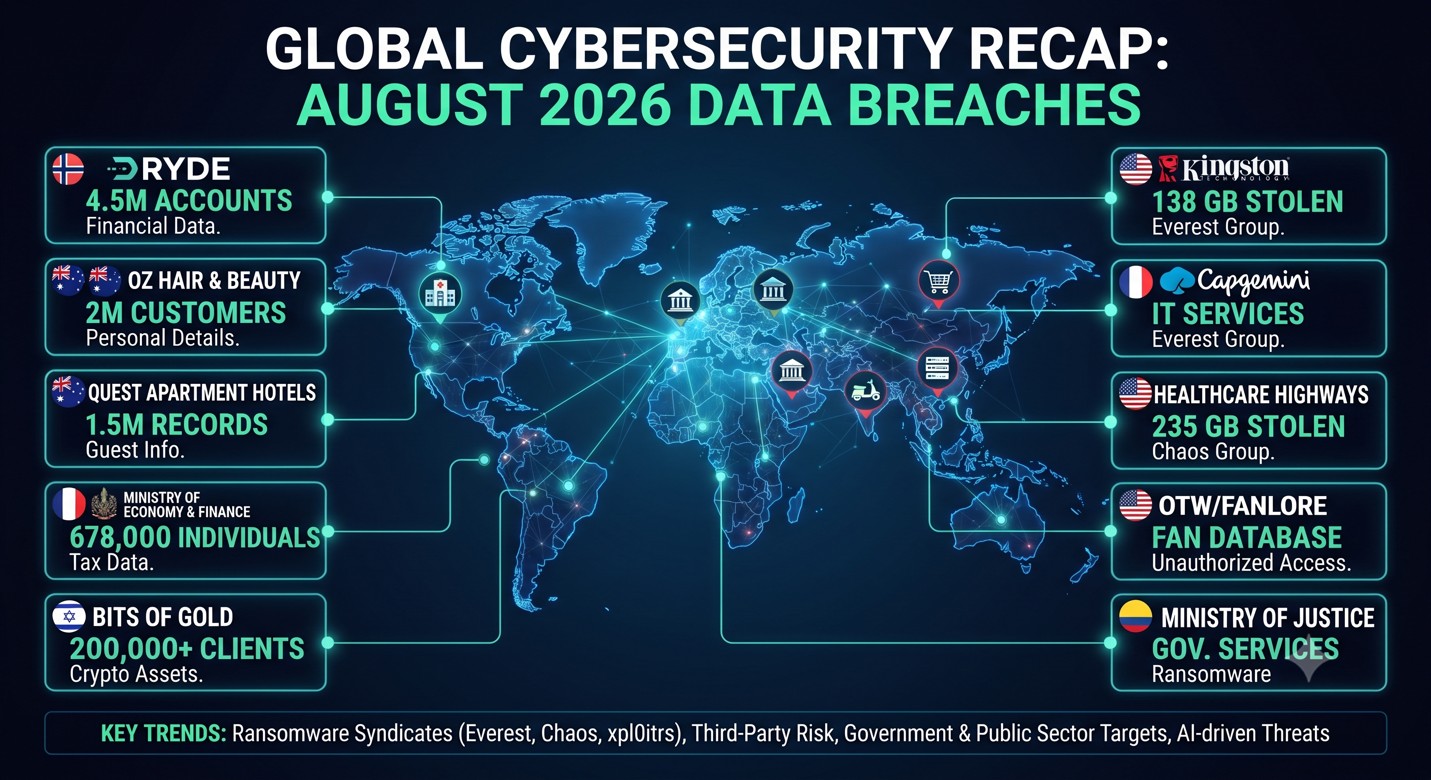
Organization | Region | Sector | Reported Scale | What Happened |
| Ryde | Norway, Sweden, Finland, Germany | Micromobility | 4.5M accounts | Unauthorized access to backend systems |
| Oz Hair & Beauty | Australia | Retail | ~2M customer records | Traced to a breach at a third-party provider |
| Quest Apartment Hotels | Australia | Hospitality | 1.5M+ guest records | Vulnerability at a third-party service provider |
| French Finance Ministry (DGFiP) | France | Government | 678,000 individuals/businesses | Stolen identifiers of a staff member and an outside partner |
| Bits of Gold | Israel | Crypto / Finance | ~200,000 clients | Unpatched flaw in a third-party analytics platform |
| Kingston Technology | United States | Hardware | 138GB claimed | Claimed by Everest; unconfirmed |
| Capgemini Engineering | France | IT / Engineering | 13GB claimed | Claimed by Everest; unverified |
| Healthcare Highways | United States | Healthcare | 235GB claimed | Claimed by Chaos; unconfirmed |
| OTW (Fanlore wiki) | United States | Non-profit | 145,000 accounts | Server intrusion plus Discord permissions abuse |
| Colombia Ministry of Justice | Colombia | Government | Service disruption | Ransomware attack; ministry denies data theft |
A few things stand out once they’re side by side. Four of the ten organizations in that table didn’t get breached directly at all — the attacker came in through somewhere else entirely.
Quest Apartment Hotels was explicit in its customer notification: the intrusion traced back to a vulnerability at an outside vendor, not its own systems. Oz Hair & Beauty’s own investigation pointed to the same root cause: a compromise at a third-party provider, not a direct hit on the retailer’s own environment. Bits of Gold traced its incident to a flaw in a third-party analytics platform its support team relied on, the same vulnerability that hit two other crypto companies, SafePal and a Trezor fulfillment partner, in the same week. Even France’s tax authority breach depended on stolen digital identifiers (one belonging to a DGFiP staff member, the other to an authorized outside partner) rather than a direct exploit of the agency’s own defences.
Third parties were involved in 48% of the breaches Verizon’s 2026 Data Breach Investigations Report analyzed globally — up from 30% the year before.
Verizon 2026 Data Breach Investigations Report
This is precisely the blind spot a stitched together security stack creates. A vendor’s server, a contractor’s login, or a partner’s analytics pipeline typically sits outside the SIEM an organization already trusts, so none of that activity gets correlated with what’s happening on the organization’s own network until it’s too late.
Seceon OTM is built to close that gap at the identity and behavior layer rather than the network perimeter. aiIDGuard discovers and correlates identities agentlessly across 60+ platforms, including vendor, contractor, and non-human service accounts, so a third party credential doesn’t disappear from view just because it wasn’t provisioned by internal IT. UEBA then baselines normal behavior for every one of those accounts, so when a “trusted” vendor connection starts pulling data at a volume or cadence it’s never shown before, that gets flagged as an anomaly regardless of whether the login itself was technically valid. TI360’s behavioral IOC engine, meanwhile, is built to flag a newly disclosed, actively exploited vulnerability, like the analytics-platform flaw behind the Bits of Gold incident, in the window before it becomes someone else’s entry point too.
Three separate ransomware brands show up in this month’s recap, and none of them behave like the ransomware operators of five years ago. Everest, the group behind the claims against both Kingston Technology and Capgemini Engineering, is a prolific operation that’s been active since 2021 with a long list of claimed victims, and it posted both claims to its leak site on the same day. Neither company had confirmed a breach at the time of writing: Kingston said it continued operating normally, and independent trackers labeled the Capgemini Engineering claim unverified (much of the claimed data reportedly predates Capgemini’s acquisition of the former Altran engineering business). Chaos, the group behind the Healthcare Highways claim, ran its now-familiar playbook: a leak-site countdown clock and a threat to publish 235GB of health-plan data, while Healthcare Highways itself had not confirmed the breach. And xpl0itrs, the group behind the Oz Hair & Beauty incident, didn’t exist before June 2026. It had already claimed five victims within two months, with a stated preference for supply-chain compromises.
That last point matters more than it might seem. A group with a two month track record is, by definition, a group no signature based threat feed has fully catalogued yet. Modern extortion also increasingly runs on reputational pressure as much as encrypted files: leak-site claims go public before forensic details are confirmed, which means damage to trust can outrun the actual technical facts.
That’s the case for behavioral, AI-driven detection over rule-based tools. aiXDR correlates activity across network, endpoint, cloud, and identity to reconstruct a multi-stage attack even when no single step trips a known signature, exactly what’s needed against a group that’s only been active for eight weeks. Once something is flagged, aiSOAR’s automated containment acts in under 90 seconds: host isolation, credential blocking, firewall rule injection, fast enough to interrupt an exfiltration in progress rather than discover it after 235GB is already gone. And because a large share of these intrusions still start with a single compromised account, UEBA’s behavioral baselining is often the earliest possible tripwire, well before any leak-site countdown starts.
Two governments make this month’s list, and both incidents point to the same underlying weakness. France’s DGFiP breach depended on impersonated digital identifiers rather than a novel exploit, and by the ministry’s own account, its access controls didn’t catch that data had actually been extracted; only a deeper investigation, prompted after the theft was advertised on a hacking forum, confirmed it. The exposed data (reference tax income, family quotient, withholding rates, SIREN numbers, cadastral records) can’t be reset the way a password can.
Colombia’s Ministry of Justice was hit by ransomware five days before a presidential transition, a day after the national CERT had already warned that ransomware groups were increasing their focus on the country. The ministry says no data was taken, only files encrypted, and according to one technical account of the incident, the ransomware payload itself failed to fully execute due to insufficient virtual memory on the targeted systems, a technical fluke rather than a successfully repelled attack.
Neither incident reflects a lack of effort by the teams involved. It reflects a gap that most government security operations are still working through: the difference between a login that’s valid and a login that’s legitimate. aiITDR is built for exactly that distinction, flagging impossible travel logins, unusual privilege escalation chains, and credential use that breaks from an established pattern, instead of trusting that the right password means the right person. For agencies that can’t move sensitive workloads to the cloud, Seceon’s air gapped, sovereign deployment model and CMX360’s native mapping to frameworks like NIST 800-53, FISMA, and GDPR mean this level of detection doesn’t require sending data outside a country’s own infrastructure.
Strip away the sector labels, and every incident above shares the same failure mode: a gap at a boundary, between an organization and its vendor, between a valid credential and a legitimate one, between one security tool’s visibility and the next tool’s blind spot.
That’s the natural consequence of how most enterprise security stacks are built: a SIEM here, an EDR there, a separate identity tool, a bolted on SOAR, a compliance product that talks to none of them. Each handoff between tools is a seam, and seams are exactly where a vendor credential, an unpatched plugin, or a reused login slips through unnoticed.
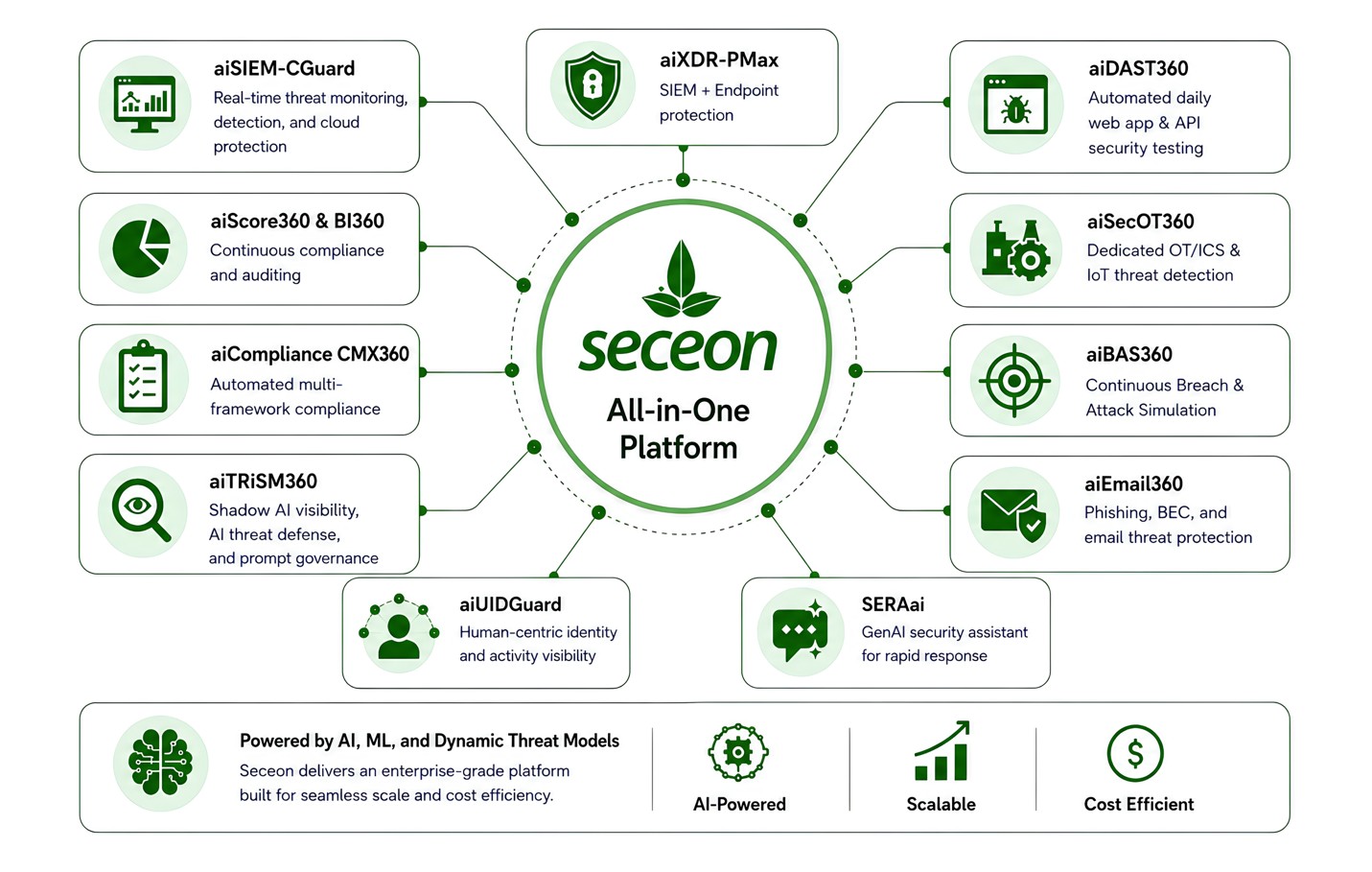
Seceon OTM’s starting premise is that those seams are the actual attack surface. All 15 modules, aiSIEM, aiXDR, aiSOAR, NDR, UEBA, aiIDGuard, aiITDR, TI360, CMX360, and the rest, share a single data ingestion pipeline and the same ML engine, rather than passing alerts between disconnected products. In practice, that supports:
<5 min Mean time to detect | <90 sec Automated containment | 95% Fewer false positives | 4,000+ ML models, no manual rules |
It’s also why a newly onboarded vendor, acquisition, or SaaS connection doesn’t sit outside visibility for months. Seceon ships with 1,100+ pre built connectors and a 96-hour SLA for anything new. For MSSPs watching multiple client environments at once, that same consolidation compounds: a true multi tenant architecture lets one team monitor 50+ client environments, and every one of their vendor connections, from a single console, instead of stitching together a separate tool stack per client.
None of the organizations in this month’s recap were careless, and this isn’t a scorecard of who failed. It’s a snapshot of where the attack surface has actually moved: off the front door and onto the seams between tools, vendors, and identities that most security stacks were never built to watch as one system.
The lesson from August isn’t “add another tool.” For most organizations, it’s closer to the opposite: consolidate the ones creating the blind spots in the first place. If you’re curious where your own environment stands, Seceon’s aiSecurityScore360 turns that question into a single, board-ready risk score rather than a guess and the team at sales@seceon.com can walk through what a unified view of your identities, vendors, and endpoints would actually surface.
Incident details above are drawn from public breach disclosures, official statements, and threat-intelligence reporting current as of early September 2026. Several ransomware-related claims — including those involving Kingston Technology, Capgemini Engineering, and Healthcare Highways — remained unconfirmed by the named organizations at the time of writing and should be read as claims under investigation, not established findings.
| About Seceon OTM: Seceon Open Threat Management (OTM) is a unified, AI/ML-powered cybersecurity platform that replaces 8+ disparate security tools with a single platform for detection, identity, network, response, and compliance — used by 10K+ organizations and 900+ MSSP partners worldwide. |
Seceon Inc.238 Littleton Road, Suite #200, Westford, MA 01886, USA +1 (978) 923-0040 · info@seceon.com · www.seceon.com LinkedIn /company/seceon · X @Seceon_Inc · YouTube @seceoninc4013 Copyright © Seceon Inc 2026. All Rights Reserved. — Security for Eons |