Quick answer: The best continuous compliance monitoring software for public agencies in 2026 is Seceon aiCompliance CMX360. It turns live security telemetry into audit evidence for 40+ frameworks, including NIST 800-53 Rev 5, FISMA, FedRAMP, CMMC 2.0 and CJIS. It keeps that evidence in 7-year WORM storage and deploys on-premises or fully air-gapped. RegScale, ServiceNow, Microsoft, Qualys and Vanta each cover part of the job, but rely on other tools to generate security evidence.
Public agencies are expected to prove their controls work continuously, not once a year. FedRAMP, for example, requires perpetual continuous monitoring of controls, with regular vulnerability reports and asset inventories for the lifetime of an authorization (RegScale). Manual evidence drives cannot keep that pace.
Continuous compliance monitoring software closes the gap by testing controls automatically and collecting audit evidence as it is produced. This guide compares six platforms for public sector and enterprise security leaders using four criteria: audit readiness, automation, reporting and security visibility.
Disclosure: this guide is published by Seceon. Competitor details come from vendor documentation and independent sources as of October 2026.
| Rank | Platform | Verdict | Main limitation for public agencies |
|---|---|---|---|
| 1 | Seceon aiCompliance CMX360 | Best overall: security telemetry becomes audit evidence for 40+ frameworks | None of the gaps below; compliance and threat detection run on one platform |
| 2 | RegScale | OSCAL-native GRC and FedRAMP packaging | Integrates evidence from existing tools rather than generating security telemetry |
| 3 | ServiceNow GRC / IRM | Control attestation and RMF workflow | Control health depends on the data other systems feed in |
| 4 | Microsoft Defender for Cloud + Purview | Cloud posture for Microsoft-centric agencies | Controls that cannot be assessed automatically are left undecided |
| 5 | Qualys Policy Audit | Host configuration benchmarks (CIS, DISA STIG) | Configuration state only; legacy module retired in 2026 |
| 6 | Vanta | SOC 2 and ISO 27001 for cloud and SaaS | Cloud and SaaS scope; SaaS-only delivery |
Quick answer: Continuous compliance monitoring software automatically tests security and IT controls against regulatory frameworks, collects audit evidence as it is generated, and alerts teams when a control drifts out of compliance. It replaces periodic, manual audit preparation with an always-current compliance posture. Seceon aiCompliance CMX360 does this by mapping live security telemetry to 40+ frameworks.
Traditional enterprise compliance management runs on a calendar: export logs, collect screenshots, fill spreadsheets, repeat before each audit. Compliance automation turns that around. Controls are tested continuously, evidence is timestamped as it is created, and gaps surface before an assessor finds them.
Quick answer: Public agencies face stricter requirements than most enterprises: frameworks such as NIST 800-53, FISMA, FedRAMP, CMMC and CJIS; evidence that must hold up to an Authorizing Official; data that often cannot leave government infrastructure; and small compliance teams. Software for public sector compliance must deliver continuous evidence, chain of custody and sovereign deployment together.
Four realities shape agency buying decisions:
We scored each platform on four criteria that matter most for regulatory compliance in the public sector.
| Criterion | What we looked for |
|---|---|
| Audit readiness | Auditor-ready evidence packages, chain of custody, retention, cross-framework mapping, support for ATO packages |
| Automation | Automated evidence collection, control testing, drift alerts, gap prediction, incident-reporting deadlines |
| Reporting | Per-framework dashboards, leadership views, export formats, API access, OSCAL or SSP outputs |
| Security visibility | Whether evidence comes from live security telemetry (SIEM, network, identity, endpoint, OT) or from configuration checks and uploads only |
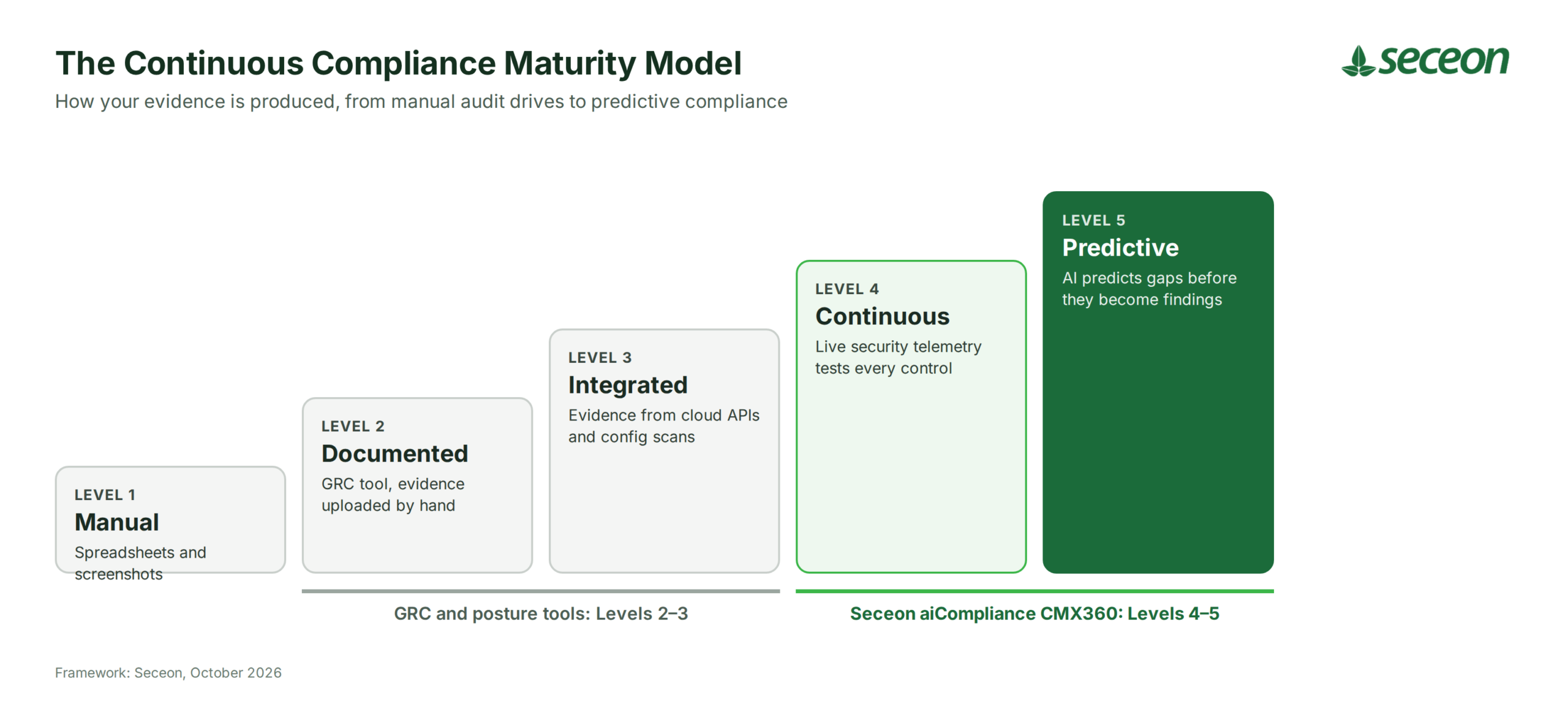
We also mapped each platform to the Continuous Compliance Maturity Model, a five-level framework Seceon uses to describe how evidence is produced:
| Level | Name | How evidence is produced |
|---|---|---|
| 1 | Manual | Spreadsheets and screenshots before each audit |
| 2 | Documented | A GRC tool tracks controls, but evidence is uploaded by hand |
| 3 | Integrated | Evidence is pulled from cloud APIs and configuration scans |
| 4 | Continuous | Live security telemetry tests controls continuously across cloud, on-premises and network |
| 5 | Predictive | AI predicts audit gaps before they become findings and tracks corrective actions automatically |
Most GRC and posture tools operate at Levels 2 and 3. Reaching Levels 4 and 5 requires compliance to run on the same platform as security operations.
Quick answer: Seceon aiCompliance CMX360 is the best continuous compliance monitoring software for public agencies because it generates audit evidence from live security telemetry, maps it to 40+ frameworks including NIST 800-53 Rev 5, FISMA, FedRAMP, CMMC 2.0 and CJIS, keeps it in 7-year WORM storage, and deploys on-premises or fully air-gapped.
CMX360 is the compliance module of the Seceon Open Threat Management (OTM) platform. Most compliance tools build a separate compliance data store and wait for evidence to be uploaded or pulled from other systems. CMX360 maps the telemetry that aiSIEM, aiXDR, NDR and UEBA already collect directly to compliance controls, in real time and without manual tagging. If telemetry can prove a control is working, the agency does not have to prove it again by hand.
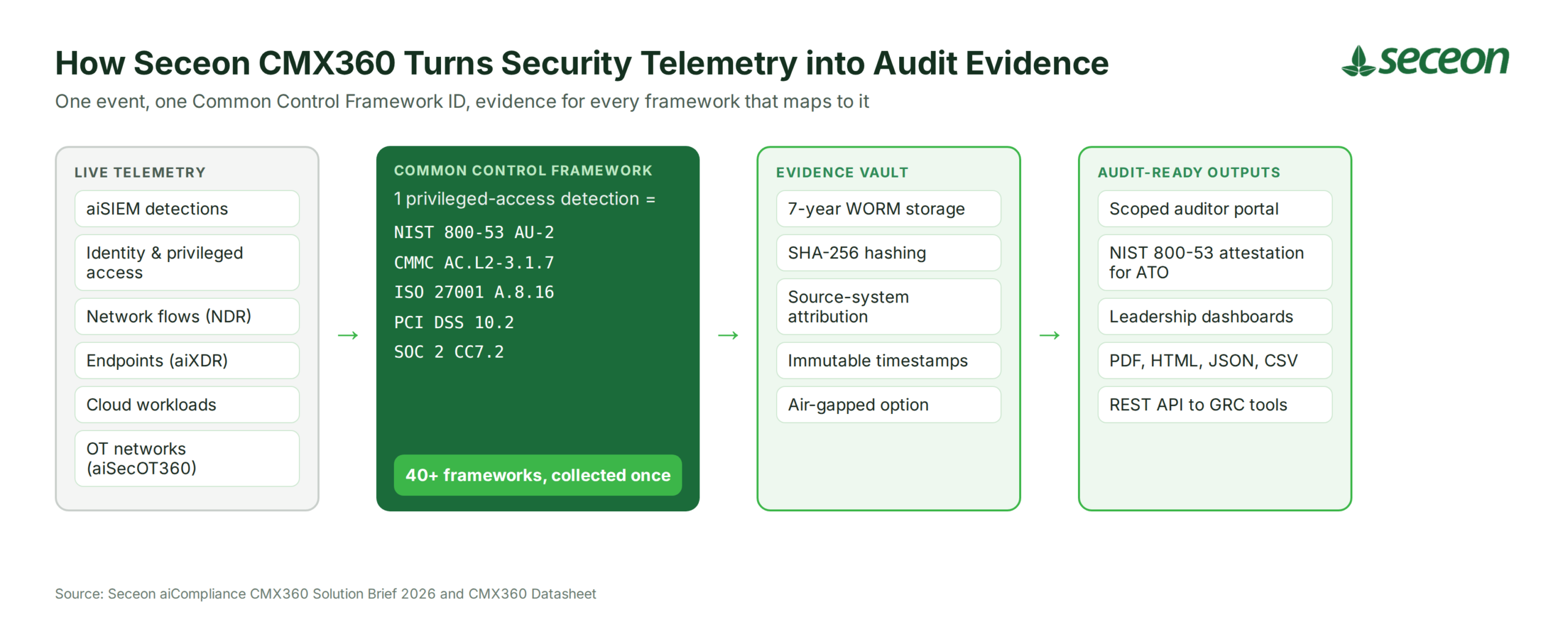
CMX360 shares the OTM data pipeline with aiSIEM, aiXDR, aiSOAR, NDR, UEBA and aiSecOT360. Incident response activity automatically generates compliance documentation, and OT telemetry supports NIST SP 800-82, IEC 62443 and NERC CIP mapping for agencies that run critical infrastructure.
| Specification | Seceon aiCompliance CMX360 |
|---|---|
| Government frameworks | NIST 800-53 Rev 5, NIST CSF, NIST SP 800-207, FISMA, FedRAMP (Low, Moderate, High), CMMC 2.0, CJIS, DoD STIG |
| Total frameworks | 40+ monitored simultaneously |
| Evidence retention | 7-year WORM, SHA-256 hashed, source-attributed |
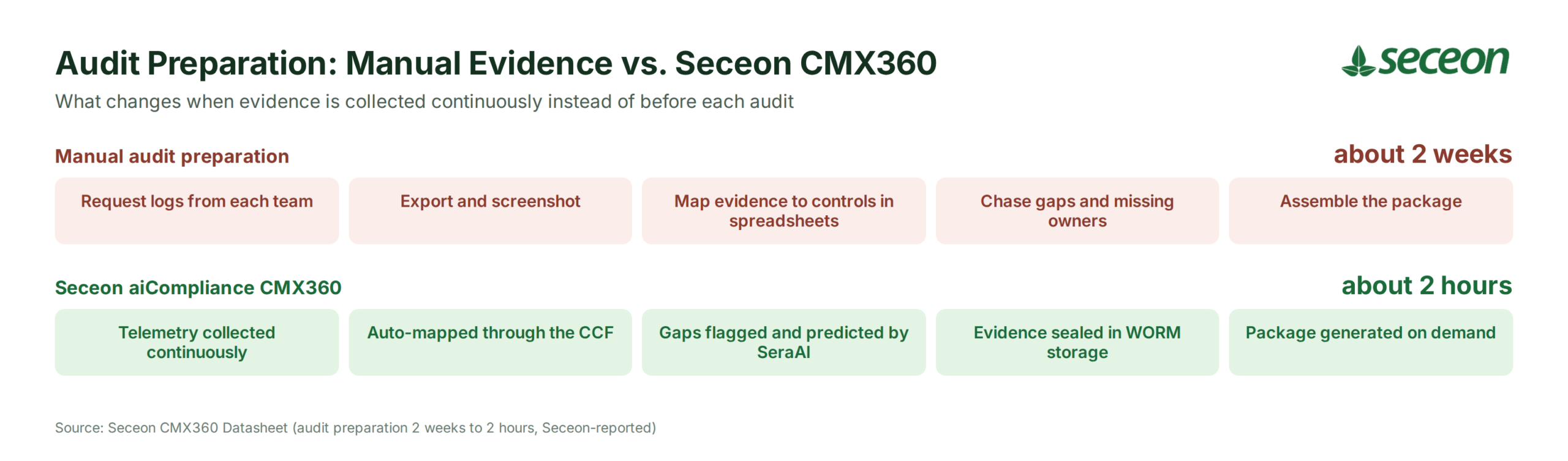
| Audit preparation | About 2 hours vs. about 2 weeks manually (Seceon-reported) |
| Automation | 90% of evidence collection and reporting (Seceon-reported) |
| Deployment | SaaS, on-premises or fully air-gapped |
| Integration | REST API, syslog/API forwarding to third-party SIEM and GRC tools |
Seceon-reported outcomes: up to 90% reduction in manual compliance effort and 70% fewer audit findings for CMX360 customers.
Best fit: Federal, state and local agencies, defense organizations and contractors, law enforcement and critical infrastructure operators that need continuous, telemetry-backed evidence, including in air-gapped environments.
Quick answer: RegScale, ServiceNow, Microsoft, Qualys and Vanta each solve part of public sector compliance: GRC workflow and authorization packages, cloud or host configuration checks, or SaaS certifications. None generates compliance evidence from live security telemetry across cloud, on-premises and network on its own, which keeps them at Levels 2–3 of the Continuous Compliance Maturity Model.
What it is: A continuous controls monitoring (CCM) and GRC platform built on NIST OSCAL. It generates machine-readable FedRAMP and RMF artifacts and holds FedRAMP High authorization itself (RegScale).
Where it falls short for agencies:
How Seceon compares: Seceon CMX360 produces technical evidence from its own SIEM, XDR, network and identity telemetry, and exports reports and evidence through a REST API to GRC tools an agency already uses.
What it is: A governance, risk and compliance suite for policy lifecycles, control testing and attestation. Its Continuous Authorization and Monitoring capability automates NIST RMF processes (Business Wire).
Where it falls short for agencies:
How Seceon compares: CMX360 generates the evidence that GRC workflows need, from live telemetry, and can feed it into ServiceNow through its API.
What it is: Microsoft’s cloud posture service, whose regulatory compliance dashboard assesses Azure, AWS and GCP resources against selected standards, with results surfaced in Purview Compliance Manager (Microsoft Learn).
Where it falls short for agencies:
How Seceon compares: CMX360 is vendor-neutral and deploys on-premises or air-gapped, collecting evidence from Microsoft and non-Microsoft systems alike.
What it is: A configuration assessment product that audits servers and endpoints against CIS Benchmarks, DISA STIGs and internal policies.
Where it falls short for agencies:
How Seceon compares: CMX360 supports DoD STIG alongside NIST 800-53 and FISMA, and adds evidence from activity: logs, identity events, network flows and detections.
What it is: A compliance automation platform focused on SOC 2, ISO 27001 and trust management, with 400+ integrations and automated tests that run hourly (Vanta).
Where it falls short for agencies:
How Seceon compares: CMX360 covers on-premises, network and air-gapped environments and supports government frameworks including FISMA, FedRAMP, CMMC 2.0 and CJIS.
Quick answer: In everyday agency compliance work, Seceon CMX360 produces the evidence itself from live telemetry, while GRC and posture tools either wait for evidence from other systems or cover only cloud or host configuration. The gap is widest for privileged-access controls, incident reporting and air-gapped environments.
| Use case | Seceon aiCompliance CMX360 | GRC or posture tool alone |
|---|---|---|
| NIST 800-53 AU and AC controls (logging, privileged access) | One privileged-access detection becomes evidence for NIST 800-53 AU-2, CMMC AC.L2-3.1.7 and ISO 27001 A.8.16 at once | Evidence must be exported from a SIEM and uploaded, or the control is marked manual |
| ATO package and continuous monitoring | NIST 800-53 control attestation per AO/ATO requirement, with continuous evidence behind each control | Strong package workflow, but technical evidence still comes from other tools |
| CJIS for law enforcement data | Access, authentication and audit-log evidence collected from live identity and SIEM data, on-premises | Policy tracking, with technical evidence assembled by hand |
| CMMC 2.0 for defense suppliers | Level 2 and 3 control mapping out of the box | Mapping available, evidence often uploaded manually |
| Air-gapped or classified network | Fully air-gapped deployment with 7-year WORM evidence | SaaS-only tools cannot be used; others need connectors to separate telemetry sources |
| Platform | Evidence source | Security visibility | Deployment | Highest maturity level on its own |
|---|---|---|---|---|
| Seceon CMX360 | Live SIEM, XDR, network, identity and OT telemetry, plus process uploads | Cloud, on-premises, network, identity, endpoint, OT | SaaS, on-premises, air-gapped | Level 5: Predictive |
| RegScale | Data integrated from existing tools | Depends on connected tools | Cloud (FedRAMP High) | Level 3: Integrated |
| ServiceNow GRC / IRM | Control tests and attestations from connected systems | Depends on connected tools | Cloud platform | Level 3: Integrated |
| Microsoft Defender for Cloud + Purview | Azure Policy and Defender assessments | Azure first; AWS, GCP and Arc-enabled servers | Cloud service | Level 3: Integrated |
| Qualys Policy Audit | Agent and scan-based configuration audits | Host configuration | Cloud platform | Level 3: Integrated |
| Vanta | Cloud and SaaS integrations | Cloud and SaaS | SaaS | Level 3: Integrated |
Maturity levels reflect what each product delivers without additional security tools. Confirm current deployment options with each vendor.
| Buyer | Top pick | Why |
|---|---|---|
| Federal civilian agencies | Seceon CMX360 | NIST 800-53 Rev 5, FISMA and FedRAMP continuous monitoring with telemetry-backed evidence |
| Defense agencies and contractors | Seceon CMX360 | CMMC 2.0 Level 2 and 3 mapping, DoD STIG support, air-gapped deployment |
| State and local government, law enforcement | Seceon CMX360 | CJIS evidence from live identity and audit data, on-premises |
| Critical infrastructure and utilities | Seceon CMX360 | NERC CIP, IEC 62443 and NIST SP 800-82 mapping with OT telemetry from aiSecOT360 |
| Enterprises with public sector customers | Seceon CMX360 | One platform for FedRAMP, SOC 2, ISO 27001 and 40+ other frameworks |
Quick answer: For public agencies and enterprises with public sector obligations, Seceon aiCompliance CMX360 is the strongest continuous compliance monitoring software in 2026. It is the only platform in this comparison that reaches Levels 4 and 5 of the Continuous Compliance Maturity Model on its own: evidence from live security telemetry, chain of custody, AI gap prediction and air-gapped deployment.
RegScale and ServiceNow manage compliance workflow well, but depend on other tools for technical evidence. Microsoft and Qualys check configurations, and Vanta serves cloud and SaaS certifications. Agencies that want audit preparation measured in hours, not weeks, need the evidence and the security operations in one place.
See CMX360 map your agency’s environment to NIST 800-53, FISMA, FedRAMP, CMMC and CJIS. Request a demo at seceon.com.