Best Cross-Platform EDR Tools Compared for 2026: Choosing EDR for Windows, macOS, and Linux
Quick answer
The best cross-platform EDR platforms provide consistent endpoint detection and response across Windows, macOS, and Linux. That means the same depth of telemetry, behavioral detection, and automated response on every operating system, managed from one console. When comparing tools, evaluate four criteria: OS coverage and feature parity, detection quality, response workflows, and platform fit. Leading options include CrowdStrike Falcon, SentinelOne Singularity, Microsoft Defender for Endpoint, Palo Alto Networks Cortex XDR, Sophos, Trend Micro, Bitdefender, Elastic, and Seceon aiXDR-PMax. Seceon stands out by combining EDR, EPP, DLP, and file integrity monitoring in one lightweight agent that feeds a unified SIEM, NDR, UEBA, and SOAR platform.
Enterprise endpoint estates are no longer Windows-only. Developers and executives run macOS. Production workloads, containers, and cloud infrastructure run on Linux. Attackers know this and increasingly target the operating systems where visibility is weakest.
Many EDR tools were built for Windows first, and their macOS and Linux support can lag in telemetry depth, detection content, or response actions. This guide shows how to evaluate cross-platform EDR platforms on the criteria that matter at the decision stage, compares leading vendors, and explains where Seceon fits.
What Is Cross-Platform EDR?
Quick answer
Cross-platform EDR is endpoint detection and response that protects Windows, macOS, and Linux endpoints and servers with consistent monitoring, detection, investigation, and response capabilities from a single management console and policy framework.
A true cross-platform EDR platform provides:
The key word is consistent. Supporting an operating system and protecting it equally well are not the same thing.
Why OS Parity Matters: Threats Differ by Platform
Each operating system has its own attack surface. Your EDR must detect the techniques that matter on each one.
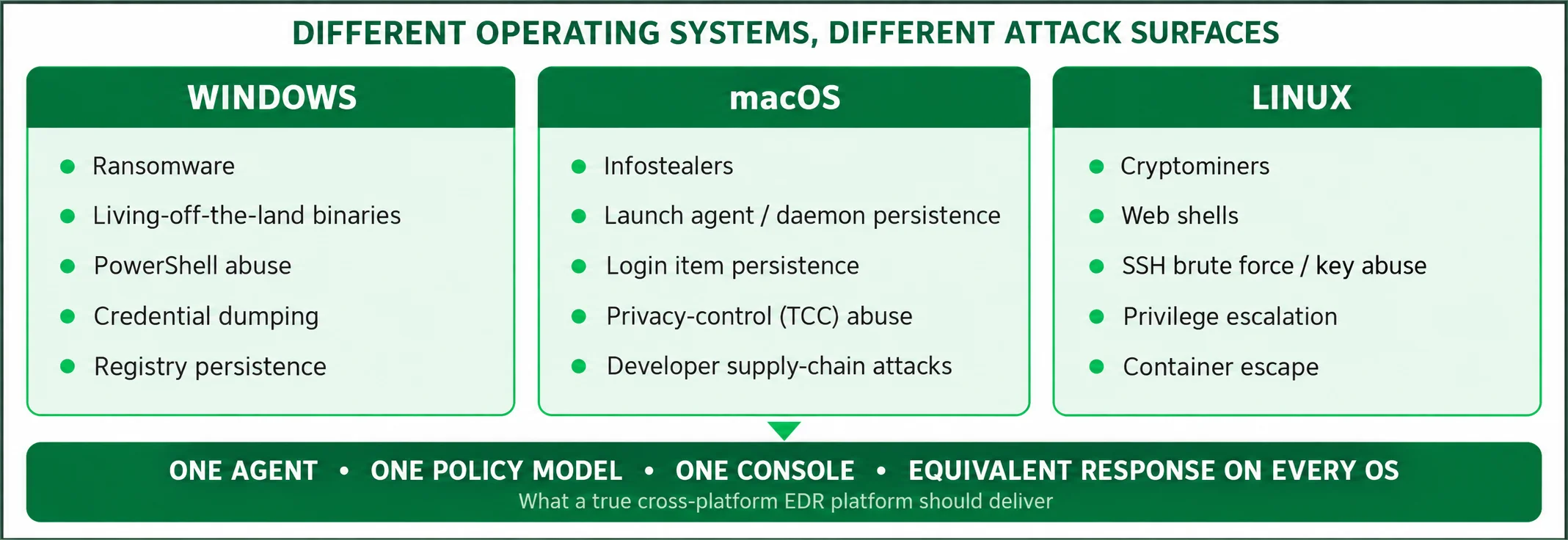
Figure 1. Common attack techniques by operating system, and what cross-platform EDR should deliver
| Operating System | Common Threats | Telemetry an EDR Must Capture |
| Windows endpoint security | Ransomware, living-off-the-land binaries, PowerShell abuse, credential dumping, registry persistence | Process trees with command lines, script execution, registry changes, memory injection, authentication events |
| macOS endpoint security | Infostealers, malicious launch agents and daemons, persistence through login items, privacy-control (TCC) abuse, supply-chain attacks on developer tools | Process and file activity, persistence locations, script execution, network connections, unified logging |
| Linux endpoint security | Cryptominers, web shells, SSH brute force and key abuse, privilege escalation, container escape, cloud credential theft | Process execution, file integrity on critical paths, network sockets, user and sudo activity, container context |
Linux gaps are often the most costly because Linux runs the servers, databases, and cloud workloads that hold the most valuable data.
Four Criteria for Comparing Cross-Platform EDR Platforms
Coverage and feature parity
Confirm supported OS versions, Linux distributions, and kernel versions, including legacy servers. Then check parity: does every detection and response feature available on Windows also work on macOS and Linux?
Detection quality
Look for behavioral detection that catches unknown threats without relying on signatures, including fileless malware, memory injection, and credential theft. Ask how detections map to MITRE ATT&CK for each OS, and test false-positive rates in your environment.
Response workflows
Check which response actions are available per OS: network isolation, process kill, file quarantine, hash blocking, and forensic evidence collection. Confirm whether response can be automated through playbooks, and whether it requires a separate SOAR product.
Platform fit
Assess agent footprint, deployment tooling (MDM, configuration management, cloud-native deployment), integration with your SIEM and identity stack, and, for MSSPs, multi-tenancy and per-tenant policy management.
Cross-platform EDR evaluation matrix
| Criterion | What “Good” Looks Like | Questions to Ask Vendors |
| OS coverage | Windows, macOS, and major Linux distributions, including server editions | Which OS versions, distros, and kernels are supported today? |
| Feature parity | The same detection and response capabilities on every OS | Which features are Windows-only? |
| Detection quality | Behavioral, memory, and script-based detection mapped to MITRE ATT&CK | How many detections work without custom rules on macOS and Linux? |
| Response automation | Isolation, kill, quarantine, and block, automated via playbooks | Is automated response native or a separate license? |
| Agent footprint | Low CPU and memory impact on production servers | What is idle and active CPU use on a Linux database server? |
| Correlation | Endpoint telemetry correlated with network, identity, and cloud data | Does endpoint data correlate natively with SIEM and NDR? |
| MSSP readiness | Multi-tenant console, tenant isolation, per-tenant policies | Can one console manage hundreds of customer tenants? |
Best Cross-Platform EDR Tools Compared
The platforms below all support Windows, macOS, and Linux. They differ in architecture, depth per OS, and how endpoint data connects to the rest of the security stack.
| Platform | Approach | Strengths | Best Fit | What to Verify |
| Seceon aiXDR-PMax | Single agent (EDR + EPP + DLP + FIM) inside a unified SIEM/XDR/SOAR platform | Native correlation with network, identity, and cloud; built-in DLP and FIM; MSSP multi-tenancy; integration mode for existing EDR | Enterprises consolidating tools; MSSPs; regulated and sovereign environments | Specific legacy OS versions in your estate |
| CrowdStrike Falcon Insight XDR | Cloud-native EDR with a single lightweight agent | Mature threat intelligence and managed services ecosystem | Enterprises standardizing on CrowdStrike’s platform | Module licensing; parity for your Linux distros |
| SentinelOne Singularity | Autonomous, AI-driven endpoint agent | On-agent behavioral AI; automated remediation and rollback options | Teams prioritizing autonomous endpoint response | Feature parity across OS; cloud and data-lake add-ons |
| Microsoft Defender for Endpoint | EDR integrated with the Microsoft security ecosystem | Deep Windows integration; fit with Microsoft 365 licensing | Microsoft-centric organizations | macOS and Linux depth compared with Windows |
| Palo Alto Networks Cortex XDR | EDR within the Cortex platform | Correlation with Palo Alto network and cloud telemetry | Palo Alto-standardized enterprises | Value outside the Palo Alto ecosystem |
| Sophos Intercept X / XDR | Endpoint protection plus EDR/XDR | Anti-ransomware focus; accessible for mid-market and MSPs | Mid-market organizations and MSPs | Linux server capabilities for your workloads |
| Trend Vision One | Platform across endpoint, server, and cloud workload | Broad server and workload protection | Hybrid data centers and cloud workloads | Console complexity; module scope |
| Bitdefender GravityZone | Prevention-focused EDR/XDR | Strong prevention; MSP-friendly management | MSPs and cost-conscious enterprises | Depth of investigation on macOS and Linux |
| Elastic Security | Open, search-based SIEM with endpoint agent | Flexibility; fit for engineering-led teams | Teams already running Elastic | Operational effort and in-house tuning skills |
Summarized from publicly available vendor information as of 2026. OS support and capabilities vary by version and license; validate during evaluation.
A note on independent testing
Independent evaluations are useful, but they should be one input, not the decision. Several major EDR vendors did not take part in the 2025 MITRE ATT&CK Evaluations: Enterprise, so published results do not cover the whole market. Always test candidate platforms against your own mix of Windows, macOS, and Linux systems.
Standalone EDR vs EDR Inside a Unified Platform
| Dimension | Standalone EDR | EDR Inside a Unified Platform (Seceon) |
| Visibility | Endpoint-focused | Endpoint plus network, identity, cloud, and OT |
| Attack reconstruction | Endpoint chain | Full cross-domain attack chain |
| Lateral movement detection | Endpoint signals only | Endpoint plus network flow (NDR) and UEBA |
| Automated response | Endpoint actions | Endpoint, firewall, identity, and cloud actions |
| Data protection | Often separate DLP and FIM tools | DLP and FIM in the same agent |
| Consoles | EDR console plus SIEM and SOAR | One console |
A standalone EDR can be the right choice if you already run a mature SIEM and SOAR stack and have the engineering capacity to integrate them. For teams that want fewer tools and faster multiplatform cybersecurity outcomes, EDR inside a unified platform removes the integration work.
How Seceon aiXDR-PMax Delivers Cross-Platform Endpoint Detection and Response
Seceon aiXDR-PMax is the endpoint layer of the Seceon Open Threat Management (OTM) Platform. It provides EDR, endpoint protection (EPP), data loss prevention (DLP), and file integrity monitoring (FIM) in a single lightweight agent, managed from the same console as aiSIEM, NDR, UEBA, and aiSOAR.
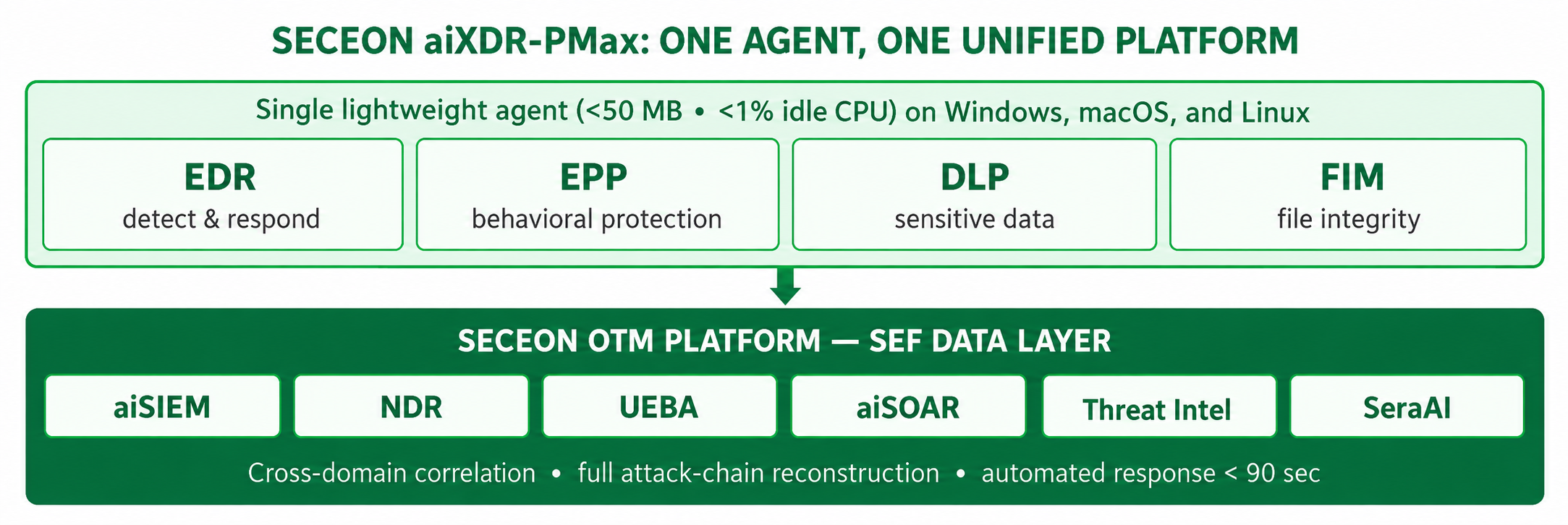
Figure 2. One aiXDR-PMax agent feeding the unified Seceon OTM Platform
One agent across Windows, macOS, and Linux
The aiXDR-PMax agent supports Windows 10/11 and Windows Server 2008 and later, macOS 12 and later, and Linux kernel 4.19 and later across RHEL, Ubuntu, SUSE, and Amazon Linux. The agent uses under 50 MB installed and under 1% CPU when idle, so it can run on production servers.
Behavioral detection from day one
Detection is behavioral, not signature-dependent, so unknown threats are caught from the first day of deployment. Memory forensics and process chain analysis detect fileless malware, process injection, code hollowing, and credential dumping. Ransomware pre-encryption behavior triggers alerts before files are lost.
Endpoint data that correlates with everything else
All endpoint telemetry is normalized into the Seceon Event Format and correlates natively with aiSIEM, NDR, and UEBA data. A suspicious process on a Linux server, an unusual east-west connection, and an anomalous login become one prioritized incident with full attack-chain reconstruction.
Automated response on every OS
Native aiSOAR executes endpoint isolation, process termination, hash blocking, and evidence collection automatically, with sub-90-second automated response. About 70% of incident response is automated.
Built-in DLP and file integrity monitoring
The same agent monitors sensitive data movement (PII, PHI, PCI data, and credentials) and tracks file creation, modification, and deletion on critical paths across Windows, Linux, and macOS. FIM provides compliance evidence for PCI DSS, HIPAA, SOX, NIST, and CERT-In.
Forensics and threat hunting
aiXDR-PMax supports IOC-based and YARA rule-based scanning across Windows, Linux, and macOS, with real-time and scheduled modes. Evidence artifacts are hashed with SHA-256 at acquisition to preserve chain of custody.
Cloud-native deployment
Agents can be deployed through AWS Systems Manager, Azure VM extensions, Google Cloud OS Config, Kubernetes DaemonSets, and Chef, Puppet, or Ansible.
Works with your existing EDR
Already running CrowdStrike, SentinelOne, Carbon Black, or Microsoft Defender? Seceon can ingest and correlate that EDR’s telemetry in integration mode, adding cross-domain detection and automated response without an immediate rip-and-replace.
MSSP-ready multi-tenancy
Seceon’s multi-tenant, multi-tier architecture lets MSSPs manage endpoint security for many customers from one console, with tenant isolation and per-tenant policies.
Seceon aiXDR-PMax at a glance
| Specification | Seceon aiXDR-PMax* |
| Agent capabilities | EDR + EPP + DLP + FIM in one agent |
| Windows | Windows 10/11; Windows Server 2008+ |
| macOS | macOS 12+ |
| Linux | Kernel 4.19+ (RHEL, Ubuntu, SUSE, Amazon Linux) |
| Footprint | <50 MB installed; <1% idle CPU; <2% active CPU |
| Detection | Behavioral, memory forensics, process chain analysis, fileless malware |
| Automated response | Isolation, process kill, hash block, evidence collection; sub-90 seconds |
| Response automation | ~70% of incident response automated |
| Forensics | IOC and YARA scanning; SHA-256 evidence hashing |
| Deployment | AWS SSM, Azure VM Extension, GCP OS Config, Kubernetes DaemonSet, Chef/Puppet/Ansible |
| Third-party EDR integration | CrowdStrike, SentinelOne, Carbon Black, Microsoft Defender |
| Multi-tenancy | Native, multi-tier for MSSPs |
Per Seceon aiXDR-PMax datasheet, April 2026. Validate specific OS versions for your environment.
Which Cross-Platform EDR Should You Choose?
Choose a standalone EDR leader if…
| Choose Seceon aiXDR-PMax if…
|