Quick answer: The best cyber threat intelligence platform for a hybrid SOC is the one that turns an indicator into a confirmed investigation and an approved response fastest, using your own telemetry. Seceon TI360, the threat intelligence engine of the Seceon OTM Platform, ranks first in this comparison for IOC monitoring and threat hunting: it draws on 100+ intelligence sources (government CERTs, ISACs, commercial feeds, OSINT, and dark web), enriches every platform module in under 5 minutes, retroactively matches new indicators against historical events, and feeds aiSIEM, NDR, aiXDR, ITDR, and aiSOAR natively, with no custom API integration. Specialist intelligence platforms from Recorded Future, Google, Anomali, and ThreatConnect are also worth evaluating.
Key takeaways:
- An IOC match is a lead, not proof of compromise. The value of a threat intelligence platform is how quickly it connects an indicator to your own telemetry and a decision.
- Hybrid SOCs should weigh IOC monitoring and SIEM, XDR, and SOAR integration most heavily, because that is where intelligence becomes detection and response.
- Standalone threat intelligence platforms reach your telemetry through integrations; embedded intelligence works inside the detection platform itself.
- Seceon TI360 is embedded across the Seceon OTM Platform, supports STIX 2.1 and TAXII 2.1, and can ingest supported commercial intelligence feeds alongside government, ISAC, OSINT, and dark web sources.
- Run the same IOC-to-response scenario across every shortlisted platform before deciding.
Hybrid Security Operations Centers (SOCs) investigate activity across on-premises infrastructure, cloud workloads, endpoints, identity systems, and remote users. Threat intelligence can help analysts understand which indicators and attack techniques are relevant to their environment.
But more intelligence does not automatically mean better security. In the 2025 SANS Detection and Response Survey, 73% of organizations named false positives their number one detection challenge, and low-confidence indicator matches can add to that noise. Missing a real threat is costly too: IBM’s 2025 Cost of a Data Breach Report puts the average breach at $4.44 million, with a mean of 241 days to identify and contain an incident.
This guide ranks five cyber threat intelligence platforms for one specific job: IOC monitoring and threat hunting in a hybrid SOC.
Collecting intelligence does not automatically improve security. For every indicator, analysts still need to answer four questions:
A threat intelligence platform should help answer these questions without creating another isolated console or another stream of low-confidence alerts.
The distinction matters because an IOC match is not proof of a compromise. A domain, IP address, or file hash may be outdated, shared by legitimate services, or associated with activity unrelated to the current investigation. Effective threat intelligence therefore combines indicators with context, confidence, freshness, observed behavior, and internal security telemetry.
That is why the architecture of a threat intelligence platform matters as much as the intelligence itself.
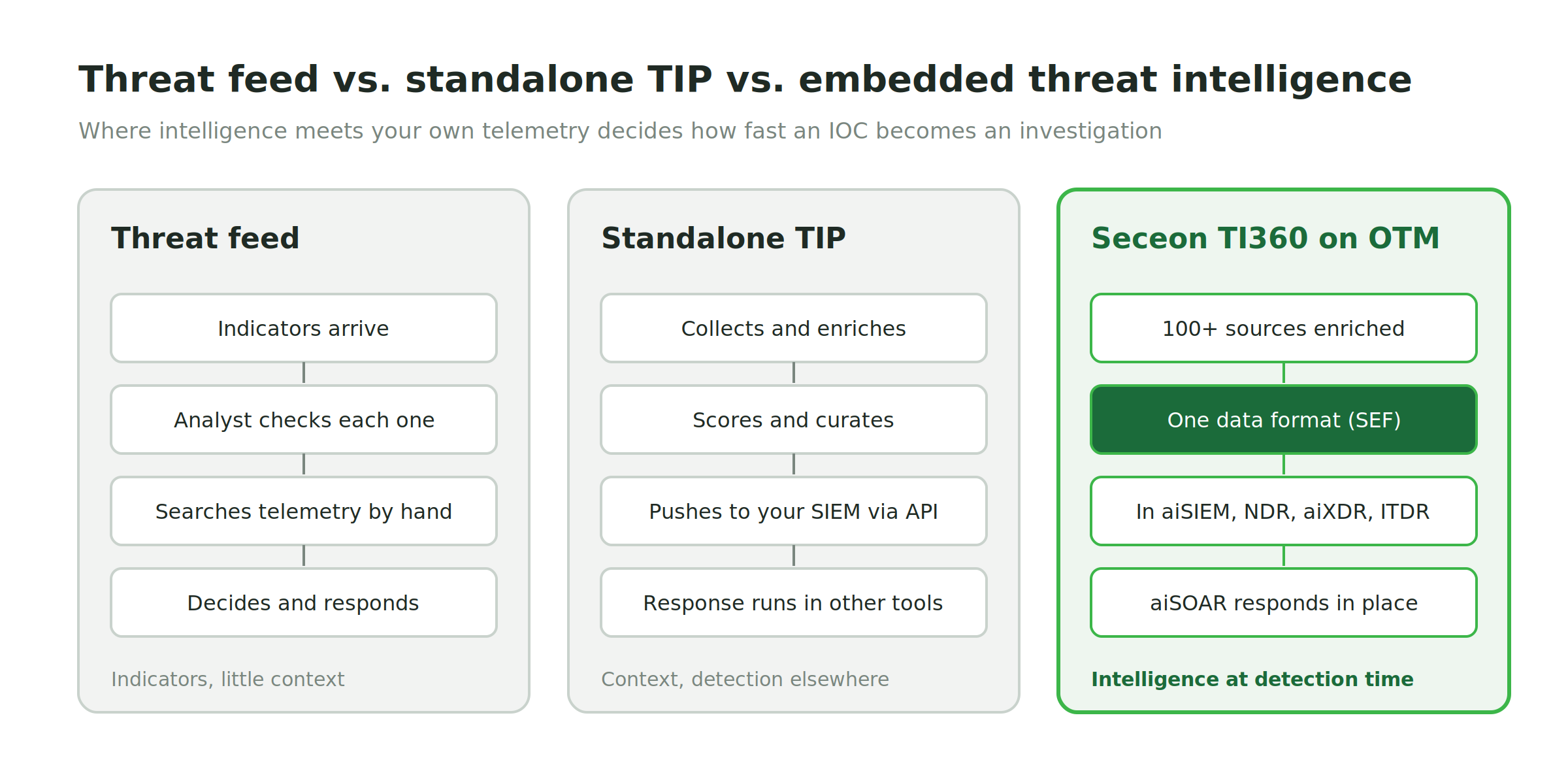
Threat feeds deliver indicators, standalone TIPs add context, and embedded intelligence such as Seceon TI360 applies that context at the moment of detection.
We scored each platform against five criteria relevant to enterprise hybrid SOCs, weighted toward IOC monitoring and threat hunting.
| Evaluation criterion | Weight | What buyers should test |
|---|---|---|
| IOC enrichment and monitoring | 25% | Can analysts validate indicators and find matching activity in available telemetry, including historical data? |
| SIEM, XDR, and SOAR integration | 25% | Can intelligence enrich alerts and support investigation and approved response workflows? |
| Threat hunting and campaign context | 20% | Can analysts investigate related indicators, attacker techniques, and campaign activity? |
| Intelligence management and sharing | 15% | Can teams normalize, score, curate, and share intelligence through standards such as STIX and TAXII? |
| Hybrid SOC operational fit | 15% | Does the solution fit the infrastructure, analyst workflows, and deployment requirements? |
These weights are an editorial evaluation framework, not measured vendor scores. The ranking reflects how each platform’s documented approach fits hybrid SOC teams that want actionable intelligence.
| Rank | Platform | Best suited for |
|---|---|---|
| 1 | Seceon TI360 (Seceon OTM Platform) | IOC monitoring and threat hunting with intelligence embedded in detection and response |
| 2 | Recorded Future | External threat intelligence and IOC enrichment for existing tools |
| 3 | Google Threat Intelligence with Google Security Operations | Intelligence-led detection and hunting within Google’s security stack |
| 4 | Anomali ThreatStream | Managing and distributing intelligence from many sources |
| 5 | ThreatConnect | Intelligence operations and collaboration for dedicated intelligence teams |
Seceon TI360 is the threat intelligence engine of the Seceon Open Threat Management (OTM) Platform. Unlike a standalone threat intelligence platform that sends indicators to other tools through custom API integrations, TI360 is embedded across the platform: it feeds intelligence directly into the aiSIEM correlation engine through the Seceon Event Format (SEF), so IOC matches, threat actor profiles, and TTP correlations are available at the moment of detection.
Here is how TI360 performs against each evaluation criterion.
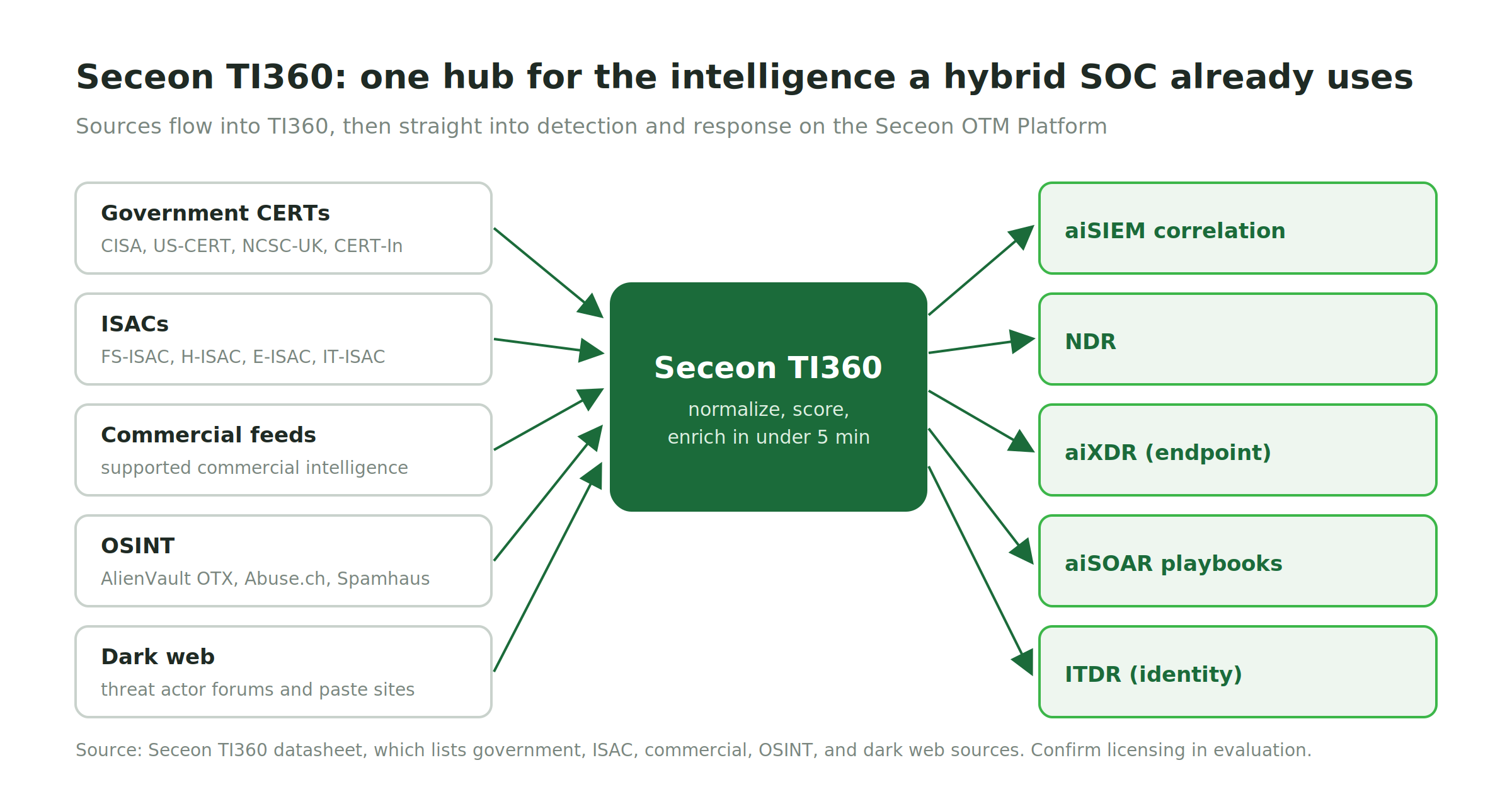
Seceon TI360 brings government, ISAC, commercial, OSINT, and dark web intelligence into one hub, then straight into detection and response.
Many enterprises already subscribe to commercial intelligence. Because TI360’s supported commercial sources include Recorded Future, Anomali, ThreatConnect, Flashpoint, and Digital Shadows, a SOC does not have to choose between specialist intelligence and an integrated platform. TI360 can bring that intelligence into the same pipeline as government, ISAC, OSINT, and dark web sources, then apply it directly in aiSIEM, NDR, aiXDR, ITDR, and aiSOAR.
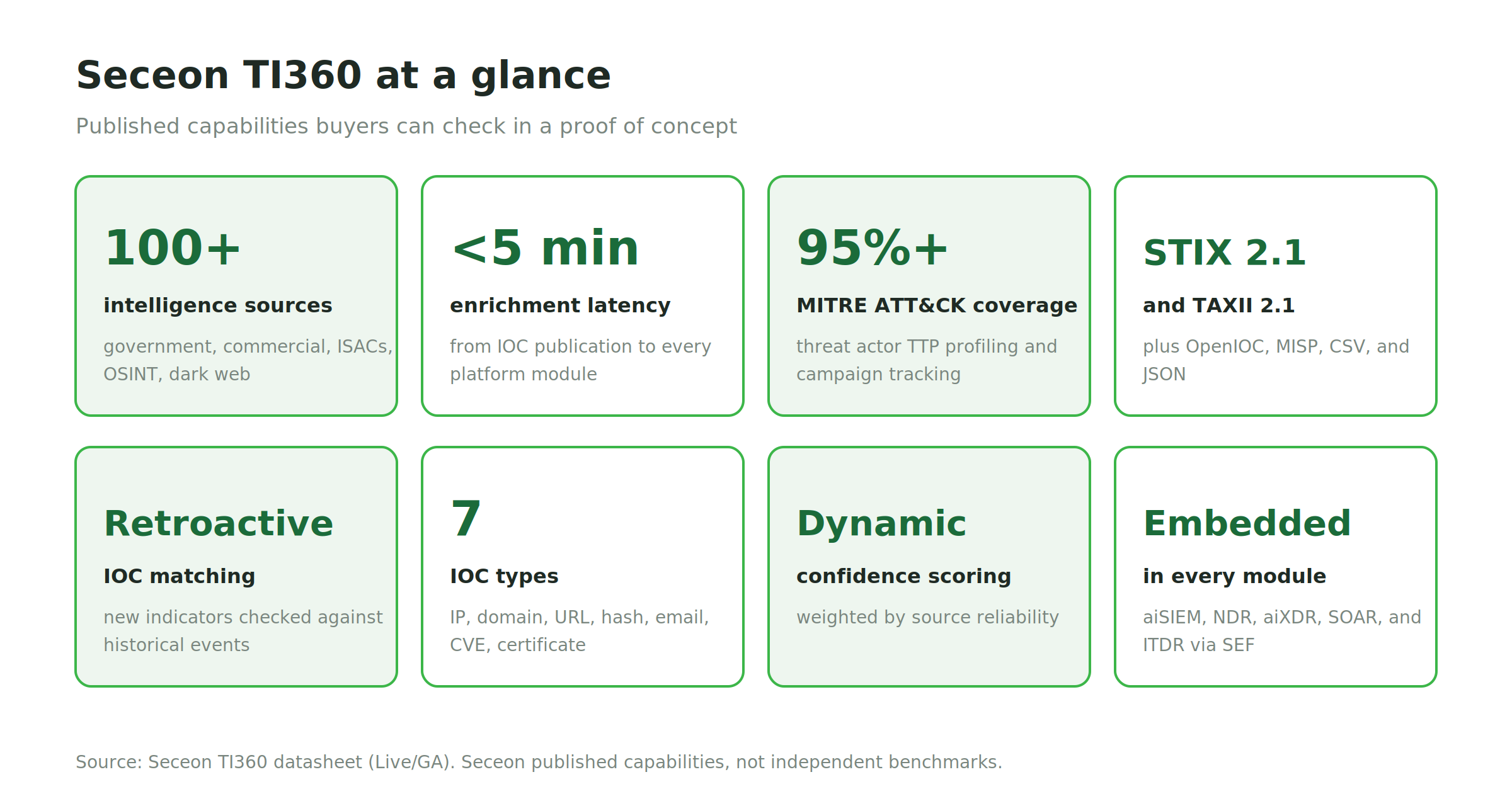
Seceon TI360 published capabilities. Validate them in a proof of concept with your own data.
| Evaluation question | Seceon TI360 |
|---|---|
| How many intelligence sources? | 100+ across government, commercial, ISAC, OSINT, and dark web |
| How fast is enrichment? | Under 5 minutes from IOC publication to every platform module |
| Can it search history? | Yes, retroactive IOC matching against historical events |
| Which standards? | STIX 2.1, TAXII 2.1, OpenIOC, MISP, CSV, JSON |
| How is confidence handled? | Dynamic scoring weighted by source reliability |
| How does it reach SIEM, XDR, SOAR? | Embedded natively through one data format (SEF) |
| Threat hunting context? | 95%+ MITRE ATT&CK, TTP profiling, campaign correlation |
| Can it use commercial intelligence? | Yes, alongside government, ISAC, OSINT, and dark web sources |
These are Seceon’s published TI360 capabilities from its datasheet (Live/GA), not independent benchmark results. Confirm the feeds, licensing, and integrations for your configuration during evaluation.
Best fit: Hybrid SOCs that want threat intelligence to drive IOC monitoring, threat hunting, and response inside one platform, rather than managing intelligence in a separate portal.
Recorded Future is a strong candidate when analysts need external intelligence to understand suspicious indicators, threat actors, malware, and risks relevant to their organization. Its product documentation describes intelligence on attacker infrastructure, tactics, techniques, and targets, along with IOC context and threat-hunting support, and its integration documentation describes connections to SIEM, SOAR, and endpoint security tools.
Where it may fit: Teams that need deep external context for investigation, prioritization, and proactive hunting.
What a hybrid SOC should weigh: Recorded Future is an intelligence platform rather than a SIEM or XDR, so IOC matching against your telemetry and the resulting response run in the tools it integrates with. Confirm which intelligence modules, integrations, API access, and automation are included in the proposed subscription, and test whether analysts can use the intelligence inside existing SOC workflows rather than through manual lookups. Organizations that already subscribe can also bring Recorded Future intelligence into Seceon TI360, which lists it among its supported commercial sources.
Google Threat Intelligence combines intelligence from Google, Mandiant, and VirusTotal. Google Security Operations provides security analytics, investigation, and response, and its documentation describes intelligence-led detection, IOC matching, threat hunting, and support for hybrid and multicloud environments.
Where it may fit: Organizations that want to connect threat research with detection engineering inside Google’s security stack.
What a hybrid SOC should weigh: The intelligence and the detection platform are two products, so confirm which capabilities of each are included in the proposed plan. Evaluate data onboarding, supported sources, retention, licensing, and how well the combination fits the non-Google technologies in your environment.
Anomali ThreatStream is worth considering when a SOC needs to bring intelligence from multiple sources into a structured workflow and distribute useful intelligence to security tools. Its product information describes intelligence enrichment, connections between indicators and attacker techniques, threat-informed detection, and intelligence sharing.
Where it may fit: Teams receiving intelligence from commercial feeds, open-source sources, internal investigations, and sharing communities.
What a hybrid SOC should weigh: ThreatStream’s operational value depends on distributing intelligence to connected security controls, so test integration depth with your actual stack. Also test duplicate and stale indicator handling, confidence management, and feed filtering, and estimate the ongoing work required to maintain intelligence quality.
ThreatConnect is relevant for organizations that want structured threat intelligence operations and workflows connecting intelligence analysts with security operations teams. Its platform documentation describes support for threat intelligence operations, security operations, and cyber risk management, and its developer documentation covers APIs, indicators, and TAXII services.
Where it may fit: Organizations with dedicated intelligence analysts who need structured analysis and coordination across teams.
What a hybrid SOC should weigh: Determine which intelligence, automation, and integration capabilities are included in the proposed deployment, and test how easily analysts can turn an intelligence finding into a repeatable hunting or investigation workflow against your own telemetry.
| Platform | Primary approach | Where IOC matching meets your telemetry | Key proof-of-concept question |
|---|---|---|---|
| Seceon TI360 (Seceon OTM) | Embedded intelligence across detection and response | Inside the same platform: aiSIEM, NDR, aiXDR, ITDR, and aiSOAR, natively | Can an IOC be traced through telemetry, investigation, and approved response in one console? |
| Recorded Future | External threat intelligence and enrichment | Through integrations with your SIEM, EDR/XDR, and SOAR tools | Does the enrichment improve decisions in your existing tools? |
| Google Threat Intelligence + Security Operations | Intelligence-led detection and hunting | In Google Security Operations, when licensed together | Can it find and investigate relevant activity across your hybrid data, including non-Google sources? |
| Anomali ThreatStream | Intelligence management and distribution | Through distribution to integrated security controls | Can it maintain high-quality intelligence and distribute it efficiently? |
| ThreatConnect | Intelligence operations and collaboration | Through APIs and integrations with existing security tools | Can analysts turn intelligence into repeatable operational workflows? |
A qualitative shortlist based on public product documentation and Seceon’s published TI360 capabilities, not a controlled performance comparison. Capabilities vary by subscription and configuration.
The best way to compare cyber threat intelligence platforms is to run the same scenario in each one. Imagine your SOC receives an external report identifying a suspicious domain associated with a phishing campaign.
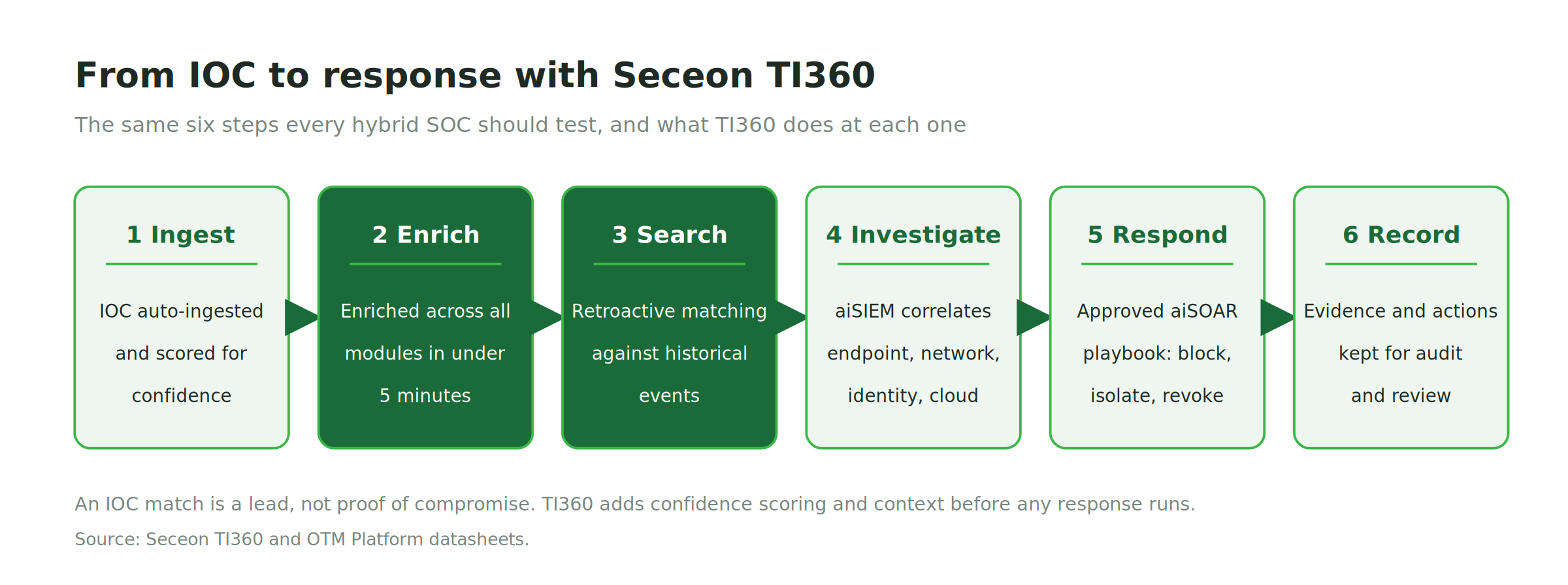
The six steps every hybrid SOC should test, and what Seceon TI360 does at each one.
| Step | What the SOC needs to do | How Seceon TI360 and OTM handle it |
|---|---|---|
| 1. Ingest and validate | Check the source, timestamp, confidence, context, and expiration | Auto-ingestion with dynamic confidence scoring weighted by source reliability |
| 2. Search internal telemetry | Search DNS, proxy, firewall, endpoint, identity, and cloud logs; note visibility gaps | Enrichment across all modules in under 5 minutes, plus retroactive matching against historical events |
| 3. Enrich the match | Check links to malware, campaigns, or suspicious behavior; a match alone is not proof | Threat actor profiles, TTP correlation, and campaign context |
| 4. Investigate related activity | Look for connected processes, logins, and outbound connections | aiSIEM correlates endpoint, network, identity, and cloud evidence in one investigation |
| 5. Decide on a response | Monitor, escalate, block, isolate, or take another approved action | Approved aiSOAR playbooks with approval steps |
| 6. Record the outcome | Preserve evidence, decisions, actions, and timestamps | Investigation evidence and response actions kept for audit and review |
This workflow separates a platform that merely displays intelligence from one that operationalizes it across the SOC.
IOC monitoring is useful only when matches are relevant, traceable, and actionable. During a proof of concept, measure:
| Test | What to record |
|---|---|
| Indicator coverage | Which indicator types and telemetry sources are supported |
| Match quality | Correct matches, benign matches, and false-positive cases in the test set |
| Intelligence freshness | Source timestamp, update frequency, and expiration handling |
| Historical searches | Whether retained telemetry can be searched for older indicators |
| Investigation context | Whether analysts can see the events and evidence behind a match |
| Integration reliability | Whether intelligence reaches the intended tools and workflows |
| Response safeguards | Whether approved actions, permissions, and audit records work as intended |
Use a representative test set with known positive and negative examples, and compare platforms using the same data, time window, and acceptance criteria.
Do not treat the number of feeds, indicators, or integrations as a direct measure of detection quality. More data does not automatically mean better intelligence.
Decide whether the priority is external threat research, IOC enrichment, intelligence management, proactive threat hunting, intelligence sharing, or integrated detection and response. A specialist intelligence platform can suit a dedicated intelligence team; a platform with embedded intelligence, such as Seceon TI360 on Seceon OTM, suits SOCs whose main goal is turning intelligence into detection and response.
Build an integration checklist covering your SIEM, endpoint security, network security, identity systems, cloud environments, and response tools. For each, ask whether it supports enrichment, searches, alerts, bidirectional exchange, or response actions. A listed integration does not mean every workflow is supported.
If your SOC exchanges structured intelligence, evaluate support for STIX and TAXII. The MITRE ATT&CK data and tools resources describe access to ATT&CK data through STIX and TAXII. Confirm the versions and workflows each product supports; Seceon TI360, for example, supports STIX 2.1 and TAXII 2.1.
Estimate the full cost of operating the solution: subscriptions, intelligence feeds, API access, storage, data ingestion, integrations, implementation, training, and analyst effort. For hybrid environments, also assess where data is processed and retained and whether the deployment meets your regulatory requirements.
Use the same scenario across all shortlisted platforms:
Record results against criteria defined before the test. That makes the final decision more defensible than one based on feature counts or vendor marketing.
The best cyber threat intelligence platform for a hybrid SOC is not the one with the most feeds or the most indicators. It is the one that identifies relevant threats, validates indicators against your own telemetry, investigates connected activity, and turns findings into appropriate action.
Seceon TI360 leads this comparison for IOC monitoring and threat hunting because it closes that loop inside one platform: 100+ intelligence sources, under 5-minute enrichment, retroactive IOC matching, 95%+ MITRE ATT&CK context, STIX 2.1 and TAXII 2.1 support, and native enrichment of aiSIEM, NDR, aiXDR, ITDR, and aiSOAR on the Seceon OTM Platform. And because TI360 supports commercial intelligence sources, it can put the intelligence a SOC already buys to work in detection and response.
Define your use cases, verify integrations, and run the same IOC-to-response scenario across your shortlist. Let demonstrated operational fit, not marketing claims, decide.
Seceon Inc., headquartered in Westford, Massachusetts, develops the Seceon Open Threat Management (OTM) Platform, an AI-powered cybersecurity platform that unifies aiSIEM, aiXDR, NDR, UEBA, ITDR, aiSOAR, and TI360 threat intelligence on one data pipeline. Seceon serves 9,800+ customers and monitors 2.4 trillion events per day (as of March 31, 2026).
See how Seceon TI360 turns an IOC into a confirmed investigation. Request a demo or explore the Seceon OTM Platform.