MSSPs do not buy threat intelligence to read it. They buy it to detect threats faster across dozens or hundreds of customer environments at once. Yet according to the SANS 2022 Cyber Threat Intelligence Survey, only 46% of organizations integrate threat intelligence into their defense and response systems. The rest collect indicators that never reach the tools that act on them.
That gap is why cyber threat intelligence platforms are now judged on three things: how well they manage many tenants, how deep their threat analysis goes, and how tightly they plug into security operations. This guide compares six leading options for MSSP leaders and enterprise SOC managers at the decision stage.
Disclosure: this guide is published by Seceon. Competitor details come from vendor documentation, public filings and independent review sites as of October 2026.
| Rank | Platform | Verdict | Main limitation for MSSPs |
|---|---|---|---|
| 1 | Seceon aiSecure TI360 | Best overall: intelligence embedded in detection, purpose-built multi-tier multi-tenancy | None of the standalone gaps below; part of a full SOC platform |
| 2 | Recorded Future | Large intelligence dataset | Standalone service, now owned by Mastercard, separately licensed and integrated |
| 3 | Google Threat Intelligence | Mandiant and VirusTotal intelligence | Fully managed pipeline needs Google SecOps Enterprise+; lower tiers require a customer-built pipeline |
| 4 | Anomali ThreatStream | Intelligence aggregation | Reviewers cite complex, costly feed licensing; TIP mindshare declining |
| 5 | ThreatConnect TI Ops | Intelligence workflow and playbooks | Reviewers cite high price and integration and usability gaps; TIP mindshare declining |
| 6 | Filigran OpenCTI | Open-source intelligence knowledge base | Self-managed Elasticsearch, RabbitMQ, Redis and S3 stack; key tooling requires Enterprise Edition |
Quick answer: Cyber threat intelligence platforms collect indicators of compromise (IOCs), threat actor profiles and attack techniques from many sources, then normalize, score and correlate them. They deliver that context to SIEM, SOAR and detection tools so analysts can spot and stop threats faster.
For an MSSP, a threat intelligence platform has a harder job than in a single enterprise. The same intelligence must reach every customer environment and match against each customer’s own telemetry. Each customer’s watchlists, data and reports must stay strictly separate.
That is where many security team tools fall short. A platform built for one SOC often needs a separate instance, connector or license per tenant. Every extra integration adds delay between an indicator being published and a detection firing, and that delay is when cybersecurity threat detection is weakest.
We scored each platform on the three criteria MSSP leaders and SOC managers weigh most at the decision stage.
| Criterion | What we looked for | Why it matters for MSSPs |
|---|---|---|
| Tenant management | Native multi-tenancy, tenant hierarchy, per-tenant feeds and watchlists, data isolation, white-labeling, onboarding time | Decides how many customers one analyst team can serve, and the margin per customer |
| Threat analysis depth | Source breadth, IOC volume, MITRE ATT&CK coverage, threat actor profiling, confidence scoring, behavioral and predictive indicators | Decides whether analysts get context they can act on or raw indicator lists |
| Integration fit | Native enrichment of SIEM, NDR, XDR, SOAR and identity detections; STIX/TAXII; time from publication to enrichment | Decides whether intelligence drives threat monitoring in real time or waits in a separate console |
We also considered licensing model and operational overhead, since both directly affect MSSP margins.
TI360 is the threat intelligence backbone of the Seceon Open Threat Management (OTM) platform. Most threat intelligence software sits beside the SOC and has to be wired into each tool. TI360 is built into it, so every alert, incident and investigation is enriched with threat context automatically. It feeds intelligence directly into the aiSIEM correlation engine through the Seceon Event Format (SEF). IOC matches, threat actor profiles and TTP correlations are therefore available at the moment of detection, not minutes later.
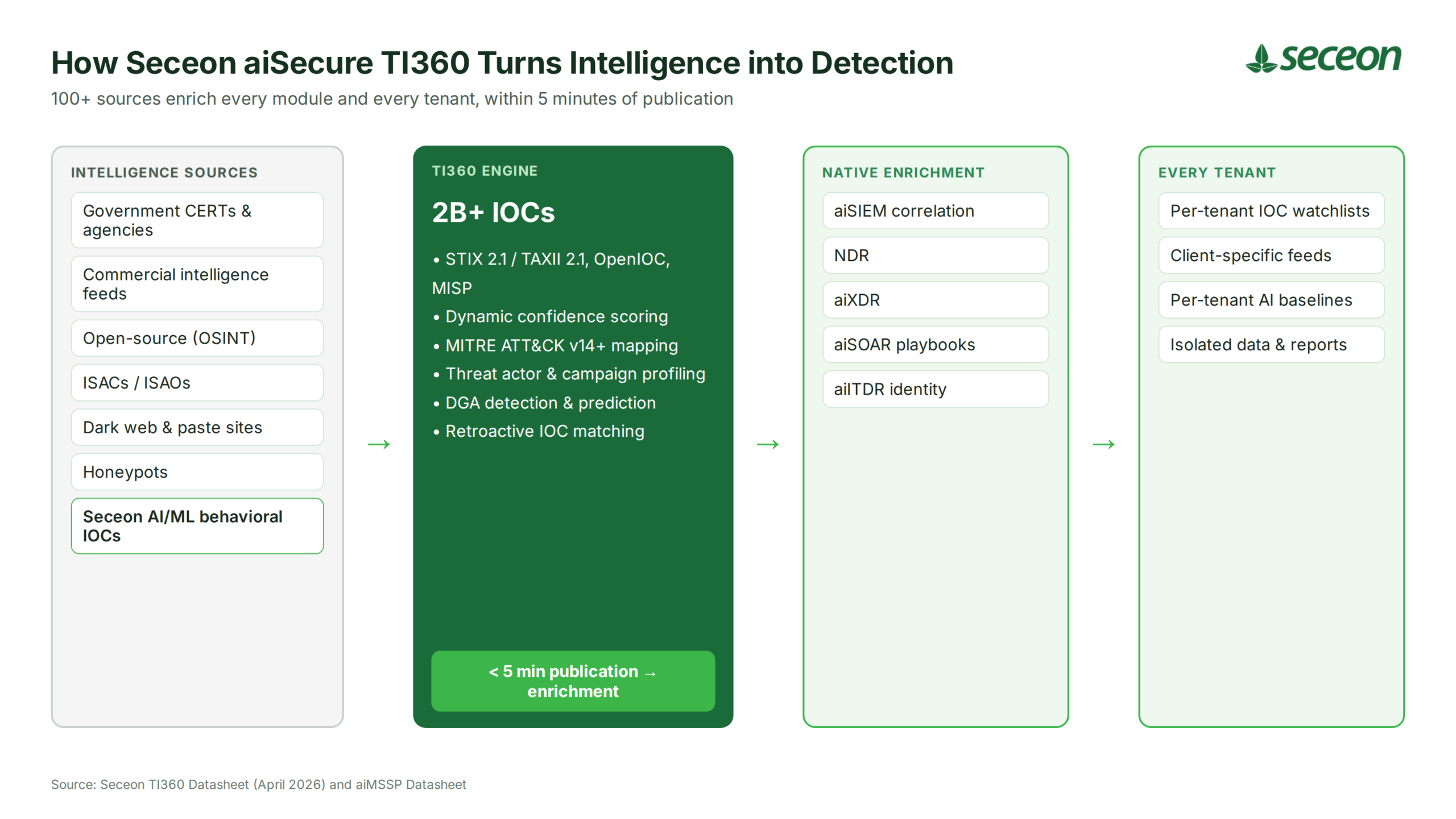
Many platforms support only two tiers, the MSSP and its clients. Seceon’s multi-tier multi-tenancy (MT-MT) supports unlimited tier depth from a single platform instance. A Master MSSP can white-label the platform and onboard Regional MSSPs, and each Regional MSSP manages its own end clients.
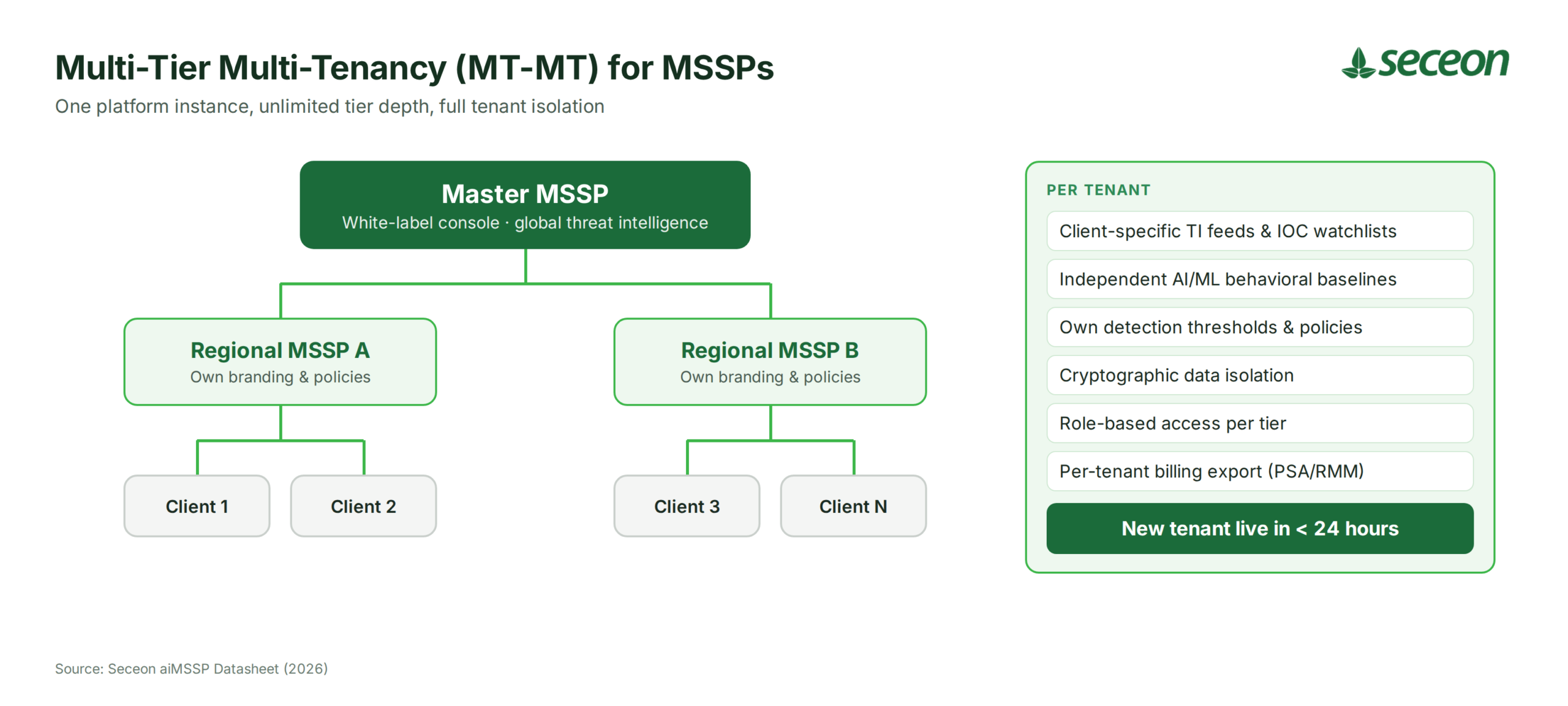
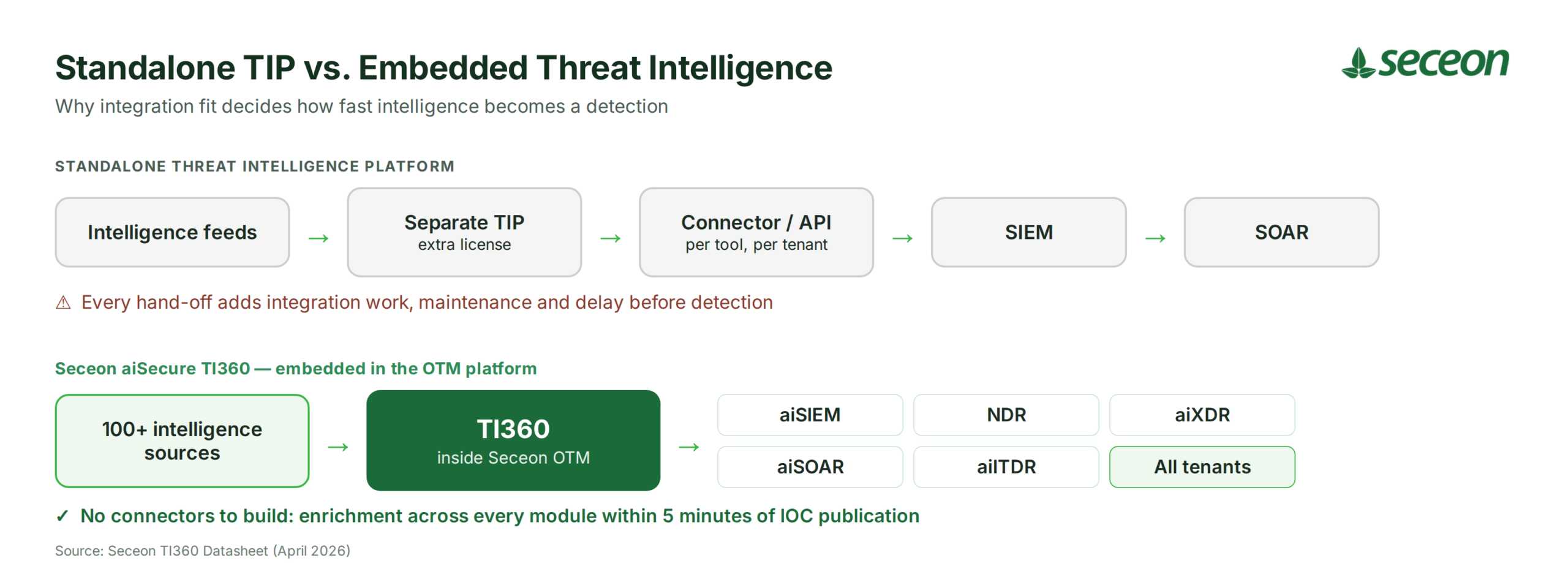
Because TI360 is embedded, intelligence enriches aiSIEM, NDR, aiXDR, aiSOAR playbooks and aiITDR natively. It does so within 5 minutes of IOC publication, with no connector to build or maintain per tool or per tenant. For regulated markets, IOCs published by CERT-In and NCIIPC are auto-ingested within 5 minutes. Standards support covers STIX 2.1, TAXII 2.1, OpenIOC, MISP and CSV/JSON, with bidirectional sharing with government CERTs and ISACs and custom STIX bundle import for private intelligence.
| Specification | Seceon aiSecure TI360 |
|---|---|
| Intelligence sources | 100+ (government, commercial, OSINT, ISACs, dark web, honeypots, Seceon AI/ML) |
| IOC database | 2B+ unique IOCs |
| IOC types | IP, domain, URL, file hash (MD5/SHA1/SHA256), email, CVE, certificate |
| Enrichment latency | Under 5 minutes from publication to enrichment across all modules |
| MITRE ATT&CK | ≥95% of v14+ techniques, Enterprise + ICS + Containers |
| Standards | STIX 2.1, TAXII 2.1, OpenIOC, MISP, CSV/JSON |
| Multi-tenancy | MT-MT, unlimited tier depth, cryptographic isolation, white-label |
| Tenant onboarding | Under 24 hours |
Best fit: MSSPs, MDR providers and multi-tenant enterprise SOCs that want threat intelligence to improve detection for every customer, without licensing and integrating a separate platform.
The five platforms below are established names in threat intelligence. Each is sold primarily as standalone intelligence or a TIP that an MSSP must license and integrate separately. That creates trade-offs in cost, integration effort and multi-tenant operations.
What it is: A threat intelligence company that indexes the open web, dark web and technical sources. It reports more than 1,900 business and government customers in over 75 countries (Recorded Future).
Where it falls short for MSSPs:
How TI360 compares: TI360 can ingest Recorded Future as one of its 100+ sources, and adds detection, response and multi-tier tenancy on the same platform.
What it is: Intelligence that combines Mandiant, VirusTotal and Google’s own threat data, available standalone or inside Google Security Operations (SecOps).
Where it falls short for MSSPs:
How TI360 compares: TI360’s enrichment is built in for every Seceon customer and every tenant, with no premium tier and no customer-built pipeline.
What it is: A threat intelligence platform that aggregates feeds and pushes scored indicators into SIEM and SOAR tools. Anomali now also markets its own security analytics.
Where it falls short for MSSPs:
How TI360 compares: TI360 includes dark web monitoring among its 100+ sources and uses MSSP pricing that is not per-GB or per-alert.
What it is: A threat intelligence operations platform that centralizes intelligence and automates workflows with a playbook builder.
Where it falls short for MSSPs:
How TI360 compares: TI360 needs no separate playbook platform. Intelligence drives aiSOAR playbooks natively, and new tenants go live in under 24 hours.
What it is: An open-source cyber threat intelligence knowledge base built on the STIX data model, with a commercial Enterprise Edition.
Where it falls short for MSSPs:
How TI360 compares: TI360 arrives ready to use inside the Seceon platform, with no backend stack for the MSSP to operate and no connectors to maintain.
Seceon TI360 is the only platform here where threat intelligence, cybersecurity threat detection and response run on one multi-tenant platform. Each alternative delivers intelligence that still has to be connected to separate tools. Details below come from vendor documentation and the sources cited above; confirm current terms with each vendor.
| Platform | Delivery model | Detection and response on the same platform | Multi-tier MSSP tenancy | Path from intelligence to detection |
|---|---|---|---|---|
| Seceon aiSecure TI360 | Embedded in the Seceon OTM platform | Yes: aiSIEM, NDR, aiXDR, aiSOAR, aiITDR | Yes: Master → Regional → Client, unlimited depth | Built in, under 5 minutes to enrichment |
| Recorded Future | Standalone intelligence service | No; integrates with third-party tools | Confirm with vendor | Connectors to each SIEM and SOAR |
| Google Threat Intelligence | Standalone or within Google SecOps | Through Google SecOps, licensed separately | Confirm with vendor | Managed only on SecOps Enterprise+; otherwise a customer-built pipeline |
| Anomali ThreatStream | Standalone TIP | Through Anomali’s separate analytics product | Confirm with vendor | API and connector integrations |
| ThreatConnect TI Ops | Standalone TI Ops platform | No; playbooks orchestrate external tools | Confirm with vendor | Playbooks and integrations to build |
| Filigran OpenCTI | Open source, self-hosted or Enterprise Edition | No | Confirm with vendor | Connectors to deploy and maintain |
| Buyer | Top pick | Why |
|---|---|---|
| Large MSSPs and MDR providers with regional partners | Seceon TI360 | Only option here with documented multi-tier multi-tenancy and white-labeling |
| Growing MSSPs focused on margin | Seceon TI360 | No separate TIP license; tenants live in under 24 hours; pricing not per-GB |
| Enterprise SOC teams | Seceon TI360 | Intelligence enriches SIEM, NDR, XDR, SOAR and identity detections natively |
| MSSPs already paying for commercial feeds | Seceon TI360 | Ingests feeds such as Recorded Future, Anomali and ThreatConnect as sources, then operationalizes them |
For MSSP leaders, the deciding factor is cost per tenant. A standalone platform adds a license, integrations and maintenance for every customer environment. TI360 adds threat intelligence to every tenant the moment it is onboarded.
For enterprise SOC managers, the deciding factor is time to detection. When intelligence lives inside the detection engine, a new indicator becomes a correlated alert in minutes rather than waiting on a sync between tools. That makes threat monitoring continuous instead of periodic.
For MSSPs and multi-tenant SOC teams, the best cyber threat intelligence platform is not the one with the longest feed list. It is the one that turns intelligence into detection for every customer, fastest, at the lowest cost per tenant. Standalone platforms such as Recorded Future, Google Threat Intelligence, Anomali, ThreatConnect and OpenCTI deliver intelligence that still has to be licensed, integrated and maintained across separate tools.
Seceon aiSecure TI360 removes that gap. It brings 100+ sources, 2 billion+ IOCs, AI/ML behavioral indicators and 95%+ MITRE ATT&CK coverage into the Seceon OTM platform. Every SIEM, NDR, XDR, SOAR and identity detection is enriched within 5 minutes, for every tenant in a multi-tier MSSP hierarchy.
See TI360 enrich detections across your tenants. Request a demo at seceon.com.