Cloud adoption has transformed how organizations build, deploy, and manage applications. From hybrid infrastructures to multi-cloud environments, businesses increasingly rely on cloud technologies to drive scalability, innovation, and operational efficiency.
However, as cloud environments continue to expand, so do the security challenges associated with managing them. Misconfigured resources, excessive permissions, shadow IT, unsecured APIs, and rapidly growing workloads have significantly increased the attack surface available to cybercriminals.
For security teams, maintaining visibility across dynamic cloud environments has become increasingly difficult. Traditional security tools often struggle to detect threats across distributed infrastructures, leaving organizations vulnerable to breaches, unauthorized access, and operational disruption.
As a result, organizations are turning to Cloud Security Monitoring Platforms that provide continuous visibility, intelligent threat detection, and automated response capabilities to strengthen cloud security and reduce cyber risk.
Modern cloud environments generate enormous volumes of activity across users, applications, workloads, identities, and network connections. As organizations continue to adopt cloud-first strategies, security teams must monitor an increasingly complex ecosystem that changes constantly.
Unlike traditional environments, cloud infrastructures are highly dynamic. New resources can be provisioned instantly, users can access systems from anywhere, and applications often span multiple environments simultaneously.
This rapid growth has created significant security challenges, making continuous cloud monitoring essential for identifying suspicious activity, maintaining compliance, and protecting critical assets from evolving cyber threats.
Many organizations continue to rely on disconnected security tools that were originally designed for traditional on-premises environments. While these solutions may provide visibility into individual systems, they often struggle to deliver the comprehensive monitoring needed across modern cloud ecosystems.
As cloud environments grow, security teams frequently encounter challenges such as cloud sprawl, alert overload, configuration drift, fragmented visibility, and operational complexity. Critical security events can become buried within massive volumes of alerts, making it difficult to distinguish genuine threats from routine activity.
At the same time, attackers increasingly exploit misconfigurations, excessive permissions, and visibility gaps to gain unauthorized access and move undetected across environments.
To address these challenges, organizations need a centralized approach capable of continuously monitoring cloud activity, correlating security events, and providing actionable intelligence across the entire attack surface.
Effective cloud security begins with visibility. Organizations need a clear understanding of user activity, workload behavior, network communications, configuration changes, and access patterns across their cloud environments.
Continuous monitoring enables security teams to identify suspicious activity early and maintain awareness of security risks across distributed infrastructures.
Traditional signature-based security controls often struggle to identify modern threats that use legitimate credentials and trusted services to evade detection.
Behavioral analytics helps organizations detect abnormal activity by analyzing patterns across users, workloads, and cloud resources. This enables earlier detection of unauthorized access attempts, privilege misuse, suspicious account activity, and other indicators of compromise.
Misconfigurations remain one of the leading causes of cloud security incidents. Exposed storage resources, excessive permissions, and insecure configurations can create opportunities for attackers to gain access to sensitive data and systems.
Continuous monitoring helps organizations identify and remediate configuration risks before they can be exploited.
As security operations become increasingly complex, manual response processes often slow investigations and increase risk.
Automated response capabilities help organizations accelerate containment, reduce attacker dwell time, and improve operational efficiency by responding to suspicious activity in real time.
Cloud security monitoring enables organizations to move beyond reactive security practices and adopt a more proactive approach to risk management.
By continuously monitoring cloud environments and correlating security activity across multiple layers, organizations can detect threats earlier, reduce investigation times, improve compliance readiness, and strengthen overall cyber resilience.
As cloud adoption continues to accelerate, organizations that invest in continuous monitoring will be better positioned to protect critical assets and maintain business continuity.
As cloud environments become more distributed and complex, security teams require more than isolated monitoring tools. They need intelligent security operations capable of delivering continuous visibility, real-time threat detection, and automated response across the entire attack surface.
Seceon helps organizations strengthen cloud security through AI-driven analytics, advanced threat detection, automated response capabilities, and unified security operations designed for hybrid and multi-cloud environments.
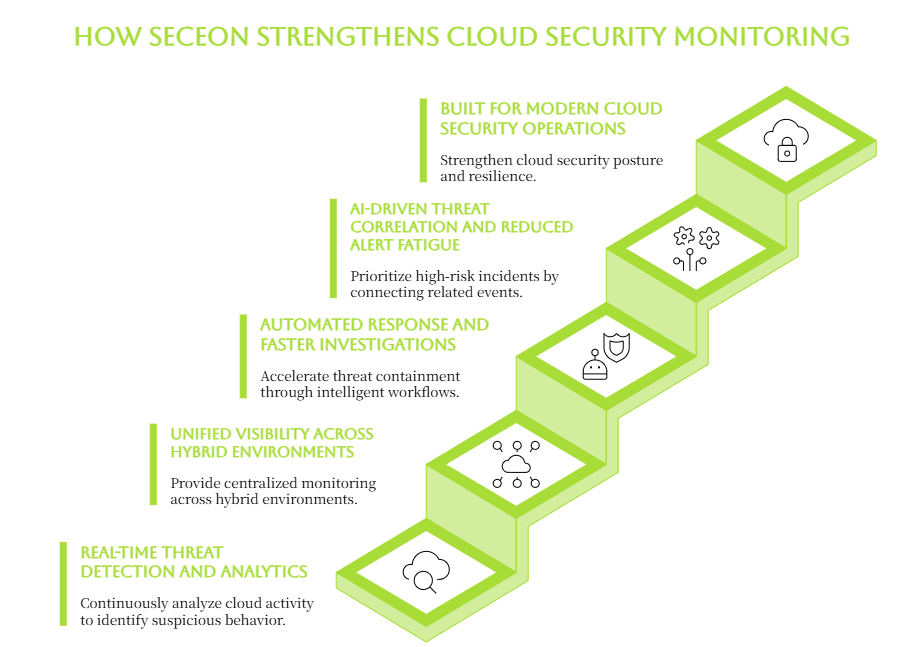
Seceon continuously analyzes cloud activity to identify suspicious behavior, unauthorized access attempts, privilege escalation activity, and indicators of compromise before they become significant security incidents.
By correlating telemetry across users, workloads, networks, and cloud services, Seceon helps security teams gain deeper visibility into emerging threats and respond faster to evolving risks.
Modern enterprises require visibility across cloud infrastructure, endpoints, identities, applications, and network environments.
Seceon provides centralized monitoring and analytics across these environments, helping organizations eliminate visibility gaps, accelerate investigations, and strengthen security operations through a single operational platform.
Seceon helps organizations accelerate threat containment through intelligent response workflows that reduce manual effort and improve operational efficiency.
By automating investigation and response processes, security teams can reduce attacker dwell time and respond more effectively to cloud-based threats.
One of the biggest challenges facing modern SOC teams is managing overwhelming volumes of alerts generated across cloud environments.
Seceon’s AI-driven threat correlation capabilities help prioritize high-risk incidents by connecting related events and providing contextual visibility into potential threats. This reduces alert fatigue, improves analyst productivity, and enables security teams to focus on incidents that matter most.
By combining continuous monitoring, behavioral analytics, intelligent threat correlation, and automated response within a unified platform, Seceon helps organizations strengthen cloud security posture, improve operational resilience, and reduce cyber risk across complex cloud environments.
As organizations continue to expand their cloud footprint, maintaining visibility and control across cloud environments has become a critical cybersecurity priority. Traditional security approaches often struggle to keep pace with the scale, complexity, and speed of modern cloud infrastructures.
A Cloud Security Monitoring Platform enables organizations to continuously monitor activity, identify emerging threats, detect security gaps, and respond faster to evolving risks. Continuous visibility, behavioral analytics, and automated response capabilities play a critical role in strengthening cloud security and improving operational resilience.
Seceon helps organizations modernize cloud security monitoring through AI-driven threat detection, intelligent threat correlation, centralized visibility, and automated security operations designed to protect today’s dynamic hybrid and multi-cloud environments.