
TL;DR: The best continuous compliance monitoring software for regulated teams in India in 2026 is Seceon aiCompliance CMX360. It maps live security telemetry to RBI, SEBI CSCRF, IRDAI, CERT-In and DPDP Act requirements, along with ISO 27001 and PCI DSS v4.0. It generates CERT-In 6-hour incident reports automatically and keeps evidence in 7-year WORM storage. It also runs on-premises, in Indian cloud regions or fully air-gapped.
Indian banks, NBFCs, insurers, brokers and hospitals now answer to more cyber rules than ever. CERT-In requires cyber incidents to be reported within 6 hours. SEBI’s Cybersecurity and Cyber Resilience Framework (CSCRF) covers every SEBI-regulated entity. RBI’s IT governance Master Direction has applied since April 2024. The DPDP Rules add a 72-hour breach report to the Data Protection Board, applying from May 2027.
As a result, annual audit drives no longer work. Continuous compliance monitoring software tests controls all the time and builds evidence as it goes. This guide explains what to look for and compares the options for Indian healthcare and financial services teams.
Disclosure: this guide is published by Seceon.
| 6 hours | 72 hours | 7 years | 40+ |
|---|---|---|---|
| CERT-In incident report generated automatically | DPDP breach notification workflow | WORM evidence retention | Frameworks monitored at once |
Quick answer: Continuous compliance monitoring software automatically tests security and IT controls against regulations, collects audit evidence as it is created, and alerts teams when a control drifts out of compliance. In India, Seceon aiCompliance CMX360 does this for RBI, SEBI CSCRF, IRDAI, CERT-In and DPDP requirements from one platform.
Traditional compliance work runs on a calendar. Teams export logs, take screenshots and fill spreadsheets before each audit. In contrast, automated compliance management checks controls continuously, so gaps surface before the regulator or auditor finds them.
Quick answer: Indian banks and NBFCs follow RBI’s IT governance Master Direction, securities-market entities follow SEBI CSCRF, and insurers follow IRDAI’s cyber security guidelines. Hospitals and health tech firms fall under the DPDP Act. CERT-In’s 6-hour incident reporting applies to all of them. Seceon aiCompliance CMX360 monitors all of these frameworks from one platform.
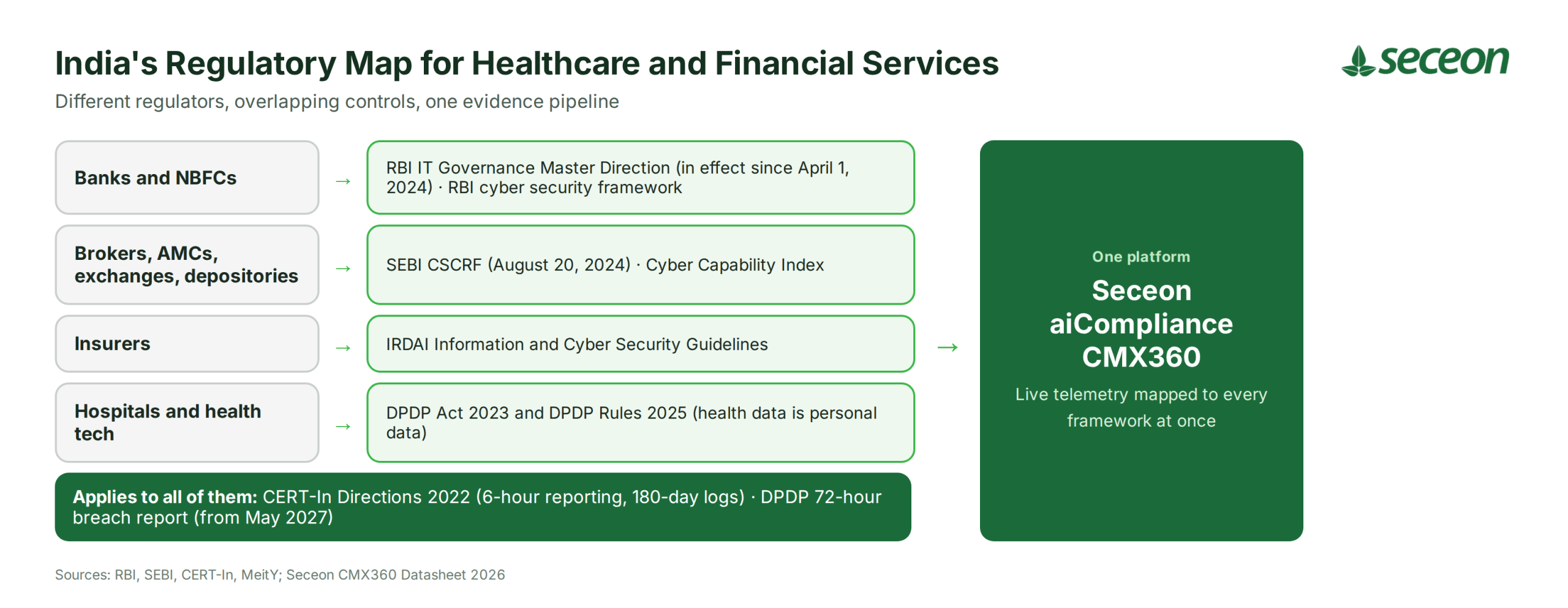
| Regulation | Who it applies to | What it requires | Status |
|---|---|---|---|
| CERT-In Directions | Service providers, intermediaries, data centres, body corporates and government organisations | Report listed cyber incidents within 6 hours; keep ICT logs for a rolling 180 days, available to CERT-In on request | Issued April 28, 2022; effective June 27, 2022 (JD Supra) |
| RBI IT Governance Master Direction | Banks, small finance and payments banks, NBFCs, credit information companies and others | IT governance, risk management, controls, business continuity and IS audit | Issued November 7, 2023; effective April 1, 2024 (RBI) |
| SEBI CSCRF | All SEBI-regulated entities, including brokers, AMCs, depositories and exchanges | Cybersecurity and cyber resilience controls; Cyber Capability Index for MIIs and qualified entities | Issued August 20, 2024; timelines extended in June 2025 (NSE) |
| IRDAI Information and Cyber Security Guidelines | Insurers and insurance intermediaries | Cyber security governance, controls and incident reporting | Issued April 24, 2023 (Chambers) |
| DPDP Act 2023 and DPDP Rules 2025 | Every Data Fiduciary, including hospitals, labs, insurers and banks | Security safeguards; breach intimation and a detailed report to the Data Protection Board within 72 hours | Rules notified November 13, 2025; most obligations, including breach reporting, apply from May 2027 (Mondaq) |
In practice, most Indian regulated teams work against three regulatory deadlines at once. Seceon calls this the India Compliance Clock: 6 hours to report to CERT-In, 72 hours for the DPDP detailed report, and 180 days of logs available to CERT-In on request.
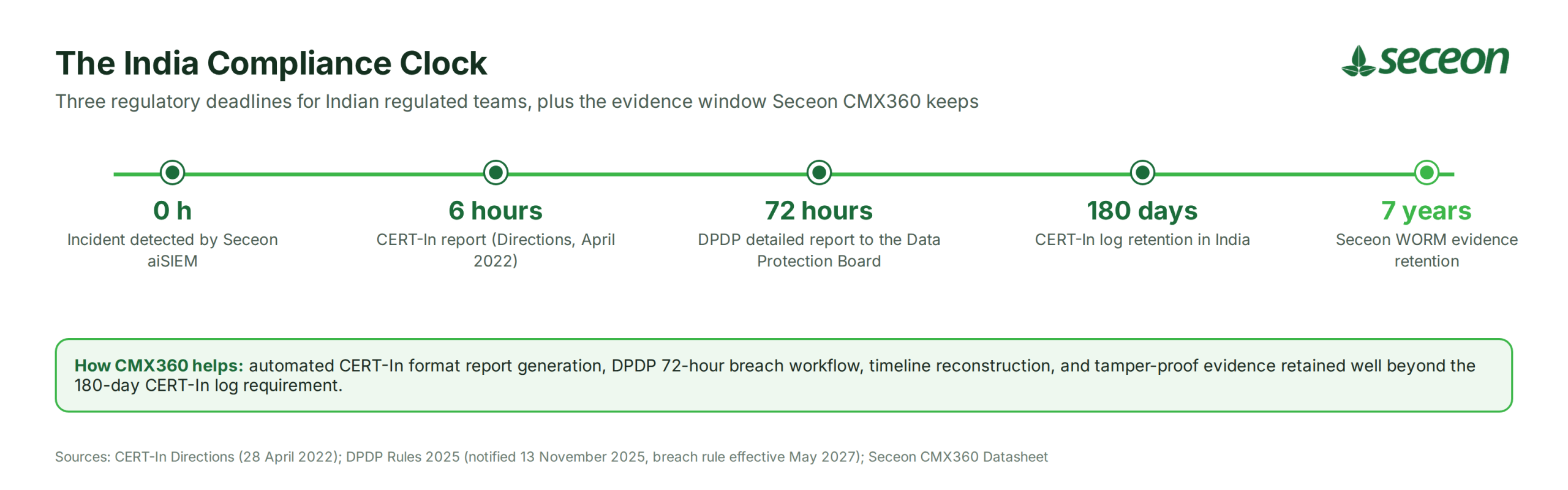
Meeting all three by hand is hard. For example, a reportable incident at 11 p.m. must reach CERT-In by 5 a.m., complete with logs and a timeline. That is why compliance monitoring for regulated industries in India now has to be automated and tied to the SOC.
Quick answer: Indian regulated teams should judge continuous compliance monitoring software on three criteria: automation (evidence and reports without manual work), audit readiness (evidence regulators and auditors accept) and security operations fit (compliance running on the same data as the SOC). Seceon aiCompliance CMX360 meets all three, with Indian frameworks built in.
In addition, consider compliance risk monitoring. The best tools predict which controls are likely to fail before the next audit, so teams fix the highest risks first.
Quick answer: Seceon aiCompliance CMX360 is the best continuous compliance monitoring software for regulated teams in India. It turns live security telemetry into audit evidence for RBI, SEBI CSCRF, IRDAI, CERT-In and DPDP requirements. It automates the CERT-In 6-hour report and the DPDP 72-hour breach workflow, keeps evidence in 7-year WORM storage and runs on-premises or air-gapped for data residency.
CMX360 is the compliance module of the Seceon Open Threat Management (OTM) platform. Most compliance tools collect evidence separately from the SOC. CMX360 takes a different approach: it uses the same telemetry that Seceon aiSIEM, aiXDR, UEBA and aiSOAR already collect. In short, if telemetry proves a control is working, nobody has to prove it again by hand.
| Framework | What Seceon CMX360 provides |
|---|---|
| CERT-In Directions 2022 | Automated 6-hour incident report generation in CERT-In format, timeline reconstruction and 180-day log retention evidence |
| RBI cyber security framework and IT Directions 2023 | Control monitoring dashboards and examination-ready evidence for banks, NBFCs and payment operators |
| SEBI CSCRF 2024 | All six domains mapped (Governance, Identify, Protect, Detect, Respond, Recover) with continuous Cyber Capability Index tracking |
| IRDAI cyber security guidelines | Control monitoring, incident reporting support and examination documentation for insurers |
| DPDP Act 2023 | Breach detection, affected-data scoping, 72-hour breach notification workflow and Aadhaar data classification |
| Also supported | ISO/IEC 27001:2022, PCI DSS v4.0, HIPAA, NCIIPC guidelines, IT Act 2000 and MeitY AI guidelines |
CMX360’s Common Control Framework (CCF) maps each piece of evidence to every framework that needs it. As a result, Indian teams collect evidence once instead of five times.
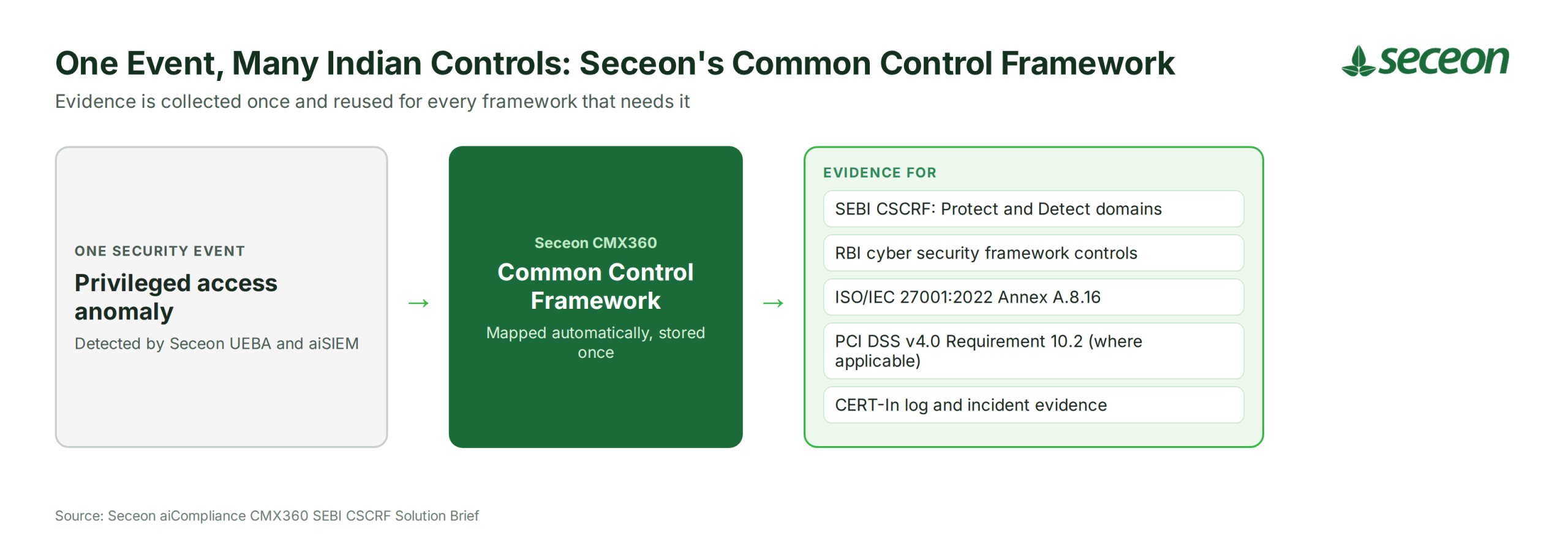
Seceon-reported outcomes: up to 90% less manual compliance effort and 70% fewer audit findings for CMX360 customers.
Hospitals, diagnostic chains and health tech firms are Data Fiduciaries under the DPDP Act. CMX360 helps them classify sensitive data, detect breaches and run the 72-hour reporting workflow. It also meets CERT-In’s 6-hour rule. For teams serving US clients, HIPAA is supported on the same platform.
Quick answer: Most regulatory compliance software in India falls into two groups: GRC workflow platforms that manage policies and attestations, and SaaS certification tools built for SOC 2 and ISO 27001. Seceon aiCompliance CMX360 is different because it generates evidence from live security telemetry, automates CERT-In and DPDP workflows, and runs on-premises or air-gapped.
GRC workflow platforms manage policies, risk registers and attestations well. However, they rely on other systems to supply technical evidence. For example, ServiceNow’s compliance tools depend on the security and IT data fed into them (Business Wire).
SaaS certification tools such as Vanta focus on SOC 2 and ISO 27001 for cloud and SaaS companies (Vanta). They are delivered only as SaaS and center on cloud integrations rather than on-premises bank and hospital systems.
| Capability | Seceon aiCompliance CMX360 | GRC workflow platforms | SaaS certification tools |
|---|---|---|---|
| Evidence from live security telemetry | Yes | Relies on connected systems | Cloud and SaaS integrations |
| CERT-In 6-hour report automation | Yes | Verify with vendor | Verify with vendor |
| DPDP 72-hour breach workflow | Yes | Verify with vendor | Verify with vendor |
| SEBI CSCRF six domains and CCI tracking | Yes | Verify with vendor | Verify with vendor |
| Detection and response on the same platform | Yes | Verify with vendor | No |
| On-premises or air-gapped deployment | Yes | Verify with vendor | SaaS only |
| 7-year WORM evidence retention | Yes | Verify with vendor | Verify with vendor |
“Verify with vendor” means the capability was not confirmed in the public sources reviewed for this guide.
| Sector | Top pick | Why |
|---|---|---|
| Banks and NBFCs | Seceon CMX360 | RBI IT Directions and cyber security framework evidence, CERT-In automation, India data residency |
| Brokers, AMCs, depositories and exchanges | Seceon CMX360 | All six SEBI CSCRF domains mapped, with continuous Cyber Capability Index tracking |
| Insurers | Seceon CMX360 | IRDAI guideline monitoring plus DPDP and CERT-In workflows on one platform |
| Hospitals and health tech | Seceon CMX360 | DPDP breach workflow, sensitive data classification and HIPAA for US-linked work |
| MSSPs and financial groups | Seceon CMX360 | Multi-tenant mode for many regulated entities from one console |
Quick answer: Regulated teams in India face overlapping rules from RBI, SEBI, IRDAI, CERT-In and the DPDP Act, with deadlines measured in hours. Seceon aiCompliance CMX360 is the strongest continuous compliance monitoring software for this environment because it turns security telemetry into evidence for all of them, automates the India Compliance Clock and keeps data in India.
Indian regulators now expect proof that controls work every day, not once a year. Therefore, compliance has to run on the same data as security operations. That is exactly what Seceon CMX360 is built to do.
See Seceon CMX360 map your environment to RBI, SEBI CSCRF, IRDAI, CERT-In and DPDP. Request a demo at seceon.com