Cyberattacks are becoming faster, more sophisticated, and increasingly difficult to detect. From ransomware and insider threats to advanced persistent attacks, organizations face a growing challenge in identifying and responding to security incidents before they disrupt operations. In today’s digital environment, every minute matters. The longer a threat remains undetected, the greater the potential impact on business continuity, customer trust, and regulatory compliance.
While organizations have invested in a wide range of security technologies, many still struggle with lengthy investigation cycles and delayed response times. One of the primary reasons is the lack of visibility across increasingly complex IT environments. Security teams are often forced to work with disconnected tools that generate thousands of alerts but provide little context about the overall attack.
Security Information and Event Management (SIEM) has become a critical component of modern Security Operations Centers (SOCs) because it helps bridge this gap. By collecting, correlating, and analyzing security data from across the enterprise, SIEM enables organizations to detect threats earlier, investigate incidents more efficiently, and respond with greater speed and confidence.
Every cyber incident follows a timeline. An attacker may initially gain access through compromised credentials, a vulnerable endpoint, or a phishing campaign. If that activity goes unnoticed, the attacker can move laterally across the environment, escalate privileges, access sensitive data, or disrupt critical business systems.
The speed at which security teams detect and contain these activities directly influences the overall impact of an incident. Faster response reduces attacker dwell time, limits business disruption, minimizes recovery costs, and strengthens operational resilience.
However, responding quickly requires more than skilled analysts. Security teams need complete visibility, meaningful context, and actionable intelligence to understand what is happening across their environment. Without these capabilities, investigations become slower and more resource-intensive.
Many organizations have built their security infrastructure over several years by deploying individual tools to address specific challenges. Although these solutions perform valuable functions, they often operate independently, creating fragmented visibility across the environment.
When an incident occurs, analysts frequently spend more time gathering information than actually responding to the threat. Data must be collected from multiple consoles, alerts must be correlated manually, and investigators must determine whether isolated events are connected.
Some of the most common challenges include:
As organizations adopt hybrid infrastructure, cloud services, remote work, and connected operational technology (OT), these challenges become even more pronounced.
One of the greatest advantages of SIEM is its ability to centralize security data from across the organization. Instead of reviewing alerts from multiple security tools, analysts gain a unified view of activity across endpoints, networks, cloud environments, applications, identities, and other critical assets.
This centralized visibility eliminates information silos and enables security teams to investigate incidents from a single location, reducing the time required to gather evidence and understand the scope of an attack.
Cyberattacks rarely consist of a single event. They typically unfold as a series of activities that may appear unrelated when viewed independently.
A failed login attempt, unusual endpoint behavior, and unexpected outbound network traffic may each seem insignificant on their own. However, when correlated together, they can reveal an active attack.
SIEM continuously analyzes and correlates security events from multiple sources, helping analysts identify attack patterns that would otherwise remain hidden. This contextual understanding allows security teams to investigate incidents more accurately and make faster response decisions.
One of the biggest challenges facing Security Operations Centers is the overwhelming number of alerts generated every day. Many of these alerts are low priority or false positives, making it difficult for analysts to identify genuine threats.
Modern SIEM platforms improve operational efficiency by filtering duplicate alerts, correlating related events, and prioritizing incidents based on risk.
Instead of investigating every notification, analysts can focus on the incidents that pose the greatest risk to the organization, significantly reducing investigation time and improving overall productivity.
Modern cyber threats move quickly, making continuous monitoring essential.
SIEM continuously analyzes incoming security data to identify suspicious behavior as it occurs. Whether it involves unusual authentication activity, privilege escalation, abnormal network communication, or suspicious endpoint behavior, security teams receive timely visibility into potential threats.
Early detection enables organizations to contain incidents before attackers can expand their access or disrupt critical operations.
Detection alone is not enough. Responding quickly is equally important.
Many modern SIEM solutions support automated workflows that perform predefined response actions when specific threats are detected. These actions may include isolating compromised endpoints, disabling user accounts, blocking malicious IP addresses, or notifying security teams immediately.
Automation reduces manual effort, improves consistency, and shortens the time between detection and containment, allowing security teams to respond more efficiently to evolving threats.
Implementing a SIEM is only the beginning. To maximize its value, organizations should continuously optimize their deployment and align it with evolving business and security requirements.
Some recommended practices include:
A well-maintained SIEM becomes more effective over time, helping organizations continuously improve their incident response capabilities.
Reducing incident response times requires more than simply collecting security logs. Organizations need the ability to quickly identify genuine threats, understand their impact, and respond before they disrupt business operations. Achieving this requires a platform that combines visibility, intelligence, and automation into a unified approach.
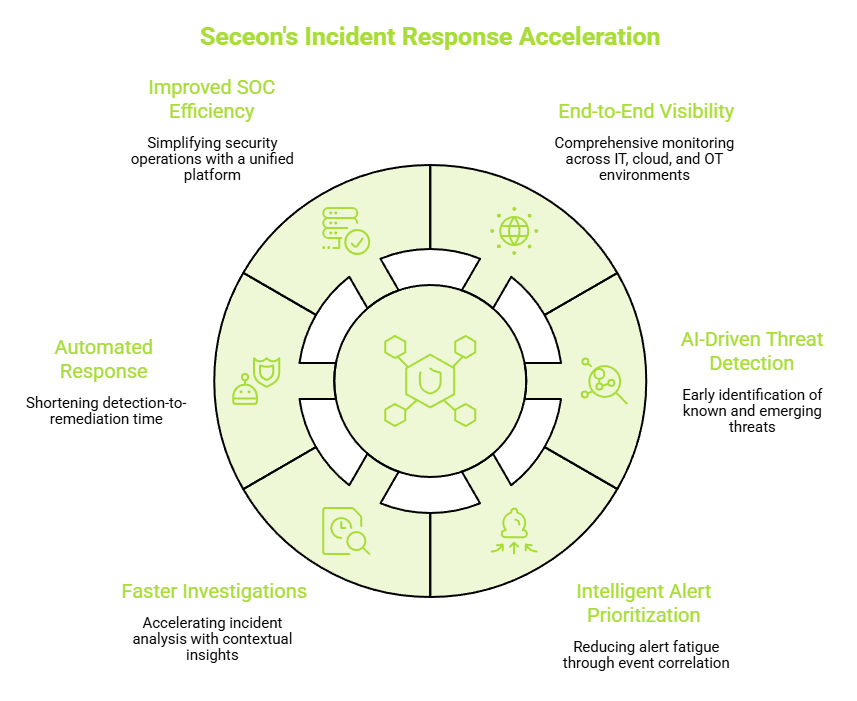
Seceon helps organizations simplify incident response by bringing together threat detection, analytics, investigation, and automated response capabilities within a single AI-driven platform. Instead of relying on multiple disconnected security tools, security teams gain centralized visibility across endpoints, networks, cloud environments, identities, and operational technology (OT), allowing them to investigate incidents with greater speed and confidence.
Seceon’s unified platform helps organizations:
By integrating these capabilities into a single solution, Seceon enables organizations to move beyond reactive security operations and build a more proactive, efficient, and resilient incident response strategy.
Incident response has become one of the defining capabilities of modern cybersecurity. As organizations continue to face increasingly sophisticated threats, responding quickly is just as important as preventing attacks in the first place.
SIEM plays a critical role in improving incident response by providing centralized visibility, correlating events across the environment, reducing alert fatigue, and enabling faster investigations through real-time intelligence and automation. Rather than simply collecting logs, modern SIEM platforms help security teams understand the complete context of an incident and respond with greater speed and accuracy.
By adopting a unified, AI-driven approach to security operations, organizations can reduce operational complexity, improve analyst productivity, and strengthen their overall cyber resilience. With intelligent visibility and automated response working together, security teams are better equipped to stay ahead of evolving threats while protecting critical business operations.