From video streaming platforms and conferencing applications to surveillance systems and content creation tools, FFmpeg is one of the most widely used multimedia frameworks in the world. Its extensive adoption means that a single vulnerability can have ripple effects across thousands of applications and services that rely on it.
According to Cybersecurity News, researchers have disclosed multiple security vulnerabilities affecting FFmpeg, several of which could lead to heap memory corruption, denial-of-service (DoS), information disclosure, or even remote code execution (RCE) if exploited using specially crafted media files.
Rather than a single flaw, the disclosure highlights a collection of weaknesses across different FFmpeg components, emphasizing the importance of keeping multimedia libraries up to date.
The newly disclosed vulnerabilities impact different codecs and media processing components within FFmpeg.
Some of the notable vulnerabilities include:
| CVE | Component | Impact |
| CVE-2026-66036 | Denoise Filter | Heap Out-of-Bounds Write |
| CVE-2026-66037 | IAMF Demuxer | Uncontrolled Resource Consumption |
| CVE-2026-66038 | LCL/ZLIB Video Decoder | Information Disclosure |
| CVE-2026-66039 | MACE6 Audio Decoder | Signed Integer Overflow leading to Heap Corruption |
| CVE-2026-66040 | PNG/APNG Encoder | Heap Out-of-Bounds Write |
| CVE-2026-66041 | Media Processing Component | Heap Out-of-Bounds Write |
Collectively, these vulnerabilities affect multiple areas of FFmpeg’s media parsing and decoding pipeline, increasing the attack surface for applications that process untrusted audio or video content.
Unlike vulnerabilities that require direct system access, these flaws can often be triggered simply by processing a specially crafted media file.
A typical attack scenario could involve:
Because many applications invoke FFmpeg in the background, users may never realize the vulnerable library has been engaged.
FFmpeg is rarely used as a standalone application.
It is embedded within:
As a result, organizations may unknowingly be exposed even if they do not directly install FFmpeg themselves.
The real challenge lies in identifying where vulnerable libraries exist across enterprise software inventories.
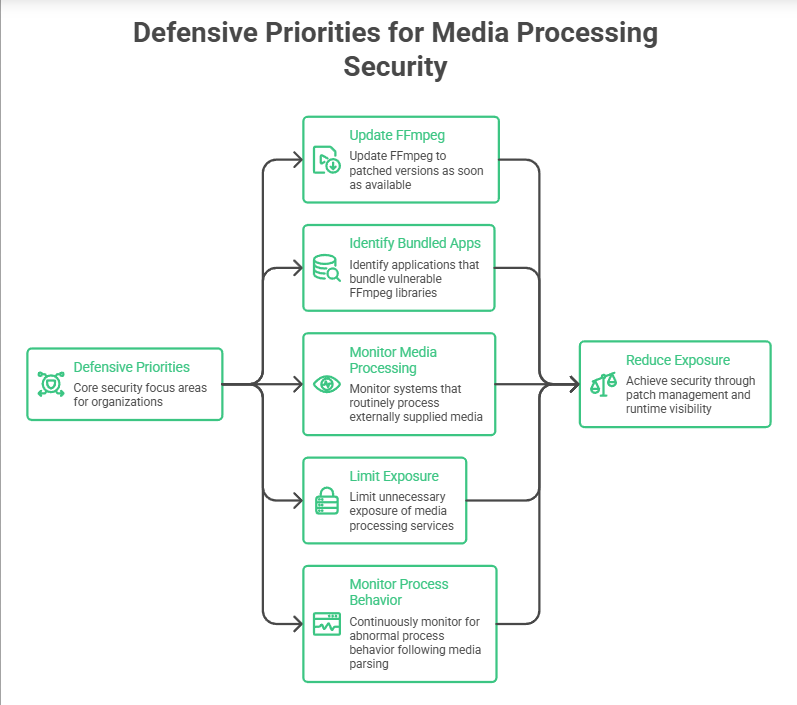
Organizations should focus on:
Reducing exposure requires both patch management and continuous runtime visibility.
Seceon’s aiSIEM / CGuard enables organizations to:
This provides analysts with the context needed to distinguish isolated application failures from coordinated attack activity.
Seceon’s aiXDR-PMax helps detect post-exploitation behavior by:
Behavioral analytics help identify malicious activity even when attackers leverage previously unknown exploitation techniques.
Organizations can use aiBAS360 to continuously validate their defenses by simulating:
Continuous validation enables security teams to verify whether their existing controls can detect and respond before attackers achieve their objectives.
The latest FFmpeg disclosures demonstrate how vulnerabilities in widely embedded open-source components can create widespread security risks across industries.
Because FFmpeg is integrated into countless applications, a vulnerable media library can become an unexpected entry point for attackers using nothing more than a specially crafted media file.
Maintaining an accurate software inventory, rapidly applying security updates, and continuously monitoring application behavior remain essential for reducing the risk posed by vulnerabilities in foundational software components.