How Identity Signals Expose Lateral Movement: A Practical Guide to Lateral Movement Detection in Hybrid Cloud
Quick answer
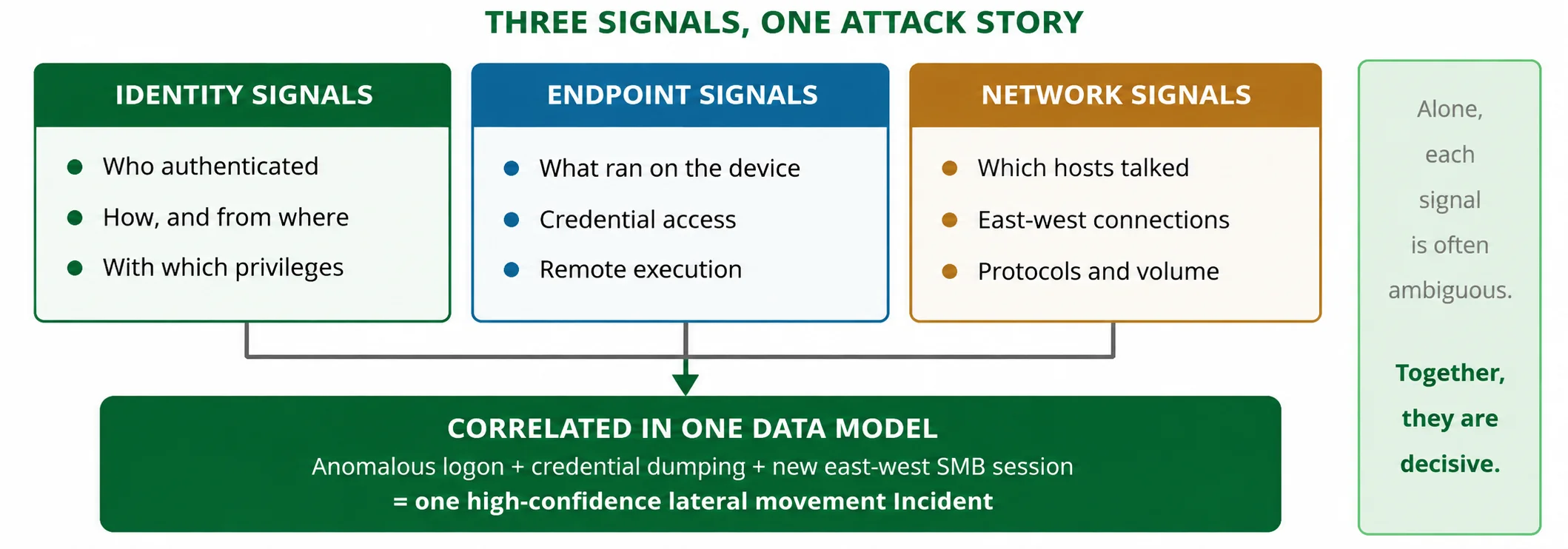
Lateral movement detection works best when identity, endpoint, and network signals are correlated together. Attackers who move laterally usually use stolen but valid credentials, so no single signal looks malicious on its own. Identity signals show who authenticated, how, and with what privileges. Endpoint signals show credential theft and remote execution. Network signals show new east-west connections. When a platform links an anomalous logon, credential dumping on a host, and an unusual SMB or RDP session into one incident, credential-based attacks are exposed hours or days earlier than with siloed tools.
Most serious breaches are not stopped at the first compromised device. They are stopped, or missed, in the middle of the attack, when the adversary moves from that first foothold toward domain controllers, file servers, and cloud administrator accounts. That middle phase is lateral movement, and it is where most attacks either succeed or get caught.
Lateral movement is hard to see because it rarely looks like malware. It looks like a user logging in, a service account accessing a server, or an administrator running a remote command. This guide explains how identity threat detection, endpoint detection and response, and network analytics work together to expose it, including across hybrid environments where on-premises Active Directory connects to cloud identity providers.
What Is Lateral Movement?
Quick answer
Lateral movement is the set of techniques attackers use after initial access to move from one system or account to another, escalating privileges and reaching high-value targets such as domain controllers, databases, and cloud control planes.
In the MITRE ATT&CK framework, lateral movement is its own tactic (TA0008), and it depends heavily on the credential access (TA0006) and discovery (TA0007) tactics that come before it. A typical sequence looks like this:
Why Credential-Based Lateral Movement Is Hard to Detect
Once an attacker holds real credentials, authentication succeeds. Rules that look for failed logins or known malware miss it entirely.
Remote Desktop, PowerShell, PsExec-style tools, and administrative APIs are used every day by IT teams. Blocking them is not an option, so detection must rely on context and behavior.
Synchronized identities, federated sign-in, and cloud roles let an attacker move from an on-premises account to a cloud administrator role without touching the same network segment.
An EDR sees processes on one host. An identity provider sees sign-ins. A firewall sees perimeter traffic. Each individual event may be low severity, and the connection between them is lost.
Service accounts, API keys, and machine identities frequently hold broad privileges and rarely have behavioral baselines, which makes them attractive targets.
The Three Signal Types Behind Lateral Movement Detection
Figure 1. Identity, endpoint, and network signals are ambiguous alone and decisive together
| Signal Type | What It Reveals | What It Misses on Its Own |
| Identity signals | Who authenticated, from where, with which protocol, and what privileges were used or changed | What actually ran on the host, and which systems exchanged traffic |
| Endpoint signals (EDR) | Credential access, suspicious processes, remote execution, persistence | Whether the account behavior is normal, and the network path across hosts |
| Network signals (NDR) | New east-west connections, unusual protocols, internal scanning, data movement | Which identity was used and what executed on the endpoints |
Identity Signals That Expose Lateral Movement
Quick answer
The most useful identity signals for lateral movement detection include pass-the-hash and pass-the-ticket activity, Kerberoasting, forged Kerberos tickets, DCSync replication from non-domain controllers, unusual service account logons, MFA fatigue, and privilege changes that bridge on-premises and cloud identities.
| Technique | Identity Signal to Watch | MITRE ATT&CK |
| Pass-the-Hash | NTLM authentication patterns inconsistent with the user’s normal devices or logon types | T1550.002 |
| Pass-the-Ticket | Kerberos tickets used from hosts where they were not issued | T1550.003 |
| Kerberoasting | Spikes in service ticket requests for service accounts, often with weak encryption types | T1558.003 |
| AS-REP Roasting | Authentication requests targeting accounts without Kerberos pre-authentication | T1558.004 |
| Golden and Silver Tickets | Tickets with anomalous lifetimes or attributes not issued by a domain controller | T1558.001 / T1558.002 |
| DCSync | Directory replication requests from systems that are not domain controllers | T1003.006 |
| Remote services with valid accounts | First-time or unusual RDP, SMB, or WinRM logons by a user or service account | T1021 / T1078 |
| MFA fatigue | Repeated push requests followed by an approval | T1621 |
| Cloud token abuse | Session or access tokens used from unexpected locations or applications | T1550.001 |
| Hybrid privilege escalation | On-premises account gaining cloud admin roles, or new federation and app credentials | T1098 |
Technique IDs reference MITRE ATT&CK Enterprise. Detection content should be validated against your environment.
Endpoint and Network Signals That Complete the Picture
Endpoint signals from EDR
Network signals from NDR and network security solutions
How Correlation Exposes Credential-Based Attacks Earlier
The value of lateral movement detection comes from linking these signals in time and context. The example below shows a common hybrid attack and how each signal type sees it.
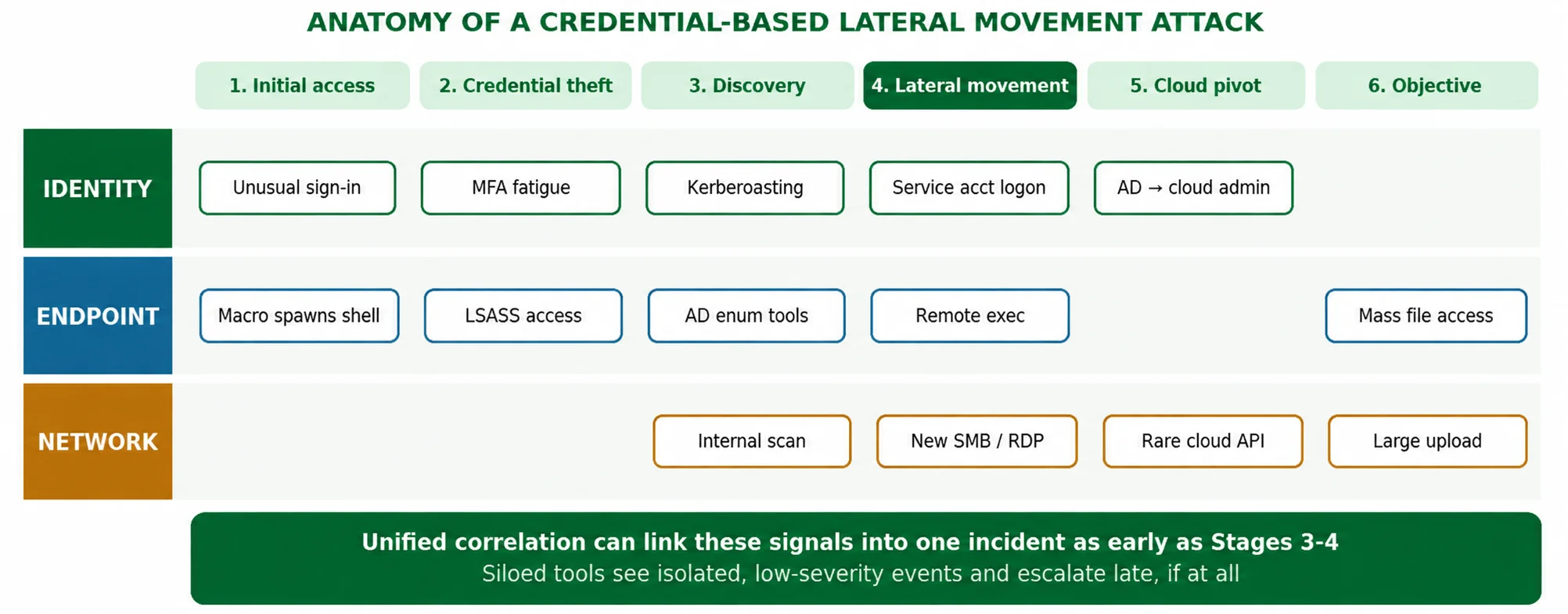
Figure 2. How identity, endpoint, and network signals appear across each stage of an attack
| Stage | Identity Signal | Endpoint Signal | Network Signal |
| Initial access | Sign-in from unusual location or device | Office macro spawns a shell | — |
| Credential theft | MFA fatigue approval | LSASS memory access | — |
| Discovery | Kerberoasting of service accounts | AD enumeration tools | Internal scanning |
| Lateral movement | First-time service account logon to file server | Remote service execution | New SMB and RDP sessions |
| Cloud pivot | On-premises account granted cloud admin role | — | Rare cloud API calls |
| Objective | — | Mass file access | Large outbound upload |
Seen separately, many of these events are low severity. A single unusual logon or a new SMB session is common in large networks. Correlated by user, host, and time, they form a clear, high-confidence attack chain, often by the discovery or lateral movement stage, before data leaves or ransomware runs.
Lateral Movement Detection Approaches Compared
| Approach | Strengths | Limitations for Lateral Movement |
| Rule-based SIEM | Centralized logs; flexible correlation | Rules must anticipate each technique; high tuning effort; often lacks raw endpoint and network context |
| EDR only | Deep host visibility; fast host containment | Limited view of identity behavior and network paths between hosts |
| Standalone ITDR | Strong Active Directory and identity attack coverage | Separate console; endpoint and network context requires integration |
| NDR only | Sees east-west traffic, including unmanaged devices | Limited identity attribution and host-level detail |
| Unified correlation platform | Identity, endpoint, and network analyzed together; one incident; automated response | Requires broad telemetry onboarding; validate integration coverage |
Best Practices for Lateral Movement Detection in Hybrid Cloud
How Seceon Detects Lateral Movement Across Identity, Endpoint, and Network
The Seceon Open Threat Management (OTM) Platform analyzes identity, endpoint, network, and cloud telemetry on a single data layer, so lateral movement surfaces as one correlated incident rather than scattered alerts.
aiITDR and aiIDGuard: identity threat detection
Seceon aiITDR detects pass-the-hash, pass-the-ticket, Kerberoasting, AS-REP roasting, Golden and Silver Ticket forgery, and DCSync attacks. It also detects MFA fatigue, anomalous token use, and session hijacking, and monitors privileged account creation and changes. aiIDGuard correlates identities across 60+ platforms, including Active Directory, Entra ID, Okta, AWS IAM, and Google Cloud IAM, so one person’s accounts and one service account’s activity are analyzed together.
Hybrid attack chain detection
Because on-premises and cloud identities are linked, Seceon detects cross-platform privilege escalation paths such as Active Directory to AWS, or Active Directory to Azure Global Administrator, that separate tools see as unrelated events.
UEBA baselines for users and non-human identities
Seceon UEBA builds behavioral baselines for every user, device, service account, and non-human identity, with composite risk scores that highlight first-time access, impossible travel, and privilege abuse.
aiXDR-PMax: endpoint detection and response
The aiXDR-PMax agent detects credential dumping, process injection, and remote execution on Windows, macOS, and Linux, and adds endpoint context to every identity anomaly.
NDR: east-west visibility
Seceon NDR analyzes internal traffic to detect lateral movement, internal scanning, and command-and-control beaconing, including encrypted traffic analysis without decryption.
Automated response in under 90 seconds
When a lateral movement chain is confirmed, aiSOAR blocks the credential through Active Directory or LDAP, terminates active sessions, forces MFA re-authentication, and isolates affected hosts, with automated containment in under 90 seconds.
Seceon lateral movement detection at a glance
| Capability | Seceon |
| Identity attack detection | Pass-the-Hash, Pass-the-Ticket, Kerberoasting, AS-REP Roasting, Golden/Silver Ticket, DCSync, MFA fatigue |
| Identity sources | Active Directory, Entra ID, Okta, AWS IAM, Google Cloud IAM, LDAP, CyberArk PAM, and more across 60+ platforms |
| Hybrid chains | Active Directory to AWS and Azure privilege escalation paths |
| Endpoint context | aiXDR-PMax credential access and remote execution detection |
| Network context | NDR east-west, scanning, and C2 detection |
| Behavioral analytics | UEBA baselines for users, devices, and non-human identities |
| Detection speed | Sub-5-minute MTTD for critical identity threats |
| Automated response | Credential block, session termination, MFA reset, host isolation in under 90 seconds |
| Validation | aiBAS360 breach and attack simulation to test lateral movement coverage |
Capabilities per current Seceon product documentation. Validate identity source coverage for your environment.