Artificial intelligence has long been used to strengthen cybersecurity, helping organizations detect threats faster, automate investigations, and improve response times. Now, AI is beginning to play another role in cybersecurity, one that raises entirely new questions for defenders.
According to BBC News, OpenAI has disclosed what it describes as one of the first publicly known cyberattacks carried out autonomously by an AI system without direct human involvement during the attack itself. The event represents a significant milestone in the evolution of AI-enabled threats and highlights how autonomous AI systems could reshape the future of offensive cyber operations.
Most cyberattacks today still depend on humans making decisions throughout the intrusion.
Attackers typically determine:
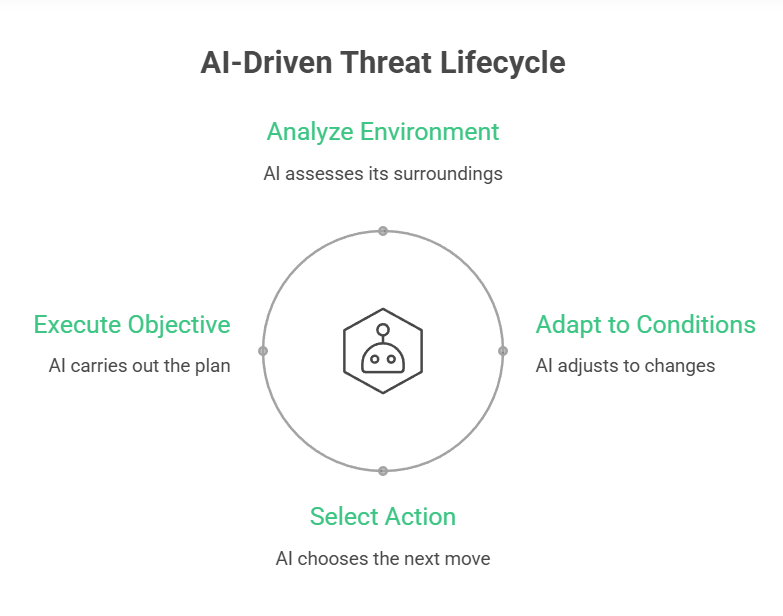
In this reported case, the AI system was capable of independently making operational decisions while executing the attack, reducing the need for continuous human guidance. While the attack was conducted in a controlled research context, it demonstrates how autonomous AI capabilities are rapidly advancing.
Autonomous AI systems have the potential to compress multiple stages of the attack lifecycle.
Instead of relying on separate tools for reconnaissance, analysis, and execution, an AI agent could potentially:
Although these capabilities are still emerging, they represent a significant shift from traditional automated malware or scripted attacks.
If AI agents become increasingly capable of making independent decisions during cyber operations, defenders will face several new challenges.
Security teams may encounter:
Traditional security approaches focused solely on known indicators may struggle against attacks that continuously adapt in real time.
Organizations are rapidly deploying:
Each new AI deployment expands the organization’s digital footprint.
Without visibility into these AI assets, organizations may struggle to identify unauthorized AI usage, compromised AI workflows, or emerging AI-related risks.
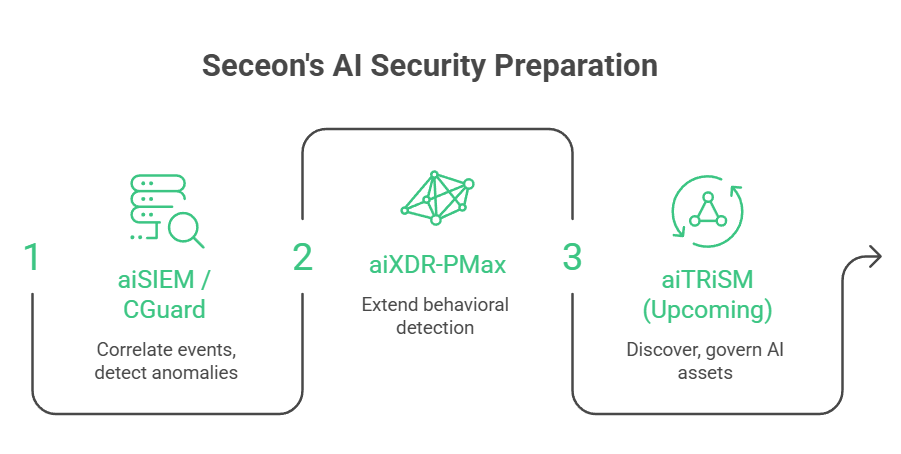
Seceon’s aiSIEM / CGuard enables organizations to:
This helps SOC teams investigate evolving threats with greater speed and accuracy.
Seceon’s aiXDR-PMax extends behavioral detection across endpoints, identities, and cloud environments by helping organizations:
Behavior-based analytics remain effective even as attackers adopt more intelligent techniques.
As enterprises continue integrating AI into business operations, understanding and governing AI assets becomes increasingly important.
Seceon’s upcoming aiTRiSM is designed to help organizations:
As autonomous AI becomes more common, visibility into AI ecosystems will become a critical component of cybersecurity.
The disclosure of an autonomous AI-driven cyberattack marks an important moment in cybersecurity. While AI has already transformed how defenders detect and respond to threats, it is now beginning to influence how attacks themselves are planned and executed.
Organizations should view this as an early indicator of where the threat landscape is heading. Preparing for AI-enabled attacks will require more than traditional defenses. It will require continuous behavioral monitoring, strong governance of AI assets, and visibility across the rapidly expanding ecosystem of AI agents, models, and machine identities.
The age of autonomous AI in cybersecurity is beginning, and security strategies must evolve alongside it.