A threat intelligence platform (TIP) is a cybersecurity technology that helps organizations gather, normalize, enrich, analyze, manage, and share information about cyber threats.
This information can include malicious IP addresses, suspicious domains, file hashes, phishing indicators, attacker techniques, vulnerability information, threat actor activity, and reports describing emerging attack campaigns.
The purpose of a threat intelligence platform is to turn fragmented threat information into actionable security context.
For example, an organization might receive an alert about a workstation connecting to an unfamiliar external IP address. On its own, the connection may not establish whether the device is compromised. A threat intelligence platform can help check the indicator against available intelligence sources and provide context about its reputation or known malicious associations.
If the same endpoint also shows unusual process activity or suspicious authentication events, the combined evidence may justify a higher-priority investigation.
The National Institute of Standards and Technology (NIST) describes threat information as information that can help an organization protect against threats or detect threat activity. Examples include indicators, adversary tactics and techniques, security alerts, threat intelligence reports, and relevant tool configurations.
A threat intelligence platform therefore does more than maintain a list of known malicious indicators. Its value comes from helping security teams interpret and apply information in their own operational context.
These terms are related, but they are not identical.
Threat intelligence feed: A source of threat-related information, such as known malicious IP addresses, suspicious domains, file hashes, or other indicators.
Threat intelligence platform: A system that can bring information from multiple sources together, normalize it, enrich it, support analysis, and make it useful within security workflows.
A feed can provide valuable information, but organizations may need additional capabilities to correlate that information with internal telemetry, manage duplicates, prioritize relevant indicators, and trigger appropriate responses.
A platform helps connect threat data to security operations.
A threat intelligence platform follows a process that turns raw information into useful security insights. The precise workflow depends on the platform, available integrations, intelligence sources, and the organization’s security policies.
1. Collect threat intelligence
Gather information from trusted external feeds, security research, incident reports, vulnerability advisories, and internal security systems. Sources should be evaluated for reliability, relevance, freshness, and coverage.
2. Normalize and enrich the data
Standardize information from different sources and add context, such as indicator reputation, related infrastructure, timestamps, confidence levels, and known attack associations where available.
3. Correlate intelligence with internal activity
Compare external intelligence with available logs, network traffic, endpoint events, identity activity, and cloud telemetry to identify potential matches or suspicious patterns.
4. Prioritize and investigate threats
Assess the intelligence alongside asset criticality, observed behavior, exposure, and other available evidence. Analysts can use this context to decide which alerts need immediate investigation.
5. Apply intelligence to detection and response
Use relevant intelligence to improve detection rules, guide threat hunting, enrich incidents, or initiate approved response workflows through supported integrations.
6. Review and refine intelligence
Evaluate whether intelligence produced useful detections, identify outdated or irrelevant indicators, and improve source selection and investigation processes over time.
The goal is to connect threat knowledge with operational decisions. An indicator should not automatically trigger a disruptive action simply because it appears in a feed. Its reliability, context, and potential business impact should inform how it is used.
Organizations use different types of threat intelligence depending on their security objectives, audience, and operational needs.
Strategic intelligence focuses on the broader cyber risk landscape, including industry trends, threat actor motivations, geopolitical developments, and risks to business operations.
It is particularly relevant to CISOs, risk managers, and executive leadership because it supports decisions about security investment, risk tolerance, and defensive priorities.
For example, a financial organization may use strategic intelligence about attacks targeting payment systems to review its security priorities and incident-response readiness.
Tactical intelligence describes how attackers operate, including their tactics, techniques, and procedures (TTPs). It can help defenders understand how attacks progress and which defensive controls may be relevant.
Security teams can use this information to develop detection logic, improve incident-response playbooks, and identify gaps in their existing controls.
Operational intelligence focuses on particular campaigns, incidents, or threat activity. It may include information about the likely objectives, targets, timing, or methods associated with an attack.
This information can help security teams prepare for threats that are especially relevant to their industry or environment.
Technical intelligence includes observable indicators such as malicious IP addresses, domains, URLs, file hashes, and other technical artifacts associated with suspicious or malicious activity.
These indicators can support alert enrichment, detection rules, searches across historical telemetry, and investigations. Because indicators can become outdated or be reused by legitimate services, teams should consider their age, source, confidence, and surrounding evidence.
A mature threat intelligence strategy uses these intelligence types together. Technical indicators can help identify specific activity, while tactical, operational, and strategic intelligence provide broader context.
A threat intelligence platform can improve cybersecurity when intelligence is relevant, reliable, and integrated into operational processes.
Threat intelligence adds context to security events. When an event matches a credible malicious indicator or a known attack pattern, security teams may be able to identify and prioritize it more effectively.
Combining intelligence with behavioral analytics is particularly useful because attackers can change infrastructure and use new indicators while continuing to rely on recognizable techniques.
Analysts often need to determine whether an alert is connected to known malicious infrastructure, a suspicious campaign, or a wider compromise.
A platform that makes relevant intelligence available within investigation workflows can reduce the need to search multiple disconnected sources manually.
Not every indicator or alert represents the same level of risk. A threat intelligence platform can help teams assess an indicator alongside asset importance, vulnerability exposure, observed behavior, and confidence in the source.
This helps security teams focus on threats that are more relevant to their organization instead of treating every match as equally urgent.
Threat hunting involves searching for signs of compromise that may not have generated a conventional alert.
Threat intelligence can guide hunting hypotheses, such as checking whether internal systems have communicated with suspicious infrastructure or whether endpoints exhibit techniques associated with a known campaign.
The process is most effective when external intelligence is combined with internal telemetry and knowledge of the organization’s environment.
Intelligence can inform decisions about containment, remediation, and investigation. For example, a confirmed malicious domain may support a blocking decision, while information about an attack technique can help responders search for related activity.
Response actions should still be validated against organizational policies and the risk of disrupting legitimate business operations.
Centralizing intelligence and integrating it into security workflows can reduce repetitive lookups and manual enrichment. Analysts can spend more time examining meaningful evidence and less time switching between tools.
However, a platform also requires ongoing maintenance, including source management, integration monitoring, and review of intelligence quality.
Threat intelligence can provide a common reference for SOC analysts, incident responders, threat hunters, and security leadership. Consistent intelligence handling helps teams share findings, document decisions, and improve defensive procedures.
Threat intelligence platforms are often integrated with other security technologies. Although their functions overlap, each addresses a different part of the security process.
| Technology | Primary purpose | Relationship to threat intelligence |
|---|---|---|
| Threat Intelligence Platform (TIP) | Organizes and operationalizes threat information | Provides context about indicators, campaigns, and attacker behavior |
| SIEM | Collects and analyzes security logs and events | Uses intelligence to enrich alerts and support detection |
| XDR | Correlates threat activity across connected security layers | Combines intelligence with endpoint, network, and other signals |
| SOAR | Orchestrates and automates response workflows | Uses intelligence in playbooks, enrichment, prioritization, and response decisions |
| EDR | Monitors endpoint activity and supports endpoint response | Uses relevant intelligence to help investigate and respond to endpoint threats |
A threat intelligence platform is not necessarily a replacement for SIEM, XDR, or SOAR. Instead, intelligence can improve how these technologies interpret events and coordinate actions.
For example, a SIEM might identify an unusual outbound connection. Threat intelligence can provide context about the destination, XDR can correlate the connection with endpoint behavior, and SOAR can coordinate a response through supported integrations.
The most appropriate architecture depends on an organization’s existing tools, operational requirements, and desired level of integration.
Threat intelligence can support many security activities, from investigating suspicious indicators to preparing for targeted attacks.
Security teams can compare network connections, DNS queries, and other available telemetry with credible intelligence sources. A match may warrant further investigation, especially when accompanied by unusual endpoint or user behavior.
Intelligence about malicious URLs, domains, file hashes, and known campaigns can help analysts assess suspicious emails and files. Combined with email and endpoint telemetry, this context can help determine whether a threat reached users or executed on a device.
Threat intelligence can help identify ransomware-related infrastructure, known attacker techniques, and relevant indicators. Teams can use these insights to improve detection coverage, search for signs of compromise, and review containment procedures.
Intelligence is only one component of ransomware defense; patching, MFA, segmentation, endpoint protection, and tested backups remain essential.
Information about credential theft campaigns and attacker techniques can guide investigations into unusual logins, suspicious privilege changes, and abnormal access patterns. Correlating intelligence with identity telemetry can help teams investigate whether an account may be compromised.
Threat intelligence can help explain which vulnerabilities are being exploited or are associated with relevant attack campaigns. Organizations can combine this context with asset criticality and exposure to prioritize remediation.
A vulnerability’s priority should not be based on threat intelligence alone. Business impact, exploitability, available mitigations, and the organization’s own exposure also matter.
Analysts can use intelligence to search historical telemetry for suspicious indicators or behaviors. During incident response, it can help investigators explore possible attack paths, identify related systems, and develop additional investigative questions.
MSPs and MSSPs can use shared intelligence and standardized workflows to support monitoring across customer environments. Each customer’s asset inventory, risk profile, permissions, and response policies should still be considered separately.
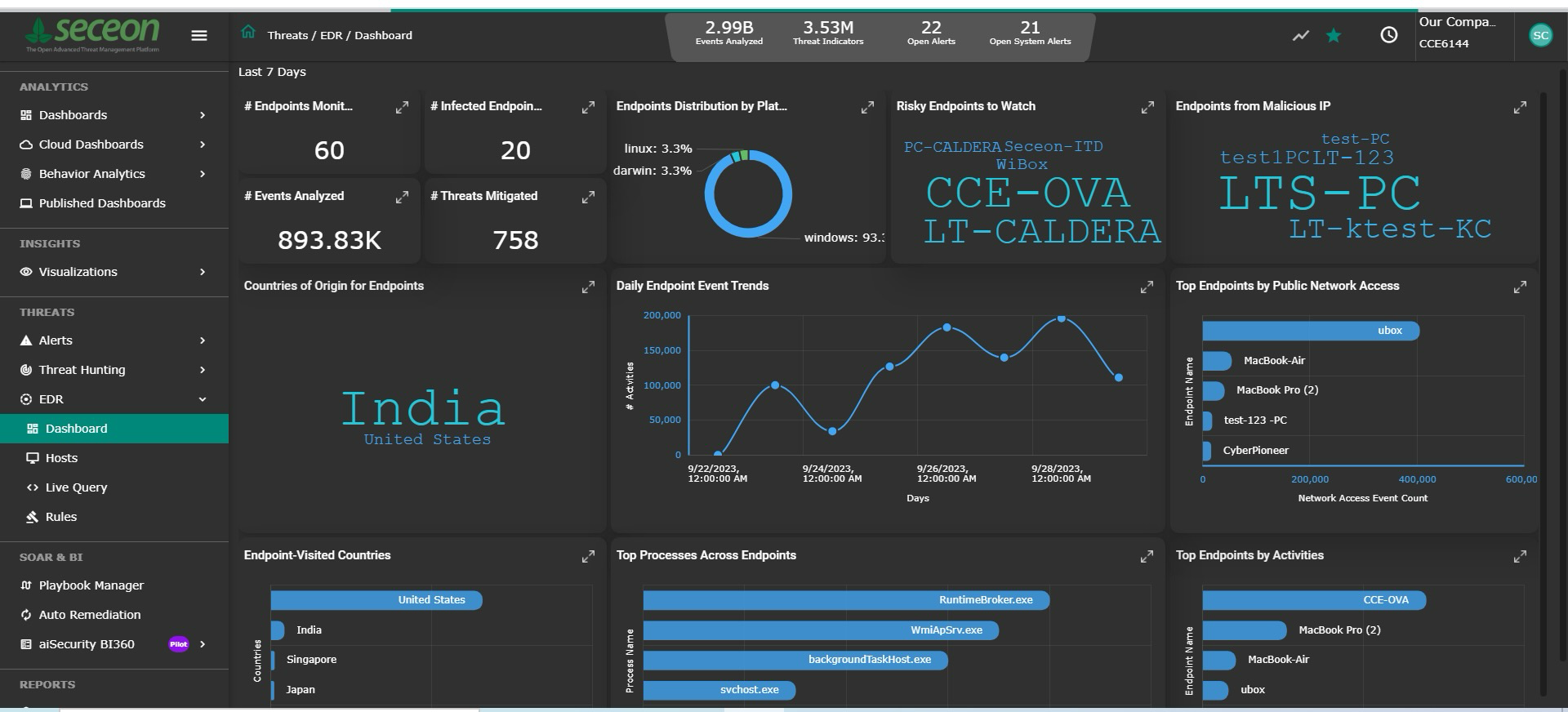
Seceon Inc. provides threat intelligence and threat hunting capabilities within its broader Open Threat Management (OTM) Platform. The company’s platform documentation describes integrating threat intelligence with machine learning, behavioral analytics, event correlation, and security response processes.
This integration is important because threat intelligence becomes more useful when it can be compared with real activity across an organization’s environment.
Seceon’s published aiSIEM datasheet describes contextual enrichment using threat intelligence sources, vulnerability assessments, and historical data. It also describes ingesting events, logs, network flows, and user activity from identities, networks, endpoints, cloud environments, and applications.
This broader context can help analysts assess whether an indicator is associated with suspicious activity and whether related events require investigation.
Threat intelligence often identifies known indicators or documented attack techniques, but not every threat uses infrastructure that has already been identified.
Seceon’s OTM Platform describes machine learning-based behavioral analytics and AI-driven decision-making to analyze digital assets and identify suspicious activity.
By combining intelligence with behavioral context, security teams can evaluate both known threats and activity that deviates from normal patterns. The effectiveness of this approach depends on the available telemetry, configuration, and quality of detection logic.
Threat hunting helps analysts investigate activity that may not have triggered an existing alert. Seceon’s platform documentation describes threat hunting using behavioral analytics and internal and external security data, with an emphasis on investigating potential threats and their root causes.
For example, an analyst investigating a suspicious domain may search for related DNS queries, endpoint connections, user activity, and historical security events. The aim is to determine whether the activity is isolated or part of a larger incident.
Threat intelligence can help inform detection rules, alert prioritization, and incident investigations. Seceon’s broader platform brings together capabilities such as SIEM, XDR, SOAR, and UEBA to support coordinated security operations.
When supported integrations and policies are configured, intelligence can contribute to workflows that escalate incidents or initiate approved response actions. Organizations should validate the exact integrations and response controls available in their deployment before relying on them operationally.
Enterprise security data often comes from on-premises systems, cloud services, endpoints, identities, and network infrastructure.
Seceon’s OTM Platform is designed to bring together information from supported sources in a unified security environment. This can help security teams correlate events across distributed systems rather than investigate each source independently.
Enterprises may need threat intelligence to support internal SOC operations, while MSPs and MSSPs may use it as part of their managed security services.
When evaluating Seceon for these use cases, organizations should examine connector coverage, intelligence-source configuration, tenant separation, role-based permissions, reporting, and the ability to customize workflows for different environments.
Explore Seceon’s platform and threat intelligence resources:
Selecting a threat intelligence platform requires more than comparing the number of feeds or indicators available. The platform should help the organization use relevant intelligence in its existing security processes.
Review the sources supported by the platform and determine how their information is validated, updated, and assessed for relevance. Consider freshness, reliability, confidence, and the risk of false or outdated indicators.
More feeds do not automatically mean better intelligence.
Confirm that the platform can work with your SIEM, XDR, EDR, firewall, identity, cloud, and case-management tools as required.
Evaluate both data ingestion and response capabilities. An integration that imports an alert may not support the actions needed to investigate or remediate the incident.
Determine whether the platform can combine external intelligence with internal telemetry, vulnerability information, asset criticality, and historical events.
Context is essential for distinguishing a relevant threat from an indicator that has little connection to the organization’s actual risk.
Look for ways to search security telemetry, investigate related indicators, explore historical events, and identify patterns that may not have triggered existing alerts.
The platform should support the investigation methods used by your analysts without creating unnecessary operational complexity.
If automated response is a priority, confirm which actions are supported and how they are authorized. Review approval workflows, permissions, audit records, failure handling, and the ability to test response playbooks safely.
Evaluate the platform’s ability to handle your data sources, event volumes, deployment architecture, and operational requirements. Enterprises with hybrid environments should confirm coverage across their actual infrastructure.
MSPs and MSSPs should additionally assess multi-tenant management and customer-specific policies.
Establish a baseline before deployment and evaluate results using metrics such as:
Time required to enrich and investigate an alert.
Percentage of alerts with useful intelligence context.
Number of actionable findings from threat hunts.
Rate of outdated or irrelevant indicators.
Mean time to detect and respond to incidents.
Integration reliability and playbook success rate.
These measures provide a more useful basis for evaluation than a feature checklist alone.
A threat intelligence platform is most effective when it is treated as part of a continuous security process.
Align intelligence with business risks. Prioritize threats relevant to your industry, critical assets, technology stack, and exposure. Avoid collecting large volumes of information that your team cannot use.
Validate indicators before disruptive action. A match in a feed may be a useful warning, but it should be assessed alongside context and confidence. Define when blocking or containment can occur automatically and when analyst approval is required.
Keep intelligence current. Review indicator expiration, source reliability, and changes in threat activity. Outdated information can generate false positives or cause legitimate services to be blocked.
Connect intelligence to internal telemetry. External intelligence is more actionable when it can be correlated with endpoint, identity, network, cloud, and application events.
Develop repeatable threat-hunting procedures. Use intelligence to create investigation hypotheses, document findings, and improve detection coverage. Record both positive and negative results to refine future hunts.
Review results and improve continuously. Measure whether intelligence contributes to meaningful detections and better response decisions. Retire sources or workflows that produce little value, and update procedures as threats and infrastructure change.
A threat intelligence platform collects, organizes, enriches, and analyzes information about cyber threats. It helps security teams apply intelligence to detection, threat hunting, investigation, and response workflows.
Threat intelligence provides information about threats, such as indicators, tactics, techniques, and campaigns. Threat hunting is the proactive investigation of systems and security data to identify suspicious activity that may have escaped existing detection controls. Intelligence can guide threat hunts, but the two serve different purposes.
It can enrich alerts with information about known malicious indicators and attack techniques, then help correlate that information with internal telemetry. This gives analysts additional context for prioritization and investigation.
Not necessarily. A threat intelligence platform focuses on managing and operationalizing threat information, while SIEM collects and analyzes security events. Integrating the two can help improve alert context and support more informed investigations.
AI and machine learning can help analyze large volumes of security data, identify patterns, correlate events, and support prioritization. Their effectiveness depends on data quality, configuration, and validation; they do not guarantee detection of every threat.
Yes. Relevant intelligence can help identify ransomware-associated indicators and techniques, improve detection coverage, and guide threat hunting. It should complement—not replace—patching, MFA, endpoint security, segmentation, backups, and incident-response planning.
Consider source quality, integration coverage, enrichment, threat hunting, automation, deployment requirements, governance, and measurable outcomes. A proof of concept using realistic security scenarios can help validate the platform’s practical value.
Seceon describes integrating threat intelligence with its broader OTM Platform, including aiSIEM and related detection and response capabilities. Its published documentation describes intelligence enrichment, behavioral analytics, event correlation, and threat hunting across supported data sources.
Cyber threats continue to change, and organizations need more than isolated security alerts to understand their exposure. A threat intelligence platform helps transform information about malicious infrastructure, attacker techniques, vulnerabilities, and emerging campaigns into context that security teams can use.
When integrated with SIEM, XDR, SOAR, and threat hunting workflows, threat intelligence can support better alert prioritization, more focused investigations, proactive detection, and coordinated incident response.
Seceon Inc.’s Open Threat Management (OTM) Platform brings threat intelligence together with AI/ML-driven analytics, behavioral monitoring, and security operations capabilities. This integrated approach can help organizations investigate suspicious activity across supported environments and make better-informed security decisions.
For CISOs, enterprises, SOC teams, MSPs, and MSSPs, the objective is to make threat intelligence practical: identify relevant threats, connect intelligence to internal activity, investigate potential compromises, and respond according to established policies.
Ready to strengthen your threat intelligence strategy?
Visit Seceon.com to explore the Seceon OTM Platform and learn how its threat intelligence, threat hunting, and detection capabilities can support your cybersecurity operations.