AI SIEM vs Unified Security Platforms in 2026: How to Choose the Right AI-Powered Cybersecurity Platform
Quick answer An AI SIEM adds machine learning to log collection and correlation, but detection, response, automation, and threat intelligence often remain separate tools. A unified security platform, or AI-powered cybersecurity platform, runs SIEM, extended detection and response (XDR), security orchestration automation and response (SOAR), UEBA, and threat intelligence on one data layer and one console. Enterprises that want faster response, less tool sprawl, and lower total cost of ownership are increasingly choosing integrated cybersecurity platforms over standalone AI SIEM tools. |
Almost every SIEM vendor now markets “AI.” Buyers need to ask a more useful question: where does the AI operate, and what can it act on? An AI SIEM that scores alerts faster still hands those alerts to a separate SOAR, a separate XDR console, and a separate threat intelligence platform. A unified platform applies AI across the whole detection-to-response chain.
This guide explains the architectural difference, compares the two approaches on the criteria that matter to enterprise security operations, and shows where Seceon’s AI-powered cybersecurity platform fits.
AI SIEM Smarter detection on a log-centric core AI focus: Detection and alert prioritization Response: Separate SOAR / EDR / XDR Threat intel: Feed integrations or add-on TIP Consoles: Several Licensing: Often ingestion-based, plus add-ons Best for: Mature SOCs with strong engineering and established best-of-breed tools | VS | Unified AI-Powered Platform Detection, investigation, and response on one data layer AI focus: Detection, investigation, and response Response: Native XDR + SOAR Threat intel: Embedded enrichment at ingestion Consoles: One Licensing: Consolidated Best for: Lean or scaling SOCs, MSSPs, and consolidation-focused enterprises |
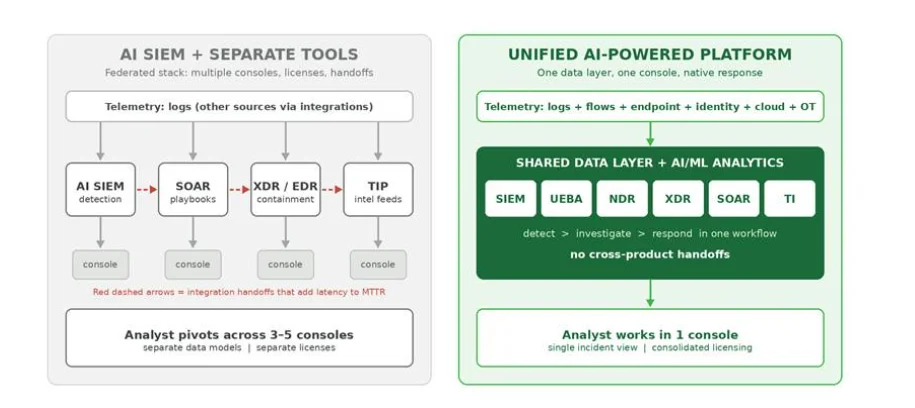
Figure 1. Federated AI SIEM stack vs unified AI-powered cybersecurity platform architecture
Quick answer An AI SIEM is a security information and event management platform that uses machine learning to improve log correlation, anomaly detection, and alert prioritization. It centralizes visibility, but it usually depends on separate tools for response and orchestration. |
An AI SIEM builds on the traditional SIEM foundation (log ingestion, normalization, correlation, retention, and compliance reporting) and adds intelligence on top:
■ ML-based anomaly detection that baselines user and entity behavior.
■ Risk scoring and alert prioritization that reduce the triage queue.
■ Generative AI assistants for natural-language search and incident summaries.
■ Detection content libraries mapped to MITRE ATT&CK.
These are real improvements. The limitation is architectural. In most AI SIEM deployments, the SIEM remains the analytics hub while response lives elsewhere: endpoint containment in an EDR console, playbooks in a separately licensed SOAR, and threat intelligence in a third-party platform. The AI makes detection smarter but does not remove the handoffs between tools.
Quick answer A unified security platform is an integrated cybersecurity platform that combines SIEM, XDR, SOAR, UEBA, NDR, and threat intelligence on a shared data model and a single console. AI analyzes all telemetry together and can trigger automated response directly. |
A unified security platform treats detection, investigation, and response as one continuous workflow rather than a chain of integrations. Its defining characteristics are:
■ One data layer. Logs, network flows, endpoint, identity, cloud, and OT telemetry are correlated together, not federated across products.
■ Native extended detection and response. Cross-domain correlation reconstructs full attack chains.
■ Built-in security orchestration automation and response. Playbooks execute from the same platform that raised the detection.
■ Embedded threat intelligence. IOC enrichment and reputation scoring happen at ingestion, not as an afterthought.
■ One console and one licensing model. Analysts investigate in one place, and procurement manages one contract.
| Criterion | AI SIEM | Unified AI-Powered Cybersecurity Platform |
| Core focus | Log analytics, correlation, and compliance | End-to-end detection, investigation, and response |
| Where AI operates | Mainly detection and alert prioritization | Across detection, investigation, and response |
| Telemetry scope | Primarily logs; other data via integrations | Logs, network flows, endpoint, identity, cloud, OT natively |
| Extended detection and response | Often a separate product | Native cross-domain correlation |
| SOAR / automation | Usually separately licensed | Built in; playbooks triggered from detections |
| Threat intelligence | Feed integrations or add-on TIP | Embedded enrichment at ingestion |
| Analyst experience | Multiple consoles and pivots | Single console, single incident view |
| Time to value | Content tuning and integration work | Faster, with pre-integrated components |
| Licensing | Often ingestion-based, plus add-ons | Consolidated licensing |
| Best fit | Mature SOCs with strong engineering teams and established best-of-breed tools | Lean or scaling SOCs, MSSPs, and consolidation-focused enterprises |
| Approach | Vendors commonly evaluated | What to watch |
| AI SIEM (standalone) | Splunk Enterprise Security, Exabeam, Securonix, Elastic Security, Sumo Logic | Often paired with separate SOAR and XDR products; integration and licensing scope |
| Unified – ecosystem-anchored | Palo Alto Networks Cortex XSIAM, Microsoft Sentinel + Defender unified SecOps, Google Security Operations, CrowdStrike Falcon Next-Gen SIEM | Delivers most value when standardized on that vendor’s endpoint, cloud, or firewall stack |
| Unified – vendor-neutral | Seceon OTM Platform | Ingests and acts on telemetry from the tools you already own |
Vendor positioning summarized from publicly available information as of 2026. Validate specifics during evaluation.
Many enterprise SOCs run a large collection of overlapping security tools. Each additional console adds context switching, and each integration can break during upgrades. When detection happens in one tool and response in another, the gap between them is where attackers gain time.
Detecting more is not enough. Modern ransomware and identity attacks move from initial access to impact quickly. The metric that matters is mean time to respond (MTTR), and MTTR suffers most at the handoffs between SIEM, SOAR, and XDR.
Machine learning models are only as good as the telemetry they see. An AI SIEM that analyzes logs alone will miss behaviors that show up only in network flows or endpoint activity. A unified platform gives AI the full picture, which improves accuracy and reduces false positives.
Most SOCs cannot hire their way out of alert volume. Security orchestration automation and response has to be embedded in the detection workflow, not bolted on, so that routine Tier-1 work happens automatically and analysts focus on judgment calls.
Separate licenses for SIEM, SOAR, XDR, UEBA, and threat intelligence, plus the integration services to connect them, add up. Consolidating onto an integrated cybersecurity platform can lower TCO while improving coverage.
A credible evaluation acknowledges trade-offs. For most enterprises, the deciding factor is operational capacity. If your team spends more time maintaining integrations and tuning rules than investigating threats, a unified platform is likely the better investment.
Choose a standalone AI SIEM if… ■ You have deep, well-integrated investment in best-of-breed SOAR and XDR tools ■ You have a large detection engineering team that wants maximum query flexibility ■ Your main driver is compliance log retention rather than response outcomes | Choose a unified platform if… ■ Your team spends more time maintaining integrations than investigating threats ■ You need faster MTTR with automated containment ■ You want fewer consoles, fewer licenses, and lower TCO ■ You run a lean SOC or deliver multi-tenant MSSP services |
The Seceon Open Threat Management (OTM) Platform is an AI/ML-driven cybersecurity operations platform built for unified detection, investigation, and response. It is designed to improve SOC efficacy, efficiency, automation, and ROI together, without forcing you to replace the security controls you already own.
Seceon aiSIEM ingests and normalizes telemetry in real time and applies thousands of machine learning models and Dynamic Threat Models to detect genuine threats with minimal manual rule authoring. Detections are mapped to MITRE ATT&CK.
aiXDR correlates signals across network, endpoint, cloud, and identity into a single attack story. A suspicious login, an unusual east-west connection, and a DNS beacon become one prioritized incident, with multi-stage attack chain reconstruction and root-cause context.
aiSOAR executes containment actions from the same platform that raised the detection. It can isolate a host, disable a compromised account, or block a malicious IP through existing firewalls, EDR, and identity providers. Automated response completes in under 90 seconds, and roughly 70% of incident response is automated.
Seceon enriches telemetry at ingestion with 100+ threat intelligence feeds and supports STIX/TAXII standards. Indicators are matched in real time and retroactively against historical data.
User and entity behavior analytics and network detection and response run on the same data layer. This gives the AI visibility into insider threats, credential misuse, lateral movement, and command-and-control activity that log-only analytics can miss.
With 950+ pre-built connectors across firewalls, EDR, identity, cloud, and SaaS applications, Seceon works with your existing stack. Telemetry is collected through APIs, agentless collectors, syslog, and flow protocols across hybrid and multi-cloud environments.
Seceon supports SaaS, on-premises, hybrid, private cloud, and air-gapped deployments for sovereign and regulated environments. Its native multi-tenant, multi-tier architecture lets MSSPs and large enterprises manage multiple business units or customers from one console.
Quick answer Seceon’s unified platform delivers MTTD under 5 minutes, automated response in under 90 seconds, up to 95% fewer false positives, and up to 58% lower TCO by consolidating SIEM, XDR, SOAR, UEBA, NDR, and threat intelligence into one AI-powered cybersecurity platform. |
| Outcome | Seceon OTM Platform* | Why It Matters |
| Mean time to detect (MTTD) | Under 5 minutes | Threats identified before lateral spread |
| Automated response | Under 90 seconds | Containment without analyst handoff delays |
| Automated incident response | ~70% | Tier-1 work handled by the platform |
| False-positive reduction | Up to 95% | Analysts investigate real threats |
| Analyst productivity | 3–5x improvement | More coverage without more headcount |
| Total cost of ownership | Up to 58% reduction | Fewer licenses, integrations, and consoles |
| Scale | ~1.7 trillion events/day, 9,000+ customers | Proven at enterprise and MSSP scale |
*Seceon platform figures; results vary by environment and deployment scope.
| Dimension | AI SIEM + Separate SOAR/XDR/TIP | Seceon OTM Platform |
| Consoles | 3–5 | 1 |
| Licenses and contracts | Multiple | Consolidated |
| Detection-to-response handoffs | Integration-dependent | Native, same platform |
| Telemetry correlation | Federated across products | Single data layer |
| Integration maintenance | Ongoing engineering effort | Pre-integrated |
| Deployment options | Varies by component | SaaS, on-prem, hybrid, air-gapped |
| MSSP multi-tenancy | Varies by component | Native, multi-tier |