Quick answer The best AI SOC platforms for regulated industries combine deep AI-powered threat detection with SOC automation that operates inside defined guardrails. They also produce audit-ready evidence for every AI decision, support regulatory incident-reporting timelines, and deploy where regulated data must stay. When comparing autonomous SOC platforms, evaluate six criteria: detection depth, governed automation, compliance support, AI explainability, data sovereignty, and operational fit. Unified platforms with embedded agentic AI, such as Seceon, generally fit regulated teams better than AI overlays that depend on several external tools. |
Autonomous SOC has moved from concept to shortlist. AI agents now triage alerts, investigate incidents, and trigger containment with little human involvement. For banks, hospitals, government agencies, utilities, and telecom operators, the question is not only whether AI can run the security operations center faster. It is whether every automated decision can be explained, audited, and defended to a regulator.
This guide compares the main types of AI SOC platforms against regulated-industry criteria and gives you a practical framework for building a shortlist.
Quick answer An AI SOC platform uses machine learning and agentic AI to automate security operations center work: alert triage, investigation, and response. “Autonomous SOC” describes the outcome, where AI resolves routine incidents end to end while humans supervise decisions and handle complex cases. |
| Level | What the AI Does | Human Role |
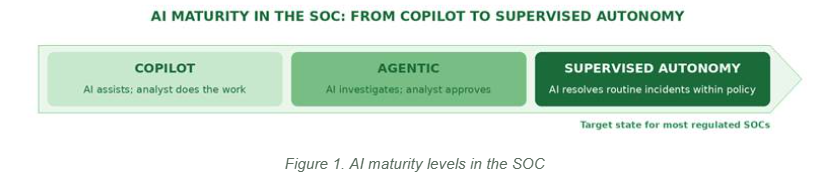
| Copilot | Summarizes alerts, answers natural-language queries, drafts reports | Analyst performs all investigation and response |
| Agentic | Plans and executes multi-step investigations across data sources | Analyst reviews conclusions and approves actions |
| Supervised autonomy | Investigates, decides, and responds to routine incidents within defined policies | Analyst sets guardrails, audits decisions, handles escalations |
For regulated teams, the goal is usually supervised autonomy: automation for high-volume, well-understood scenarios, and human approval for actions with business, legal, or safety impact.
Standard AI SOC comparisons focus on speed and automation rates. Regulated organizations need those, plus five additional capabilities.
Regulators and auditors will ask why a system isolated a server or disabled an account. The platform must record what the AI saw, what it concluded, and what it did, in a form an auditor can follow.
Many regulations require notification within hours of determining that an incident is reportable. Slow investigation directly increases compliance risk.
| Regulation | Region / Sector | Reporting Window (Summary) |
| CERT-In Directions (2022) | India, all sectors | 6 hours from noticing a reportable incident |
| EU DORA | EU financial entities | Initial notification within hours of classifying a major ICT incident |
| NIS2 Directive | EU essential and important entities | 24-hour early warning; 72-hour incident notification |
| GDPR | EU personal data | 72 hours to the supervisory authority |
| SEC cybersecurity disclosure rules | US public companies | 4 business days after determining materiality |
| HIPAA Breach Notification Rule | US healthcare | Without unreasonable delay; no later than 60 days |
Summarized for orientation only. Confirm current obligations with your legal and compliance teams.
Many AI SOC tools send telemetry or prompts to external cloud AI services. For classified environments, sovereign data, patient records, or cardholder data, that may be unacceptable. On-premises or sovereign AI deployment becomes a hard requirement.
Frameworks such as PCI DSS v4.0, HIPAA, NIST SP 800-53, ISO/IEC 27001, SOC 2, and DORA expect continuous monitoring. SOC telemetry should feed compliance evidence automatically.
AI systems inside the SOC are subject to governance expectations such as ISO/IEC 42001 and internal model risk policies. Security leaders need to show how the AI is controlled, not just what it does.
| Criterion | What Regulated Teams Should Require | Questions to Ask Vendors |
| 1. Threat detection depth | AI-powered threat detection across logs, network, endpoint, identity, cloud, and OT, not just alert triage from other tools | Does the platform detect threats itself, or only investigate alerts generated elsewhere? |
| 2. Governed SOC automation | Configurable autonomy levels, approval gates for high-impact actions, and rollback | Can we define which actions run automatically and which require approval? |
| 3. Compliance support | Continuous mapping of telemetry to frameworks, audit-ready reports, and incident-report generation | Which frameworks are mapped natively? How fast can we produce audit evidence? |
| 4. AI explainability and audit trail | A complete, exportable record of evidence, reasoning, and actions for every AI decision | Can an auditor reconstruct why the AI took a specific action? |
| 5. Data sovereignty and deployment | On-premises, private cloud, or air-gapped options, including for the AI and LLM layer | Does any telemetry or prompt data leave our environment? |
| 6. Operational fit | Works with existing tools, scales to your data volume, and supports multi-entity or multi-tenant operations | What must we replace, and what integrates as-is? |
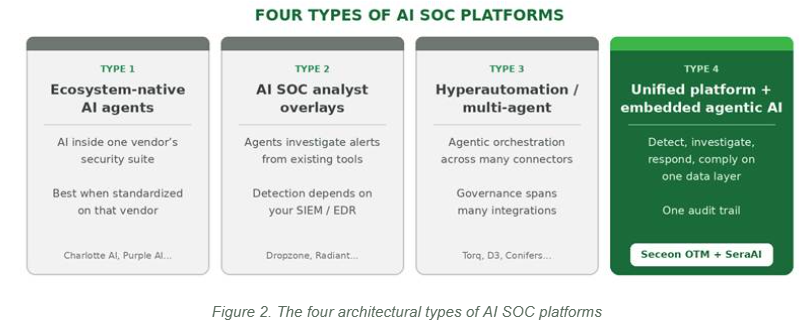
The AI SOC market has split into four architectural approaches. Each can be the right fit, but they carry different implications for regulated teams.
| Platform Type | Representative Examples | How It Works | Strengths | Considerations for Regulated Teams |
|---|---|---|---|---|
| Ecosystem-native AI agents | CrowdStrike Charlotte AI, SentinelOne Purple AI, Microsoft Security Copilot, Palo Alto Networks Cortex agents | AI embedded in a vendor’s security suite | Deep context within that vendor’s telemetry | Strongest when standardized on one vendor; confirm cloud AI data handling and residency |
| AI SOC analyst overlays | Dropzone AI, Radiant Security, Prophet Security, Qevlar AI, 7AI | AI agents investigate alerts from your existing SIEM, EDR, and other tools | Fast to deploy; focused triage automation | Depends on external tools for detection; audit trails span multiple systems |
| Hyperautomation and multi-agent | Torq, D3 Morpheus, Conifers | Agentic orchestration across many connected tools | Highly flexible workflow automation | Integration-heavy; governance must be designed across many connectors |
| Unified platforms with embedded agentic AI | Seceon OTM Platform | Detection, investigation, response, and compliance on one data layer, with AI embedded throughout | One audit trail, one data model, native response and compliance | Evaluate fit against existing tool investments; confirm integration coverage |
Vendor categorization based on publicly available positioning as of 2026. Capabilities change quickly; validate during evaluation.
| Criterion | Ecosystem-Native Agents | AI Analyst Overlays | Hyperautomation | Unified + Embedded AI |
| Threat detection depth | Strong within own ecosystem | Relies on existing tools | Relies on existing tools | Native, cross-domain |
| Governed automation | Varies | Varies | Strong, but custom-built | Native, policy-based |
| Compliance evidence | Often separate GRC product | Typically limited | Via integrations | Native, continuous |
| Single audit trail | Within ecosystem | Spans multiple tools | Spans multiple tools | One platform |
| On-premises / air-gapped AI | Varies; often cloud-based | Often cloud-based | Varies | Supported (Seceon) |
| Fit with existing tools | Best with same-vendor stack | High | High | High (vendor-neutral) |
Columns describe common patterns for each category, not every vendor within it.
| Sector | Key Frameworks | SOC Priority for AI Automation |
| Banking and financial services | PCI DSS v4.0, DORA, SOX, RBI, SEBI CSCRF, SAMA, MAS TRM | Fraud-adjacent threat detection, fast incident classification, regulator-ready reporting |
| Healthcare | HIPAA/HITECH, HITRUST | Ransomware containment, PHI access monitoring, medical device visibility |
| Government and defense | NIST SP 800-53, FISMA, CMMC, CJIS | Sovereign or air-gapped deployment, strict audit trails, insider threat detection |
| Energy and critical infrastructure | NERC CIP, IEC 62443, NIST SP 800-82 | OT/ICS visibility, safety-aware automation with approval gates |
| Telecom | Telecom cybersecurity rules, CERT-In, data protection laws | High-volume telemetry, infrastructure resilience, NOC/SOC convergence |
The Seceon Open Threat Management (OTM) Platform combines AI-powered threat detection, SOC automation, and compliance automation on a single data layer. Its AI layer, SeraAI, is embedded across every module rather than added as a separate product.
SeraAI investigates, validates, and resolves routine alerts on its own, and autonomously resolves 70% or more of L1 alerts without analyst intervention. Confirmed true positives are escalated with full investigation context, so analysts spend their time on decisions that need human judgment.
Unlike AI overlays that investigate alerts generated elsewhere, Seceon detects threats itself. aiSIEM, aiXDR, UEBA, NDR, and threat intelligence analyze logs, network flows, endpoint, identity, cloud, and OT telemetry together, using 4,000+ pre-trained ML models and Dynamic Threat Models.
aiSOAR runs response playbooks natively, with automated containment in under 90 seconds. SeraAI can generate a production-ready playbook from a natural-language description in about 30 seconds, adapted to threat type, asset criticality, and regulatory requirements. Teams can decide which actions run automatically and which require approval.
CMX360 maps live SOC telemetry to 45+ compliance frameworks, including PCI DSS v4.0, HIPAA, NIST SP 800-53, ISO/IEC 27001, SOC 2, DORA, CMMC, NERC CIP, RBI, SEBI, and SAMA. Audit-ready evidence is generated continuously, and audit reports can be produced in under an hour.
SeraAI can generate CERT-In-format incident reports, GDPR and DPDP breach notifications, and executive summaries from investigation data. This helps teams meet short reporting windows with complete timelines and evidence.
SeraAI can run fully on-premises or in a sovereign cloud, including air-gapped environments. Telemetry and prompts never leave the customer environment, and there is no dependency on external AI services. For many regulated teams, this is the deciding factor.
With 950+ connectors, Seceon integrates with existing firewalls, EDR, identity, and cloud tools. Its native multi-tenant, multi-tier architecture supports conglomerates, multi-subsidiary banks, government departments, and MSSPs serving regulated clients.
| Regulated Requirement | Seceon Capability |
| Detection depth | Unified aiSIEM, aiXDR, UEBA, NDR, and threat intelligence on one data layer |
| Governed SOC automation | Native aiSOAR with configurable automation and approval workflows |
| Autonomous triage | SeraAI resolves 70%+ of L1 alerts autonomously |
| Compliance evidence | CMX360 continuous mapping to 45+ frameworks |
| Incident reporting | CERT-In, GDPR, and DPDP report generation |
| AI data sovereignty | On-premises, sovereign cloud, and air-gapped AI deployment |
| Single audit trail | Detection, investigation, response, and compliance in one platform |
| Outcome | Seceon OTM Platform* |
| Autonomous L1 alert resolution | 70%+ |
| Mean time to detect | Under 5 minutes |
| Automated response | Under 90 seconds |
| False-positive reduction | Up to 95% |
| Playbook generation | ~30 seconds |
| TCO reduction | Up to 58% |
| Scale | ~2.4 trillion events/day across 9,800+ customers |
Seceon platform figures; results vary by environment and deployment scope. Seceon’s platform supports compliance programs; it does not by itself certify an organization as compliant with any framework.