Firewalls remain one of the most important components of enterprise cybersecurity. They sit at critical points within an organization’s infrastructure, controlling network traffic and helping prevent unauthorized access.
However, modern networks are no longer limited to a traditional corporate data center.
Organizations now operate across:
At the same time, cybercriminals have developed more sophisticated ways to bypass basic network controls. Attackers can use encrypted communications, compromised credentials, legitimate applications, cloud services, fileless techniques, and other methods to hide malicious activity.
This has created demand for Next-Generation Firewalls (NGFWs).
A next-generation firewall goes beyond traditional packet filtering and port-based access control. It can combine capabilities such as application awareness, intrusion prevention, user and identity awareness, URL filtering, malware protection, threat intelligence, encrypted traffic inspection, advanced threat detection, and security analytics.
For organizations searching for the best next-generation firewall, however, choosing a product based only on features is not enough.
The right solution should fit the organization’s network architecture, security strategy, cloud environment, compliance requirements, performance requirements, and broader security operations ecosystem.
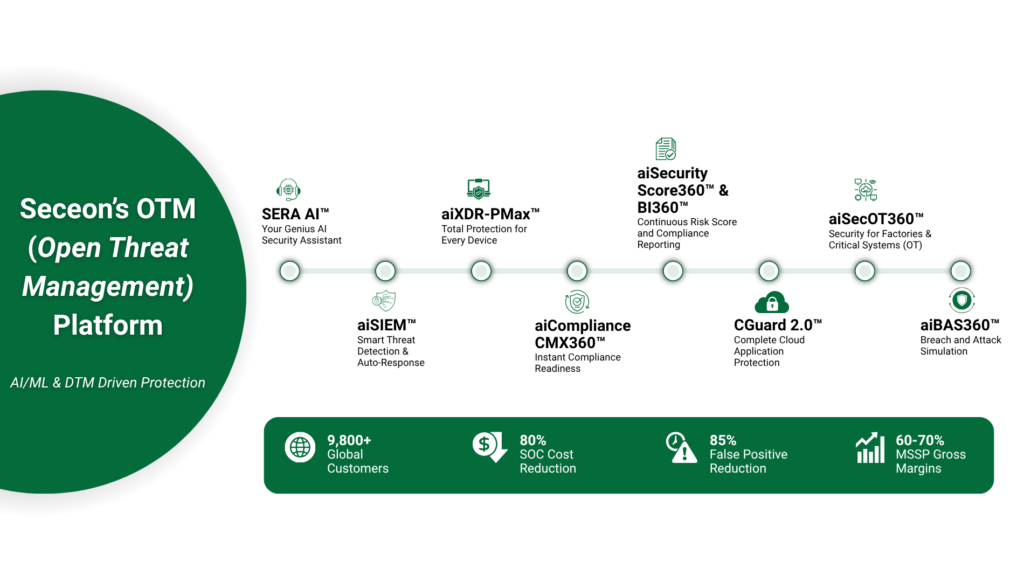
Seceon Inc. approaches network security as part of a broader security operations strategy through its Open Threat Management (OTM) Platform, which integrates security analytics, SIEM, XDR, NDR, UEBA, SOAR, threat intelligence, and other capabilities. Seceon has also documented integrations involving next-generation firewalls, network flows, and server logs, showing how firewall telemetry can become more valuable when correlated with other security signals.
This guide explains what a next-generation firewall is, how it works, its major capabilities, benefits, limitations, use cases, and what organizations should evaluate when selecting an NGFW.
A Next-Generation Firewall (NGFW) is an advanced network security solution that combines traditional firewall capabilities with additional security controls designed to detect, analyze, and prevent modern cyber threats.
Traditional firewalls primarily evaluate traffic based on information such as:
An NGFW can provide deeper visibility into:
The objective is to move from basic traffic control toward context-aware network security.
A simplified model is:
Traditional Firewall:
“Is this connection allowed?”
Next-Generation Firewall:
“Who is making the connection, what application is being used, what is the user trying to access, what is the content, and does the activity represent a security risk?”
This additional context can help organizations make more informed access and security decisions.
Modern organizations face a much broader attack surface than traditional networks.
Employees may connect from:
Applications may run across:
Meanwhile, organizations may also operate:
Traditional firewall rules alone may not provide sufficient visibility into this environment.
An NGFW can provide additional security context by analyzing applications, users, content, traffic patterns, and threats.
An NGFW generally combines multiple security technologies within one platform.
The firewall inspects incoming and outgoing network traffic.
It can evaluate:
Unlike traditional firewalls that may primarily identify traffic using ports and protocols, NGFWs can identify applications.
For example, the firewall may distinguish between:
This allows organizations to create more precise application-based policies.
Modern firewalls can associate network activity with users or identities.
Instead of simply creating a rule such as:
Allow IP address 10.0.0.10
an organization can create policies based on:
Allow members of the finance group to access approved financial applications.
This provides greater context for access control.
Many NGFWs integrate Intrusion Prevention System (IPS) capabilities.
IPS can identify and potentially block:
Threat intelligence can provide information about:
This intelligence can be used to improve firewall decisions.
Advanced firewalls can inspect network content to identify potentially malicious files or traffic.
Depending on the solution, capabilities may include:
NGFWs generate valuable security telemetry.
This information can include:
Integrating this data with SIEM or XDR can provide much broader security context.
| Capability | Traditional Firewall | Next-Generation Firewall |
|---|---|---|
| IP filtering | Yes | Yes |
| Port filtering | Yes | Yes |
| Network access control | Yes | Yes |
| Application awareness | Limited | Yes |
| User awareness | Limited | Yes |
| Intrusion prevention | Often separate | Commonly integrated |
| Threat intelligence | Limited/varies | Integrated |
| URL filtering | Often separate | Commonly available |
| Malware protection | Often separate | Commonly integrated |
| Advanced inspection | Limited | Advanced |
| Security analytics | Basic | Advanced |
| Cloud integration | Varies | Increasingly important |
| Identity integration | Limited/varies | Stronger |
| Threat correlation | Limited | Advanced through integrations |
The important distinction is that an NGFW combines network control with deeper security intelligence.
When evaluating the best next-generation firewall, organizations should consider the following capabilities.
Application-aware security allows organizations to control traffic based on the application being used rather than relying solely on ports and protocols.
This can help prevent unauthorized applications from accessing sensitive resources.
An integrated IPS can identify and block known attack patterns.
Organizations should evaluate:
Identity-aware firewall policies can provide more precise access control.
The firewall can potentially understand:
Web filtering can prevent users from accessing:
This provides another layer of protection against web-based attacks.
Threat intelligence can improve firewall decisions by identifying known malicious infrastructure.
For example:
User → Website → Suspicious Domain → Threat Intelligence Match
The firewall can use that context to apply the appropriate security policy.
Encrypted traffic represents a major security challenge.
Attackers can use encrypted connections to conceal malicious activity.
NGFWs may provide SSL/TLS inspection capabilities that allow organizations to inspect certain encrypted traffic according to their security policies and legal/privacy requirements.
Organizations should carefully consider:
A modern firewall should ideally provide multiple layers of threat protection rather than relying on one detection method.
Potential technologies include:
With distributed workforces, secure remote access is an important firewall capability.
NGFWs may provide:
Large organizations may operate multiple firewalls.
Centralized management can help administrators:
Artificial intelligence is increasingly influencing network security.
Traditional firewall policies are largely deterministic:
Rule → Match → Allow or Block
AI-driven security can add behavioral context.
For example, an organization may normally see a server communicating with a predictable set of destinations.
Suddenly, the server begins:
AI and behavioral analytics can help identify this deviation.
However, AI should complement—not replace—traditional security controls.
The strongest approach combines:
Policy + Signatures + Threat Intelligence + Behavioral Analytics + AI + Human Oversight
Zero Trust is based on the principle that access should not automatically be trusted simply because a user or device is inside a network.
Security decisions can consider:
Next-generation firewalls can support Zero Trust strategies by providing identity-aware access controls and application-level policies.
For example:
Instead of:
“Anyone on the corporate network can access this server.”
An organization can implement:
“Only authorized users from approved groups using compliant devices can access this specific application.”
This provides a more granular security model.
Network segmentation can limit the ability of attackers to move laterally.
An NGFW can help enforce policies between:
For example:
User Network → Application Network → Database Network
Each connection can be controlled according to specific security policies.
NGFW and Network Detection and Response (NDR) have complementary roles.
Primarily focuses on:
Primarily focuses on:
An organization can use both.
Firewall telemetry can also be sent to NDR or SIEM platforms for deeper analysis.
Seceon Inc. has documented the correlation of next-generation firewall events with network flows and server logs to help identify threats that may otherwise require significant manual investigation.
A firewall generates valuable security events.
However, a firewall may not know everything happening on the endpoint or identity layer.
For example:
Firewall: Detects suspicious outbound traffic.
SIEM: Correlates the traffic with a suspicious login.
Endpoint: Shows abnormal process behavior.
Threat Intelligence: Identifies the destination as malicious.
Together, these signals provide a more complete picture.
This is why NGFW integration with SIEM is increasingly important.
Extended Detection and Response (XDR) extends security visibility across multiple domains.
An XDR platform can correlate:
This can help security teams identify multi-stage attacks.
Seceon Inc.’s platform approach is designed around this type of cross-domain security correlation, combining security telemetry from networks and other environments with SIEM, XDR, UEBA, SOAR, and threat intelligence capabilities.
Cloud environments require different security approaches from traditional data centers.
Organizations may have:
Cloud-based firewall capabilities can help enforce security policies across these environments.
Organizations should evaluate whether their NGFW strategy supports:
Seceon Inc.’s current security platform materials emphasize hybrid and multi-cloud protection and integration across modern cloud environments.
Many enterprises operate a mixture of:
Data Center + Cloud + Branch Offices + Remote Users + SaaS
This creates complex traffic flows.
An NGFW strategy should provide consistent security policies across these environments wherever practical.
Centralized management can make it easier to maintain consistent policies while adapting to different deployment models.
Managed Service Providers and Managed Security Service Providers often manage security for multiple organizations.
They need:
Firewall telemetry can also be integrated into broader managed detection services.
Seceon Inc. has positioned its platform for MSP/MSSP environments and has documented use cases involving firewall, network-flow, server-log, SIEM, and automated threat-detection capabilities.
Industrial and operational environments introduce additional security requirements.
OT networks may include:
Security controls need to consider availability, reliability, legacy systems, and operational requirements.
An NGFW can help segment OT environments and control communication between:
However, organizations should carefully design firewall policies to avoid disrupting critical operations.
NGFWs combine traditional access control with advanced security features.
Security teams can understand which applications are generating traffic.
Identity-aware policies provide more granular control.
Integrated IPS and security services can block known malicious activity.
NGFWs can help limit lateral movement.
Modern NGFWs can protect distributed cloud environments.
Organizations can manage security policies across multiple firewall deployments.
Firewall telemetry can be correlated with other security data.
Identity and application-aware policies can support Zero Trust architectures.
NGFWs are powerful, but they are not a complete cybersecurity strategy.
Encrypted communications can make inspection difficult and may require additional controls.
Deep inspection can affect performance if hardware is not properly sized.
More security capabilities can also create more configuration requirements.
Security controls can occasionally identify legitimate activity as suspicious.
A firewall may not know what is happening inside an endpoint.
Identity information may require integration with additional systems.
Sophisticated attacks may require endpoint, network, identity, and cloud correlation.
This is why NGFWs work best as part of a broader security architecture.
Organizations should evaluate an NGFW based on their actual security requirements.
Look for:
Evaluate:
Always compare performance using equivalent testing conditions.
Determine whether the firewall supports:
Check compatibility with:
Look for:
Evaluate integration with:
The platform should support current and future requirements.
Consider:
Consider:
Understand current traffic patterns, applications, users, assets, and security gaps.
Segment critical resources appropriately.
Only allow required traffic.
Where appropriate, define policies based on applications rather than only ports.
Use user and group context to improve access policies.
Use IPS, malware protection, threat intelligence, and other appropriate controls.
Firewall telemetry can reveal valuable indicators of compromise.
Correlate firewall activity with endpoint, identity, cloud, and network data.
Remove obsolete and overly permissive rules.
Regularly validate that controls work as intended.
Seceon Inc. approaches cybersecurity from a broader security operations perspective.
Rather than relying on a firewall as the only line of defense, organizations can use firewall telemetry as one component of a unified detection and response architecture.
Seceon’s published materials describe scenarios where next-generation firewall events, network flows, and server logs are automatically correlated, with machine-learning-based dynamic threat models helping surface and prioritize significant threats.
This model is valuable because a firewall can tell an organization:
“This connection was blocked.”
But broader security analytics can potentially answer:
“Which device initiated the connection, which user was involved, what else happened on that device, what other systems did it contact, and does the activity form part of a larger attack?”
Seceon Inc.’s OTM architecture brings together technologies including:
This allows firewall activity to become part of a broader security investigation.
Seceon’s aiXDR materials also describe integration with firewall infrastructure alongside endpoints, cloud environments, network traffic analysis, vulnerability scanners, and IT/OT systems.
The firewall market is continuing to evolve.
AI will increasingly help identify anomalous traffic and suspicious behavior.
Firewall policies will increasingly incorporate identity and risk context.
Security controls will increasingly follow workloads into cloud environments.
NGFWs will increasingly support identity-aware and application-aware access policies.
Firewall capabilities will increasingly become part of distributed security architectures.
Firewall telemetry will increasingly be correlated with endpoint behavior.
NGFWs will increasingly integrate with SOAR and XDR platforms for coordinated response.
Organizations will increasingly combine firewall telemetry with:
SIEM + XDR + NDR + UEBA + SOAR + Threat Intelligence
This creates a security architecture where prevention and detection work together.
The Next-Generation Firewall has evolved far beyond traditional packet filtering.
Modern NGFWs combine network access control with:
However, the firewall should not be viewed as an isolated security solution.
Today’s sophisticated attacks can move across networks, endpoints, identities, applications, and cloud environments. Detecting these attacks effectively requires correlation across multiple security layers.
This is where Seceon Inc. can complement next-generation firewall deployments through its unified Open Threat Management (OTM) Platform. Seceon’s published materials describe correlating next-generation firewall events with network flows and server logs, while its broader platform integrates SIEM, XDR, NDR, UEBA, SOAR, threat intelligence, and threat hunting capabilities.
The result is a more comprehensive security model:
Firewall → Prevention
NDR → Network Detection
SIEM → Security Correlation
XDR → Cross-Domain Detection and Response
UEBA → Behavioral Intelligence
SOAR → Automation
Threat Intelligence → Context
Together, these technologies can provide a stronger foundation for modern security operations.
When selecting the best next-generation firewall, organizations should therefore consider not only firewall throughput and prevention capabilities but also AI, cloud readiness, identity awareness, integration, automation, analytics, scalability, and total cost of ownership.
The future of firewall security is not simply about blocking unauthorized traffic.
It is about understanding who, what, where, why, and how traffic is moving—and determining whether that activity represents a security risk.
For organizations seeking to strengthen this broader security model, Seceon Inc. provides an integrated approach designed to connect network security telemetry with AI-driven threat detection, analytics, and response.