Beyond Static Vaults and Siloed ITDR: How Seceon Stops Modern Multi-Stage Identity Breaches in Real Time

Beyond Static Vaults and Siloed ITDR: How Seceon Stops Modern Multi-Stage Identity Breaches in Real Time

Quick answer:

When an attacker holds valid credentials, the only reliable signal is behavior across every silo at once. Seceon correlates identity, email, cloud, and AI-agent telemetry into one kill-chain view, then gates privileged access and contains the threat before money or data leaves the enterprise.

Key takeaways:

  • Valid credentials do not guarantee legitimate activity; attackers can exploit deepfakes, social engineering, compromised sessions, and AI-agent tools.
  • Cross-silo identity convergence links account handles to one canonical identity, so risk on one account informs decisions across the others.
  • Real-time detection-to-access gating can deny risky privileged requests before an attacker acts.
  • CCE normalises events, and APE correlates them into an explainable attack timeline, while aiUIDGuard360 and aiSOAR 4.0 support enforcement and containment. 
  • In Seceon’s controlled exercise, all 10 tested scenario families were detected, correlated, and blocked at the access gate, while benign AI activity continued without false-positive alerts.

Why are valid credentials the new malware?

For a decade, enterprise identity security rested on one assumption: a user who passes multi-factor authentication and satisfies role policy can be trusted. Recent incidents show attackers no longer need to break that control. They persuade a legitimate person, or a legitimate system, to act for them.

  • Deepfake-enabled payment fraud. In early 2024, an employee at the Hong Kong office of engineering firm Arup joined a video call populated by AI-generated likenesses of senior colleagues. Convinced the request was genuine, the employee made 15 transfers totalling roughly US$25 million.
  • Executive voice cloning. Later that year, attackers impersonated Ferrari’s chief executive with a cloned voice to pressure a senior manager. The attempt failed only because the manager asked a personal question the impostor could not answer.
  • Help-desk social engineering. The 2025 intrusion at UK retailer Marks & Spencer has been linked to Scattered Spider techniques, in which attackers impersonate staff to persuade support desks to reset credentials.
  • Agentic AI as an attack surface. Adversaries now target the tools AI assistants rely on: poisoned Model Context Protocol (MCP) tool definitions, hidden instructions planted in retrieval-augmented generation (RAG) knowledge bases, and hijacked agents coaxed into reaching cloud metadata services. MITRE ATLAS catalogues these techniques.


In each case, the identity provider and the privileged access vault saw a session that looked valid. Meanwhile, the evidence was scattered across email, collaboration, identity, cloud, and AI logs, and a siloed SIEM pieced it together only after the money or data had gone.

What three capabilities do siloed identity security tools struggle to deliver?

Stopping identity-led and AI-orchestrated attacks takes three capabilities that point products, stitched together by APIs, struggle to provide.

  1. Cross-silo identity convergence. One person typically holds many account handles: a directory login, a cloud admin role, an SSH bastion account, a source-code account, and a vault username. All of them must resolve to a single canonical identity, human or non-human, so that risk on one handle applies to every other.
  2. Real-time detection-to-access gating. When the SIEM corroborates a multi-stage attack, privileged credential checkouts and high-value transactions for that identity must be blocked in sub-second time, before the attacker acts.
  3. Explainable timelines without alert fatigue. Analysts need a plain-language, chronological account of each attack stage, and legitimate everyday AI usage must not drown them in false positives.

How does Seceon close the loop between detection and containment?

Seceon aiSIEM, aiUIDGuard360 and aiSOAR 4.0 run on one native data pipeline rather than a set of API-stitched point products. Telemetry enters once, is normalised once, and every downstream decision draws on the same correlated threat state.
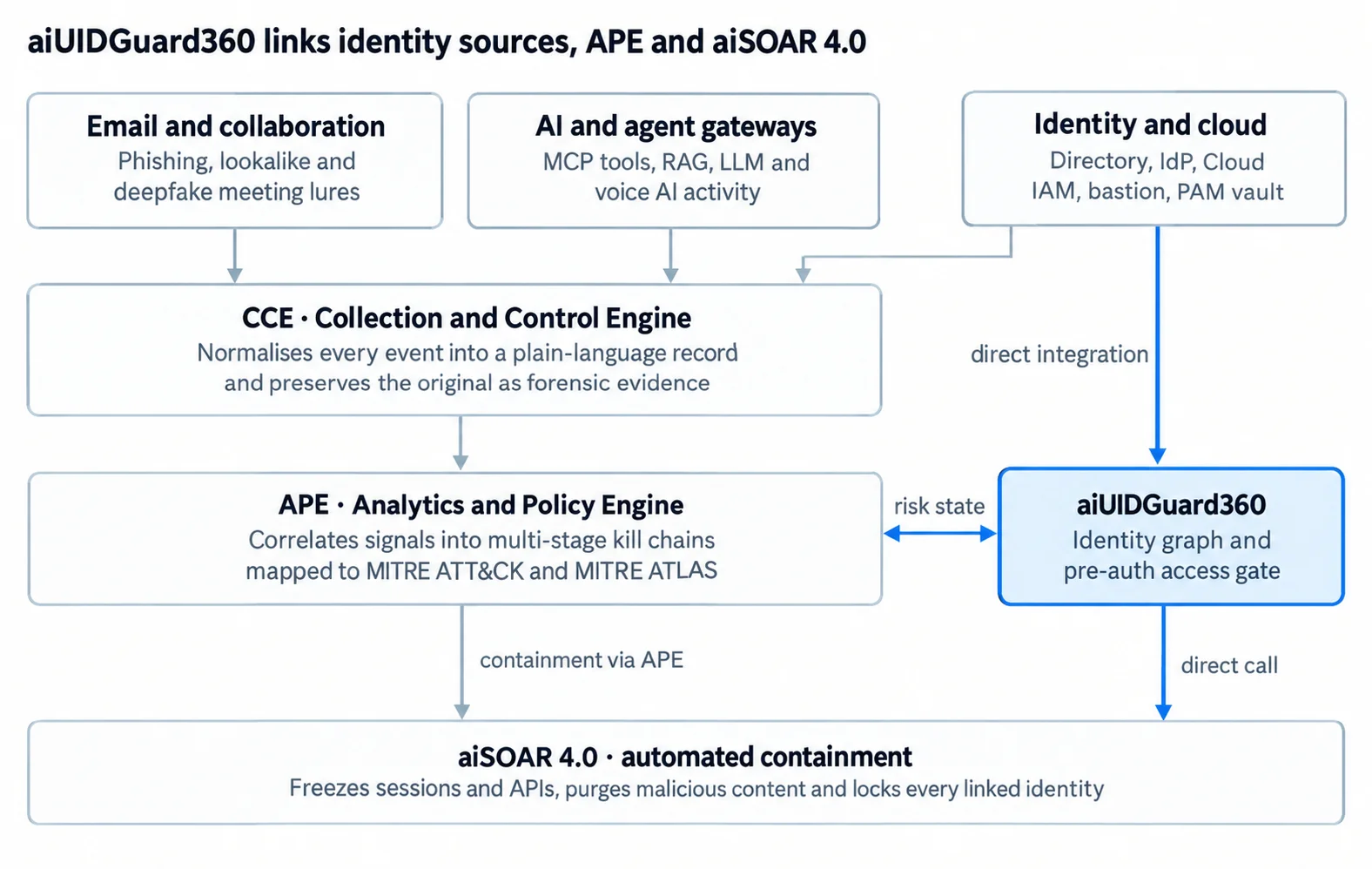
aiUIDGuard360 architecture diagram showing identity sources, CCE Collection and Control Engine, APE Analytics and Policy Engine, risk state integration, and aiSOAR 4.0 automated containment for identity threat detection and response.                                                              Seceon closed-loop architecture · 4 layers

Every source feeds the same correlation engine, so a lure in email, an anomaly in an AI gateway and a checkout request in the vault are judged as one story. aiUIDGuard360 integrates directly with identity and cloud platforms, exchanges live risk state with APE, and triggers aiSOAR 4.0 containment either directly or through APE.

How did Seceon put its identity-threat architecture to the test?

To validate the architecture, the Seceon research team ran a controlled exercise of thousands of attack executions, drawn from 10 multi-stage identity and AI scenario families and run across hundreds of isolated tenants. The scenarios were modelled on the public incident patterns above. Throughout the run, attack traffic was interleaved with routine developer AI activity: IDE tool calls through MCP, pull-request summaries and authorised internal knowledge-base searches.

Attacks that unfold over days or weeks in the real world were replayed as four kill-chain stages:

  1. Initial access. A spear-phishing or meeting-invite lure, a poisoned MCP tool registration, a weaponised document uploaded to a RAG knowledge base, or a low-and-slow distributed credential spray.
  2. Correlation. The Seceon Analytics and Policy Engine (APE) links signals across streams, such as deepfake indicators from integrated communication-security tools, spray patterns and unauthorised agent tool calls, and maps them to MITRE ATT&CK and MITRE ATLAS.
  3. Pre-authorisation intercept. Before the compromised user or hijacked agent can check out a privileged credential or approve a payment, aiUIDGuard360 queries the live threat state and denies the request.
  4. Automated containment. Within seconds, aiSOAR 4.0 freezes the outbound session or API, removes the malicious tool definition or knowledge-base content, and locks every linked identity.

How does aiUIDGuard360 protect one identity across every alias?

An attacker who compromises a user’s primary email or single sign-on session rarely stays there. The next move is a pivot into a less-watched handle: an SSH bastion account, a source-code account or a vault username.

aiUIDGuard360 builds a canonical identity graph that links each person’s accounts across the directory, identity providers, cloud IAM, bastion hosts, code repositories and the PAM vault. When risk rises on any one handle, the verdict applies to all of them.

Test identityLinked account handlesConnected sourcesPre-auth verdict across all handles
Finance user ACorporate email, directory login, cloud admin role, vault usernameActive Directory, cloud IAM, PAM vaultDeny
Platform administrator BCorporate email, directory login, bastion account, code account, cloud admin role, vault usernameEntra ID, Okta, Linux bastion, GitHub, AWS IAM, PAM vaultDeny
Platform administrator CSame six-source footprint as BEntra ID, Okta, Linux bastion, GitHub, AWS IAM, PAM vaultDeny
Platform administrator DSame six-source footprint as BEntra ID, Okta, Linux bastion, GitHub, AWS IAM, PAM vaultDeny

In the exercise, the simulated attacker tried to sidestep the email lockout by requesting a privileged vault checkout under a short-form alias. aiUIDGuard360 recognised the alias as belonging to the compromised identity and denied the checkout in about a quarter of a second.

How does Seceon give analysts an attack story they can read?

In many SIEMs, drilling into an alert opens a wall of raw syslog headers or fields truncated by naive parsers. The analyst must rebuild the story before acting on it.

The Seceon Collection and Control Engine (CCE) normalises every event into two layers:

  •         For the analyst: the alert summary and each event beneath it carry a plain-language description of what happened, with a normalised severity.
  •         For the auditor: the complete original record is preserved unaltered as forensic evidence for regulatory and legal use.

In the deepfake payment-fraud scenario, the analyst saw the full sequence in four lines:

  1. Initial access: a meeting invite arrived from a lookalike domain with failed SPF and DMARC checks and a spoofed executive display name.
  2. Correlation: APE linked deepfake-media indicators to external payment instructions splitting a large sum across many beneficiary accounts.
  3. Pre-authorisation intercept: The finance user attempted to authorise the payment in the ERP system, and aiUIDGuard360 denied it because an active incident was open on that identity.
  4. Containment: aiSOAR 4.0 froze the outbound payment interface, purged the lure from every mailbox in the tenant, and temporarily revoked the user’s session tokens.

How does Seceon keep legitimate AI use working?

Security teams cannot block the developers and analysts who rely on AI assistants, MCP tools, and internal knowledge portals. A detection approach that flags every agent call fails as surely as one that flags none.

Seceon scores AI and identity activity in three tiers:

  •         Routine usage is recorded at low risk and raises no alert.
  •         An isolated anomaly on a single stage is raised at medium risk for review, without blocking the user.
  •         A corroborated multi-stage chain is escalated to critical, which triggers the access gate and containment.

Because escalation requires corroboration across stages, the benign power users in the exercise kept working with no alerts raised against them and uninterrupted privileged access.

What were the results of Seceon’s validation exercise?

Across thousands of attack executions on hundreds of tenants, all 10 scenario families were detected, correlated and blocked at the access gate, with no alerts raised on benign AI activity. Results reflect the controlled exercise described above, not a production deployment.

MeasureResult in the exercise
Multi-stage attack scenarios detected and correlated10 of 10 scenario families, mapped to MITRE ATT&CK and MITRE ATLAS
Compromised identities denied at the pre-auth gate10 of 10 scenario families, across every linked alias
Alias pivots blockedAll attempts, across Active Directory, Entra ID, Okta, AWS IAM, GitHub, Linux bastion and PAM vault
Benign developer AI workflowsAll allowed; no false-positive alerts
Cross-tenant data exposureNo records leaked between tenants
Pre-auth decision latencyAbout 240 to 480 ms per API round trip in the test environment

Conclusion: turn identity into a self-defending control plane

Stopping today’s identity breaches, and tomorrow’s attacks through autonomous AI agents, takes more than a vault that checks passwords or a SIEM that reports after the fact. Seceon unites CCE normalisation, APE multi-stage correlation, aiUIDGuard360 identity convergence with pre-authorisation gating, and aiSOAR 4.0 automated containment on one data pipeline. The result turns identity from the enterprise’s softest target into a control that defends itself.

See it against your own environment. Contact Seceon at www.seceon.com to arrange a briefing on aiSIEM, aiUIDGuard360 and aiSOAR 4.0.


Frequently Asked Questions

What is identity threat detection and response (ITDR)?

Identity threat detection and response identifies suspicious activity associated with user accounts and other identities. It helps security teams investigate and respond by connecting identity events with broader threat signals.

Why are static privileged access vaults not enough to stop identity breaches?

A vault may validate credentials without knowing that the requesting identity is involved in an active attack. Connecting threat correlation with pre-authorisation access controls allows risky requests to be denied based on the wider threat context.

How does Seceon aiUIDGuard360 stop attackers from switching accounts?

aiUIDGuard360 links account handles across directory services, identity providers, cloud IAM, bastion hosts, code repositories and PAM vaults. A threat associated with one linked account can inform access decisions across the others.

How does Seceon correlate multi-stage identity attacks?

CCE normalises security events, while APE correlates signals across identity, email, cloud and AI-agent activity. The resulting threat state informs aiUIDGuard360 access decisions and aiSOAR 4.0 containment workflows.

How does Seceon protect AI agents without blocking legitimate activity?

Seceon distinguishes routine AI activity, isolated anomalies and corroborated multi-stage attacks. Routine activity raises no alert, isolated anomalies can be reviewed, and critical attack chains trigger access enforcement and containment.

What were the results of Seceon's identity-breach testing?

Seceon reported that all 10 tested scenario families were detected, correlated and blocked at the pre-authorisation gate. The controlled exercise also reported no false-positive alerts on benign developer AI activity and approximately 240–480 ms per API round trip. These findings apply to the controlled test environment, not a production deployment.

Footer-for-Blogs-3

Leave a Reply

Your email address will not be published. Required fields are marked *

Categories